Alternative Provision & Specialist One-to-One Education
"I believe many learners who struggle with education do not lack ability; they lack confidence, connection, or the right support at the right time. My role is to help learners rebuild those foundations and move forward successfully."
Every learner deserves an education that inspires confidence, curiosity and success.
At PanovEducation, our lessons are carefully designed to engage reluctant learners through immersive learning experiences, structured support and high-quality teaching resources.
Who We Support
Understanding Individual Barriers to Learning
SEND & EHCP Learners
Tailored learning paths that align with Education, Health and Care Plan (EHCP) targets, ensuring milestones are met at a comfortable pace.
Autism (ASC) & ADHD
Calm, predictable, and highly structured online spaces designed to respect neurodivergent processing styles and sustain focus without overwhelm.
EBSA & Anxiety
Compassionate guidance for students experiencing Emotionally Based School Avoidance (EBSA) or intense anxiety-related barriers to learning.
Home-Educated Learners
Providing core academic continuity, structure and tailored support for families choosing home education paths.
Educational Re-engagement
A gentle pathway back to learning, focusing on rebuilding routines, confidence and positive learning habits.
SEMH Needs
Targeted provisions honoring Social Emotional and Mental Health goals through patient, safety-first relationship building.
Medical Needs
Providing flexible, accessible education for learners whose medical conditions prevent regular school attendance, ensuring continuity of learning while prioritising health and wellbeing.
Awaiting Placement
Serving as a vital academic bridge to keep skills sharp and active during complex school transitions.
Awaiting Referral
Providing continuity, structure and meaningful learning for students awaiting specialist assessment or support services, ensuring progress continues while longer-term provision is being arranged.

One-to-One Intervention
"Many students simply learn better when the noise of a crowded classroom is removed. My core approach relies on dedicated, individual attention. Every session focuses on lowering anxiety first, allowing learning to naturally follow."
The Provision Layout
- 100% Student-Led Pace
- Reduced Sensory Overwhelm
- Consistent, Reliable Structure
What makes our lessons different?
- Story-driven learning
- Gamified progression
- Explicit teaching
- Scaffolded independence
- Retrieval practice
- Immediate feedback
- Reflection and improvement
GCSE English
Complete preparation for both English Language and Literature, eavily focused on accessible text analysis and stress-free exam techniques.
Functional Skills
Practical English qualifications designed to build essential, real-world literacy and open pathways for future college or career placements.
ESOL / EAL Support
Dedicated language acquisition for students navigating English as an Additional Language, helping them communicate confidently.
S3 Maths & Science Support
Fundamental booster sessions for Key Stage 3 learners to ensure they maintain a balanced curriculum alongside their English progression.
Expected Outcomes
- Re-engage cleanly with education parameters
- Improve core lesson attendance and active participation
- Develop personal confidence and self-esteem foundations
- Strengthen core literacy and communication skills
- Build positive, sustainable learning habits
- Prepare for reintegration into mainstream education where appropriate
- Achieve GCSE or Functional Skills qualification credentials
- Develop independence and vital self-advocacy skills
Monitoring and Reporting
- Diagnostic initial baseline assessment phase
- Highly individualised learning milestone targets
- Comprehensive session logging history records
- Regular structural progress logs and updates
- Formal end-of-block summary report distributions
- Continuous communication with associated professionals and families where appropriate
Documentation & Downloads
Section 1:
Organisational Framework (ORG)
Section 2:
Governance (GOV)
Section 3:
Declarations
Section4:
Governance (GOV)
Our Referral Pathway
How we build a trusted baseline setup framework safely
Step 1
Initial
Discussion
Connect to outline general needs, background timelines, and basic delivery parameters.
Step 2
Review of Learner Needs
Detailed evaluation of documentation, statutory EHCP targets, and past adaptations.
Step 3
Provision
Planning
Collaborative layout configuration to sync core milestones across stakeholders.
Step 4
Tuition
Begins
Structured, live online session instructions begin inside a low-anxiety space.
Step 5
Progress
Reviews
Data metrics and end-of-block updates deployed back to networks and families.
Explore Our Learning Experiences
Discover how PanovEducation transforms the National Curriculum into immersive, role-based learning adventures that inspire curiosity, confidence and a genuine love of learning.
English
Become a detective, journalist or author as you investigate texts, solve mysteries and develop confident reading and writing skills through immersive learning experiences.
Maths
Transform maths into an exciting adventure through missions, challenges and problem-solving quests that build confidence, resilience and mathematical thinking.
Science
Think like a real scientist by investigating mysteries, carrying out experiments and discovering how the world works through hands-on scientific missions.
Alternative Provision enquiry form
I’m just a message away

English Language – Detective Academy
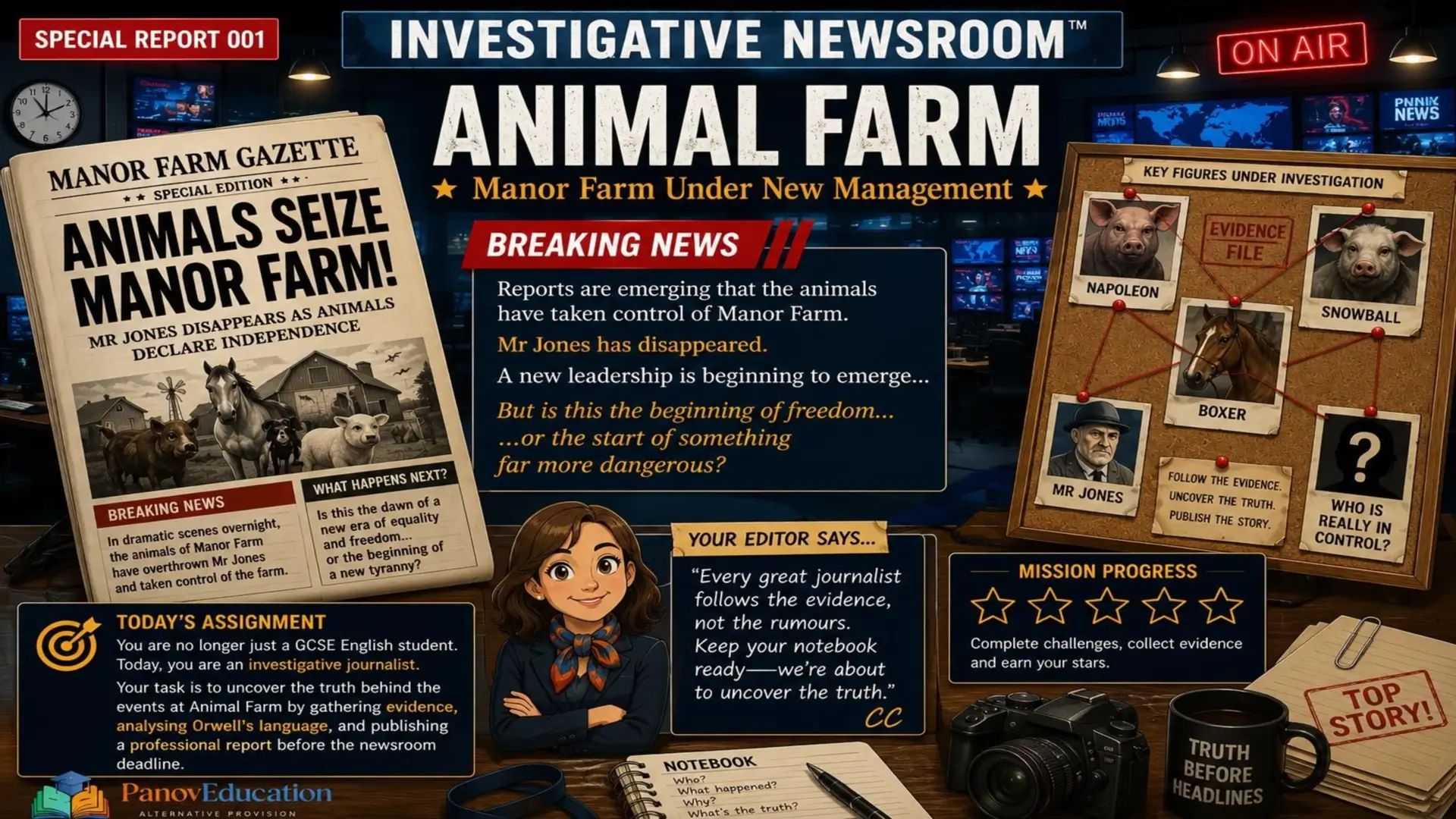
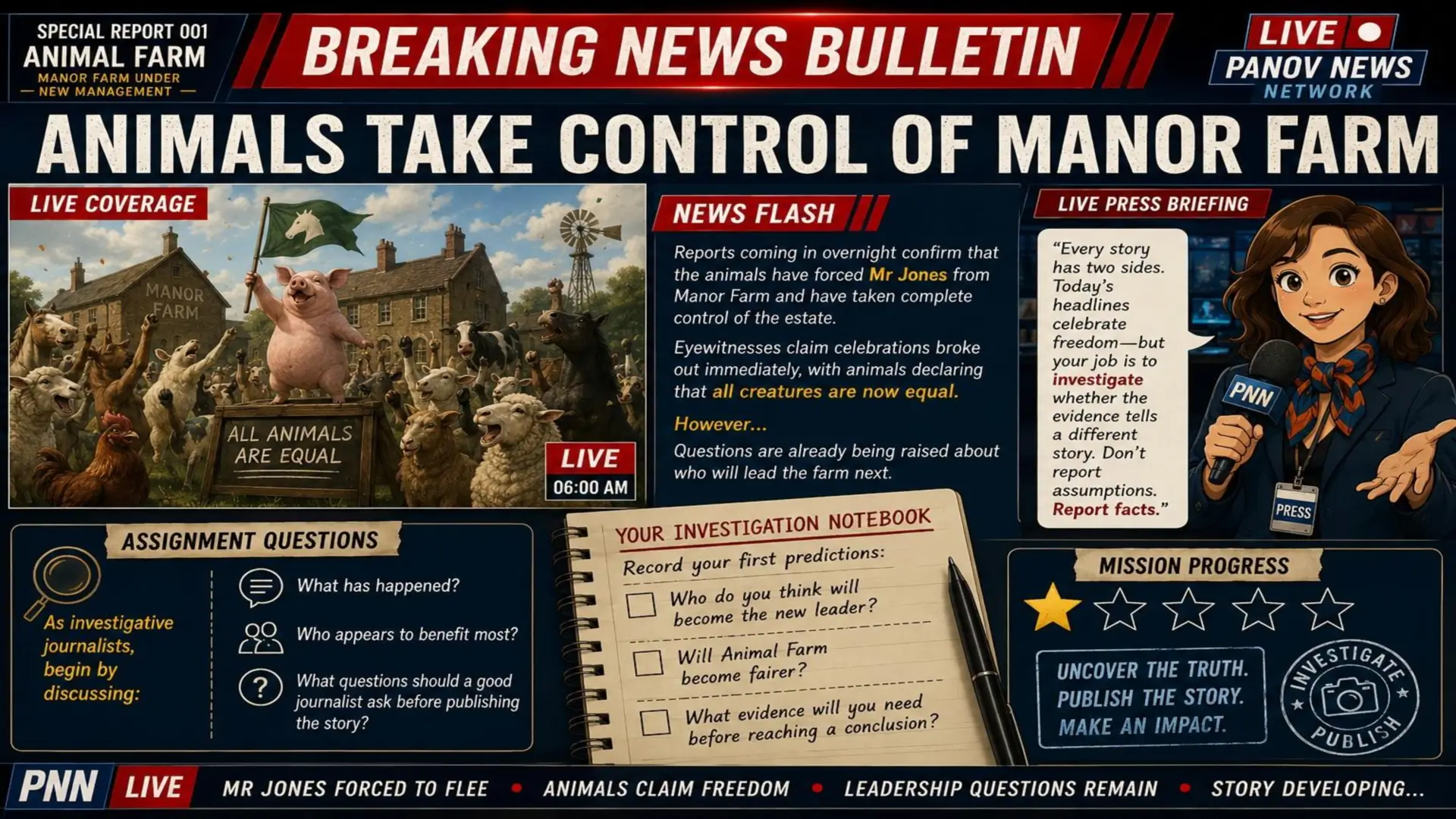
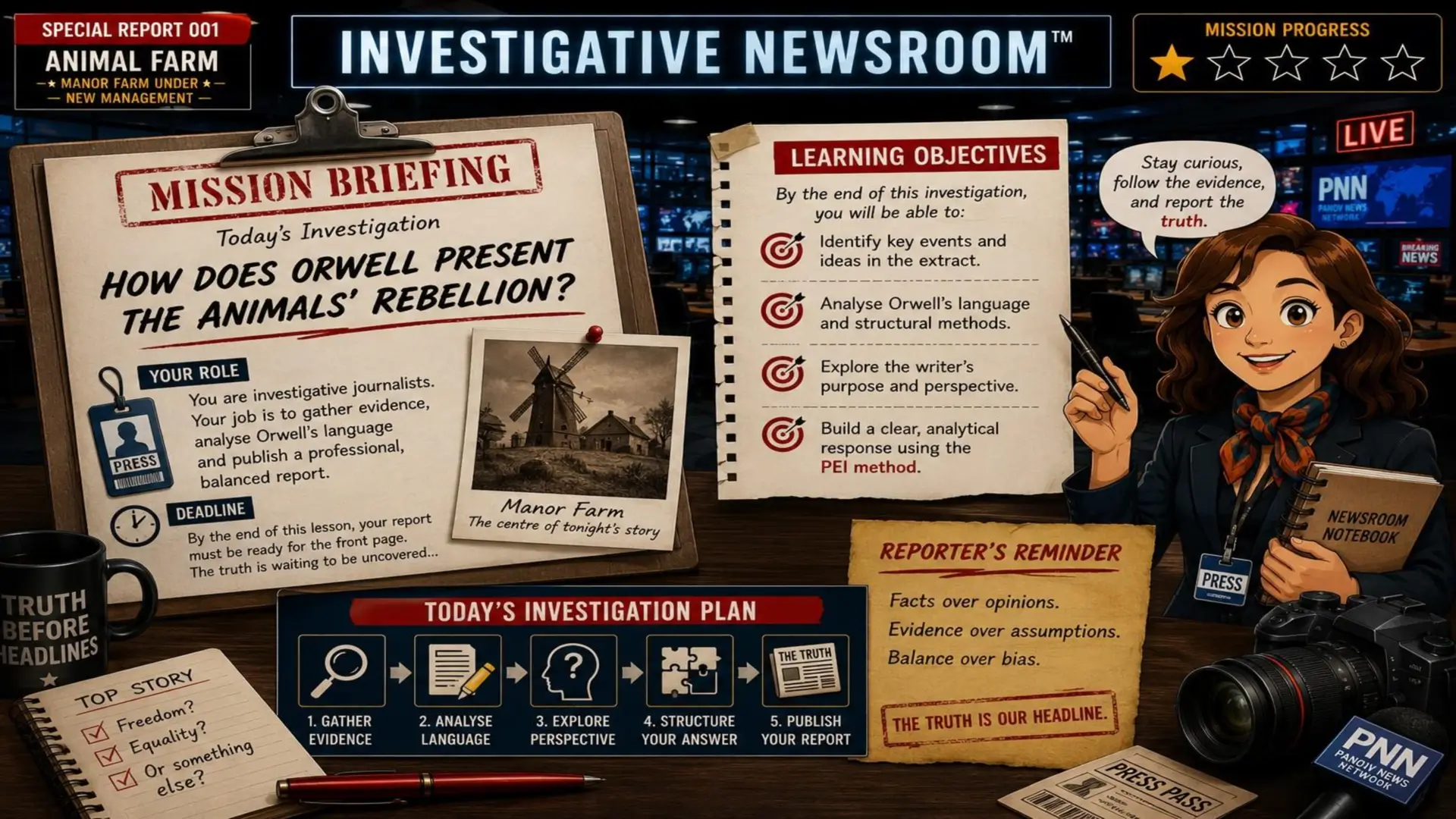
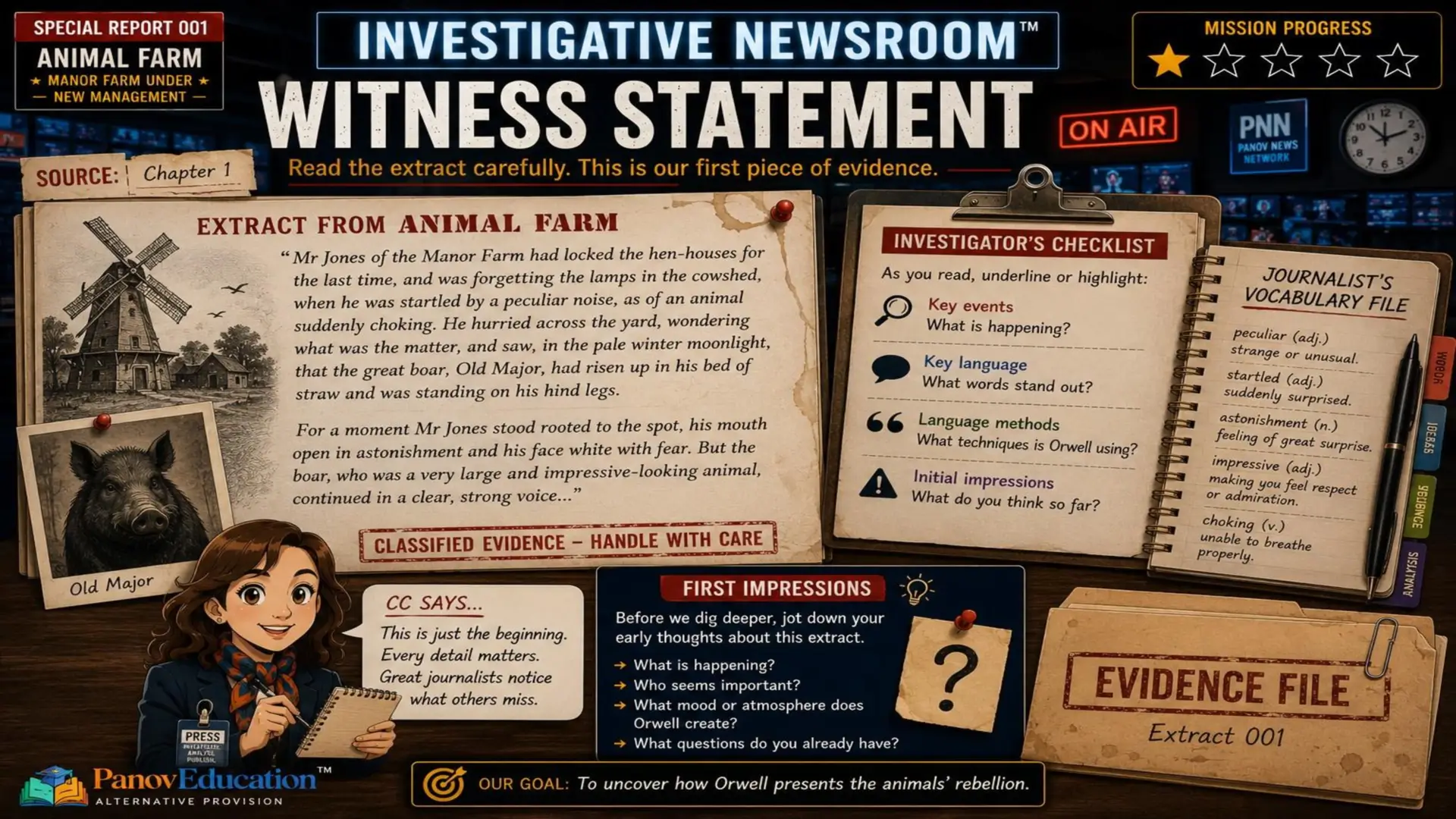
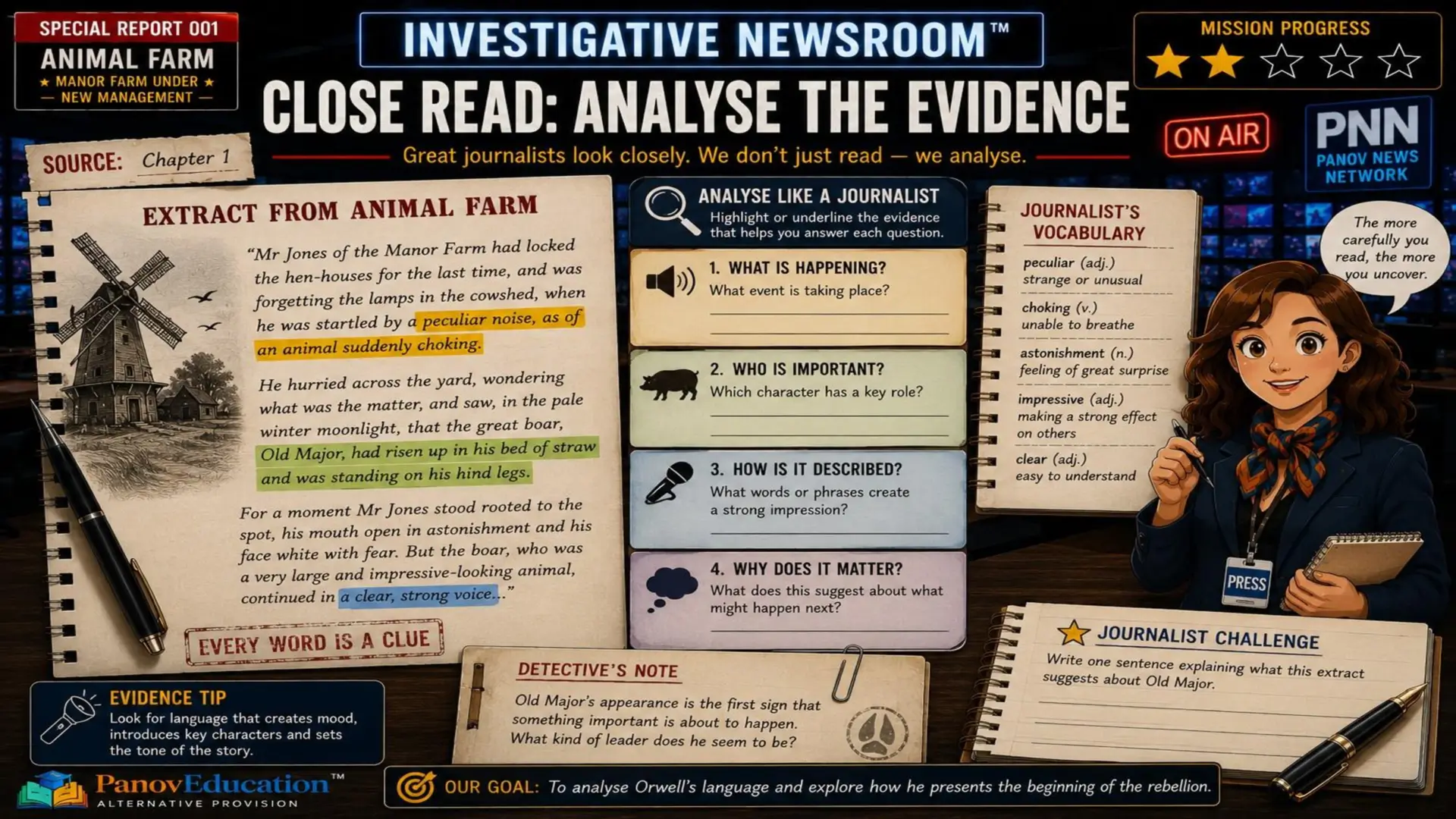
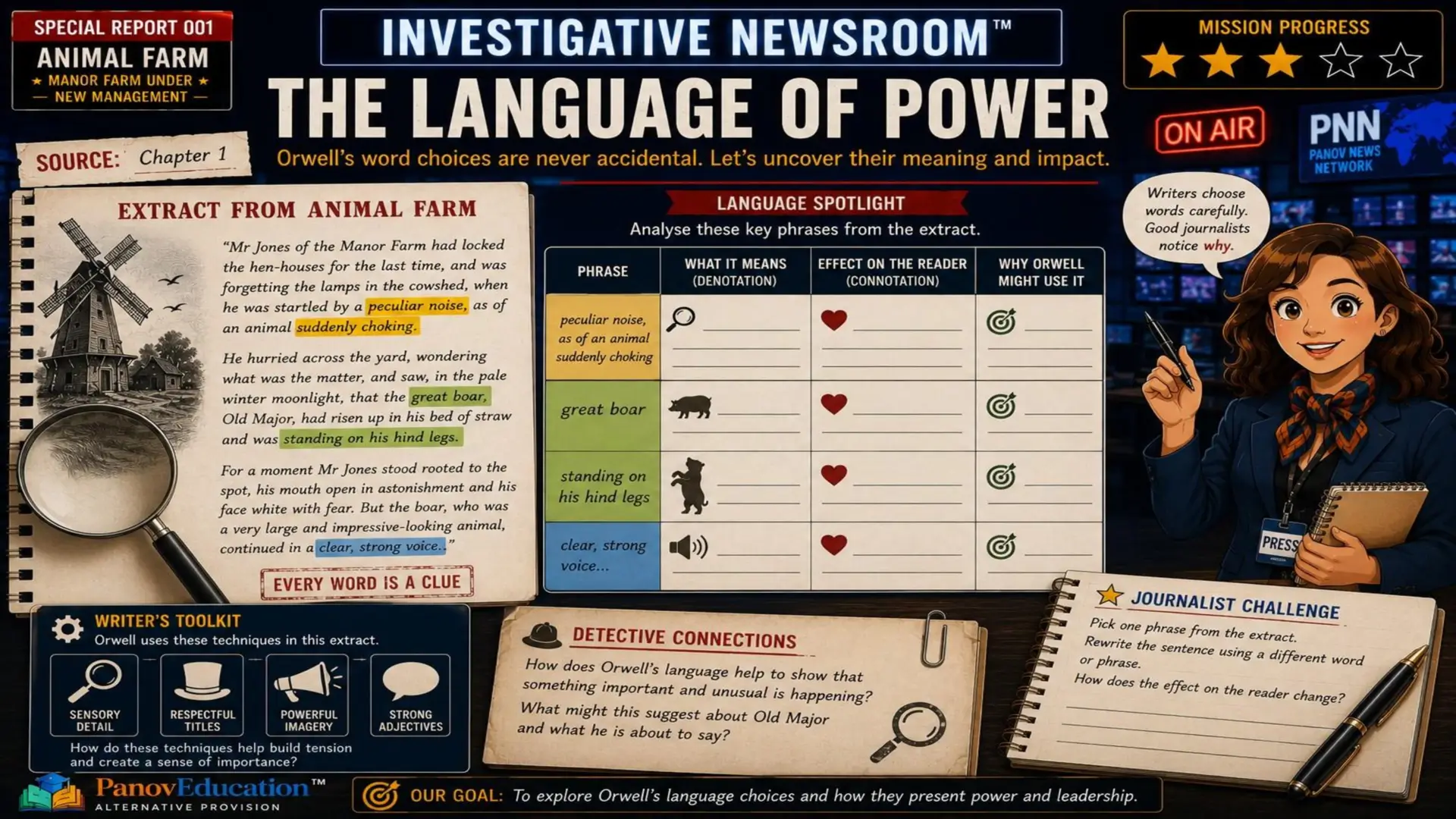
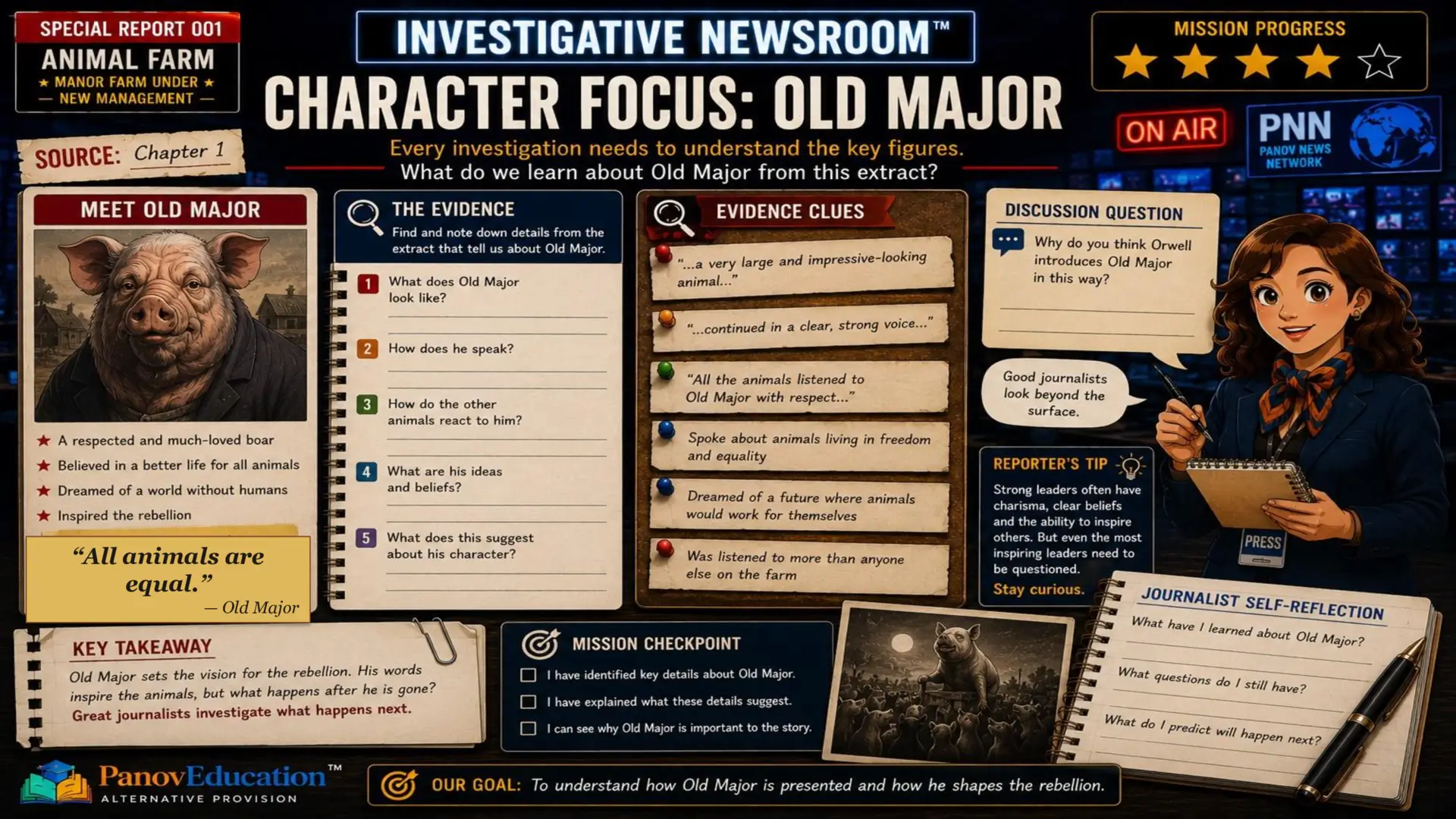
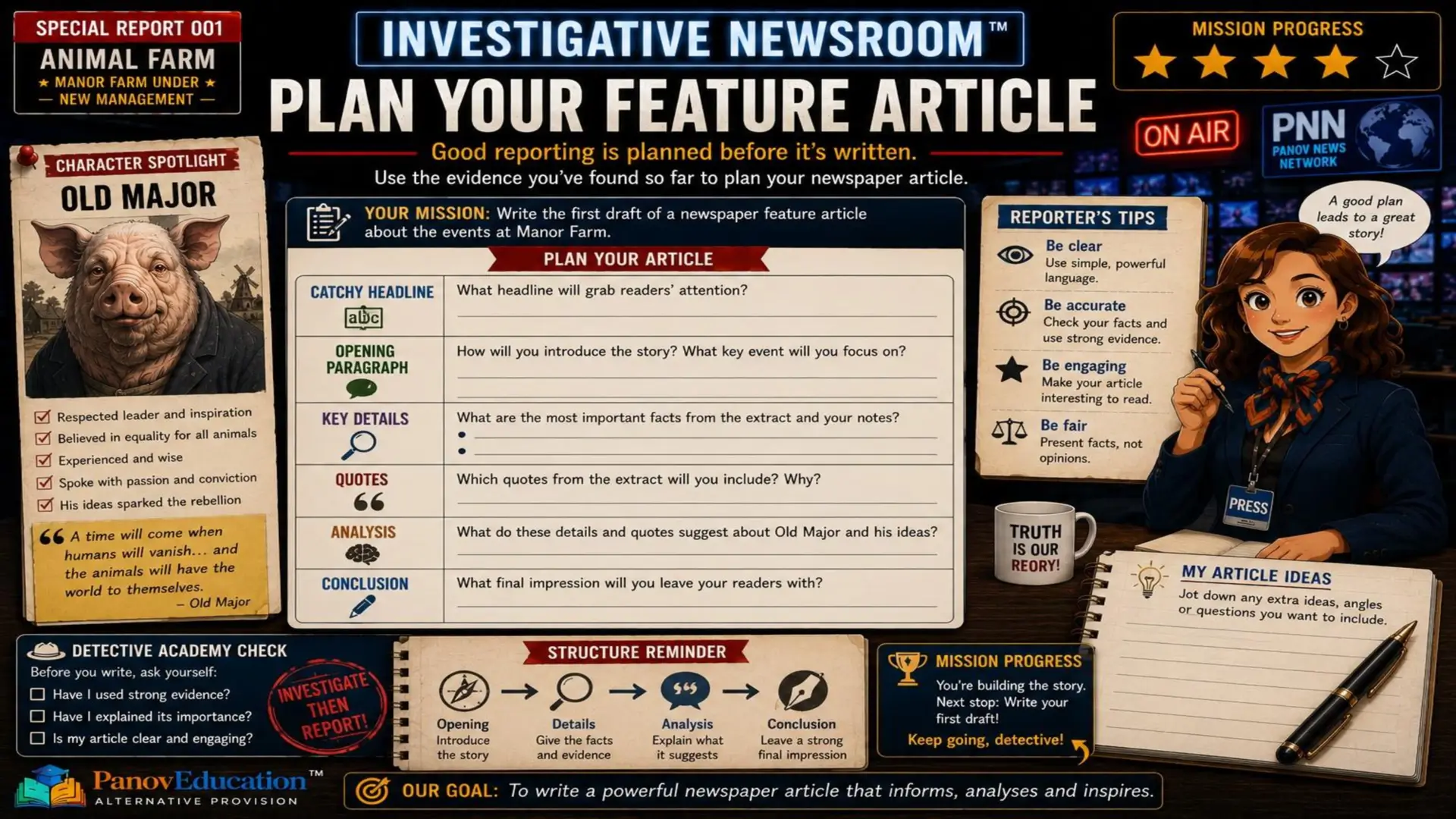
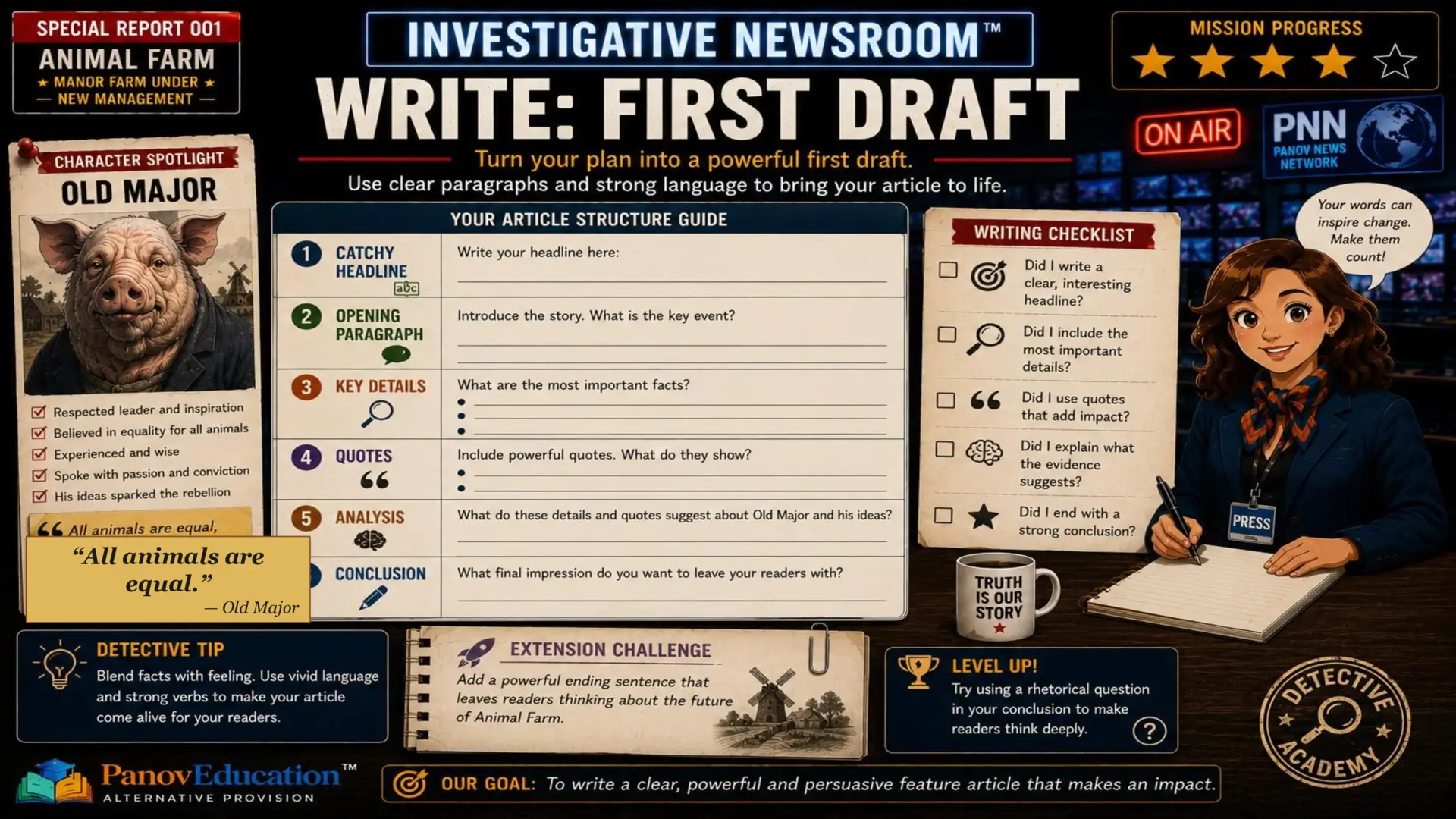
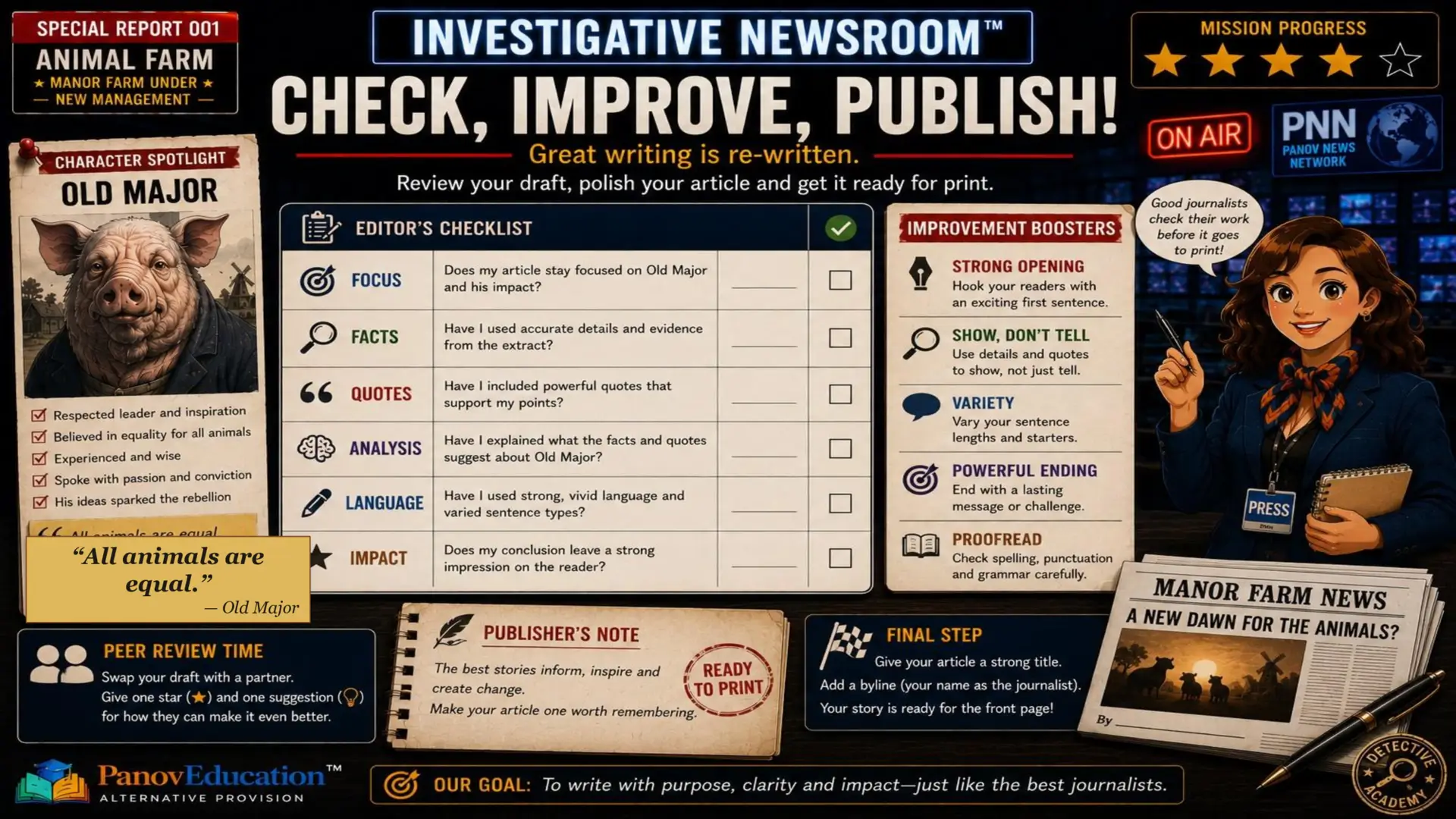
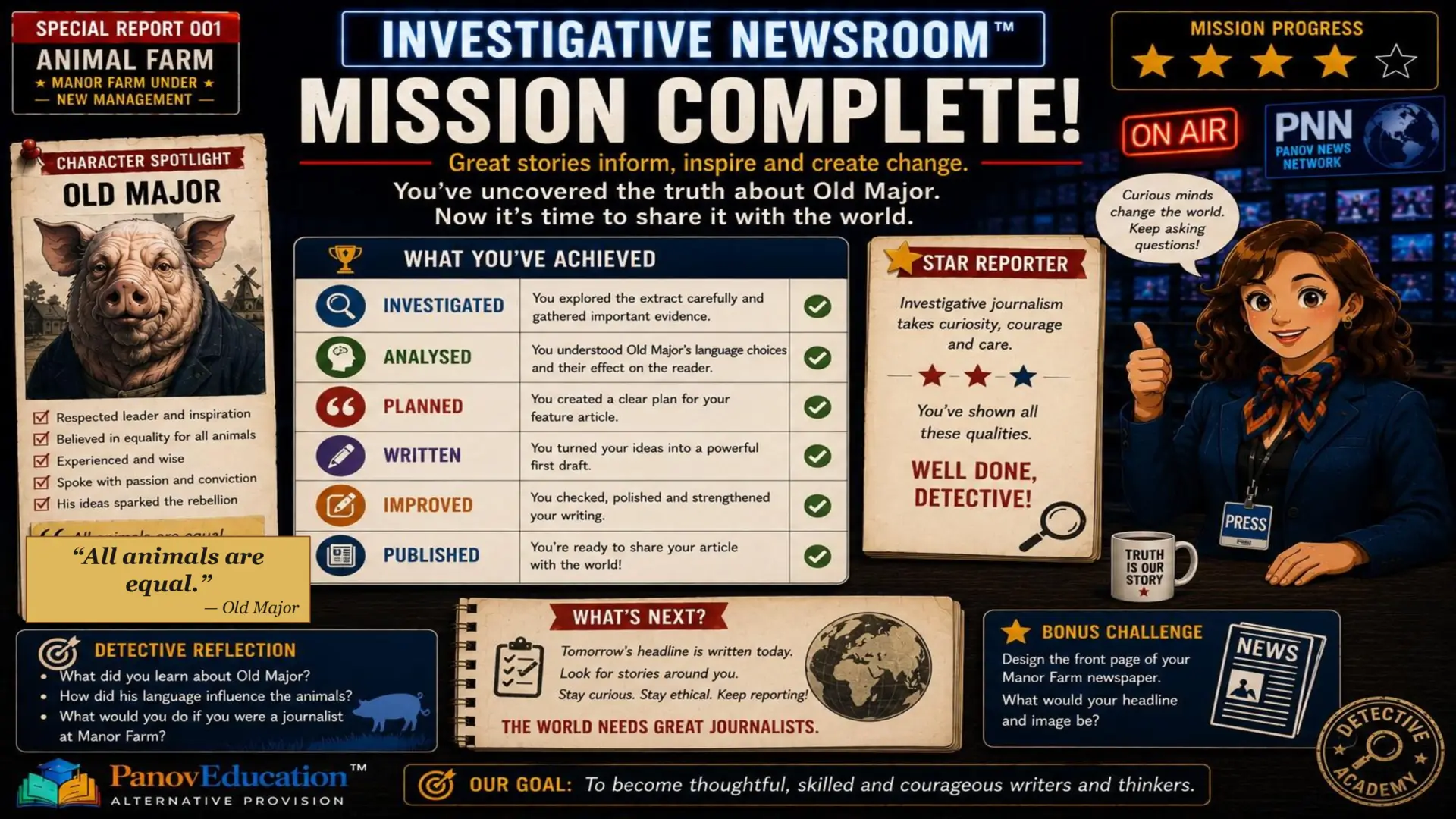
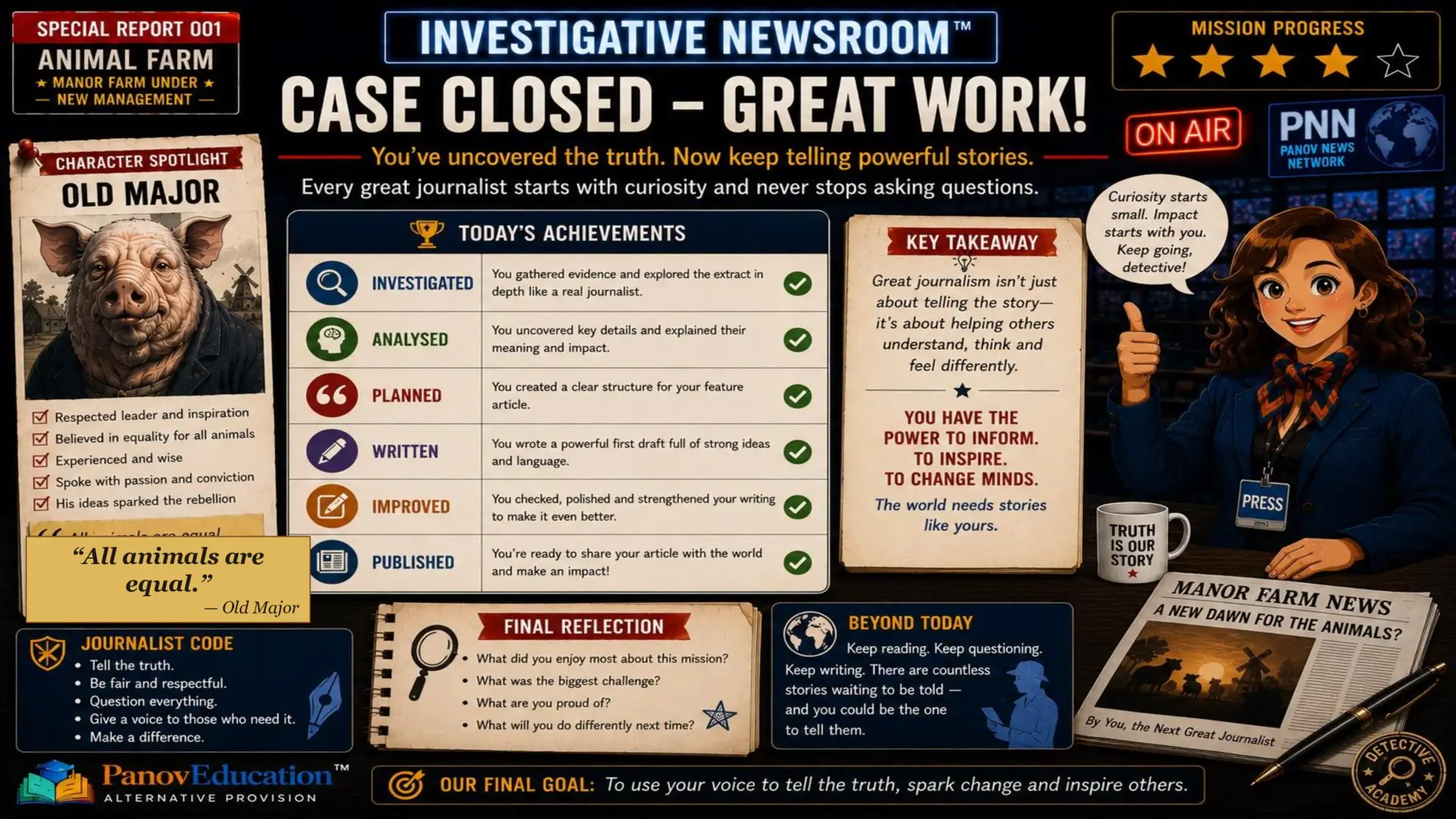
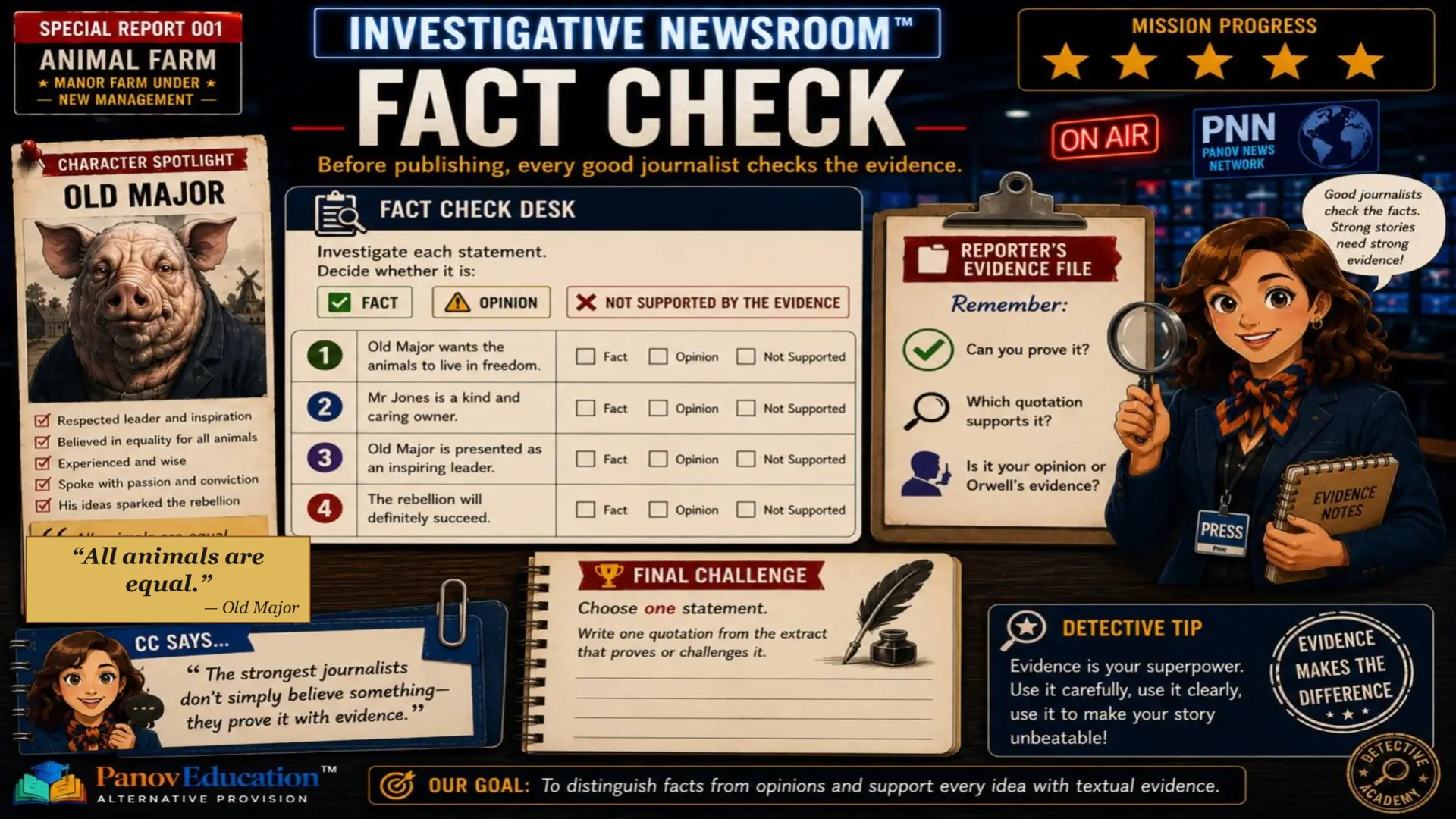
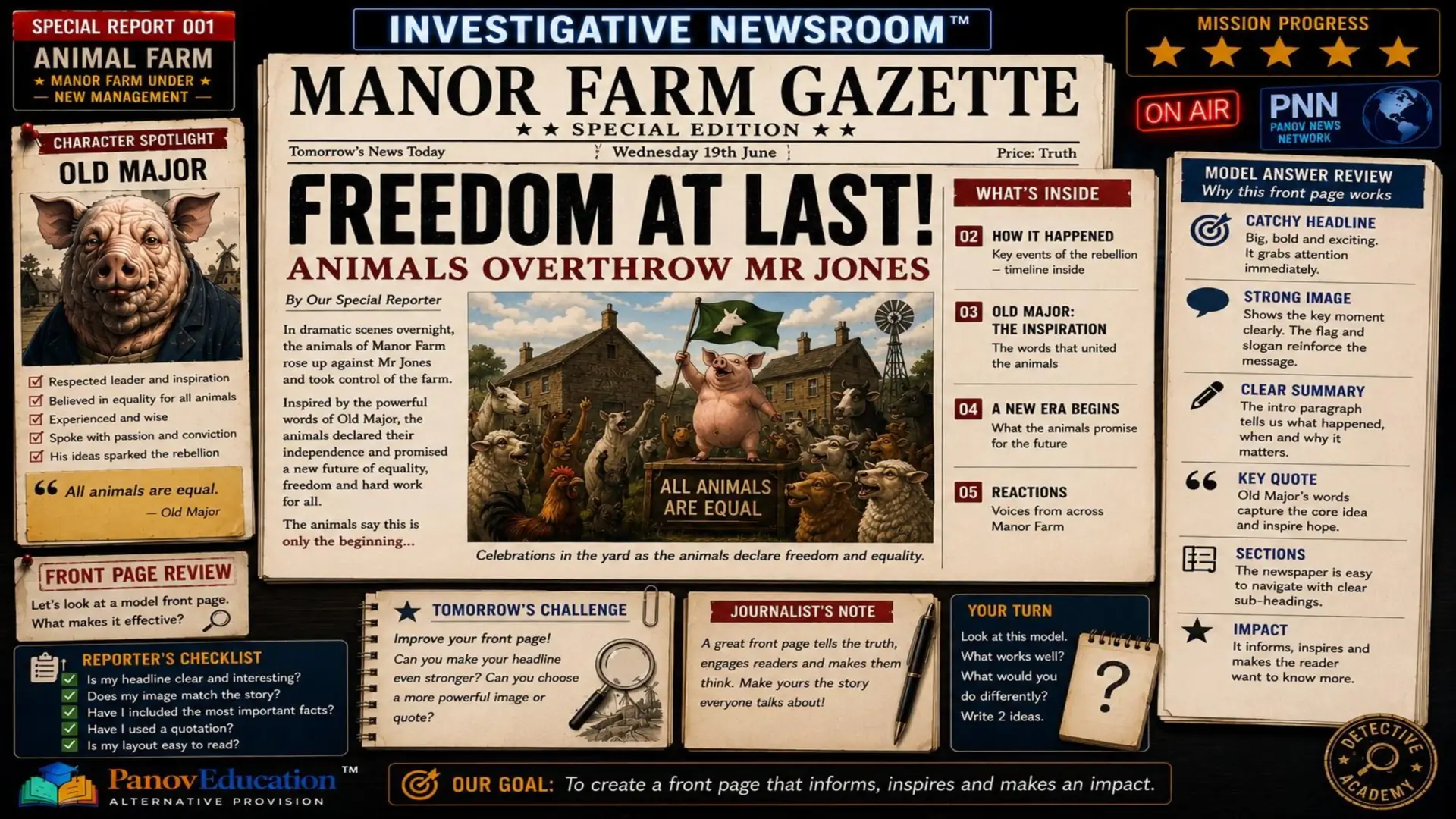
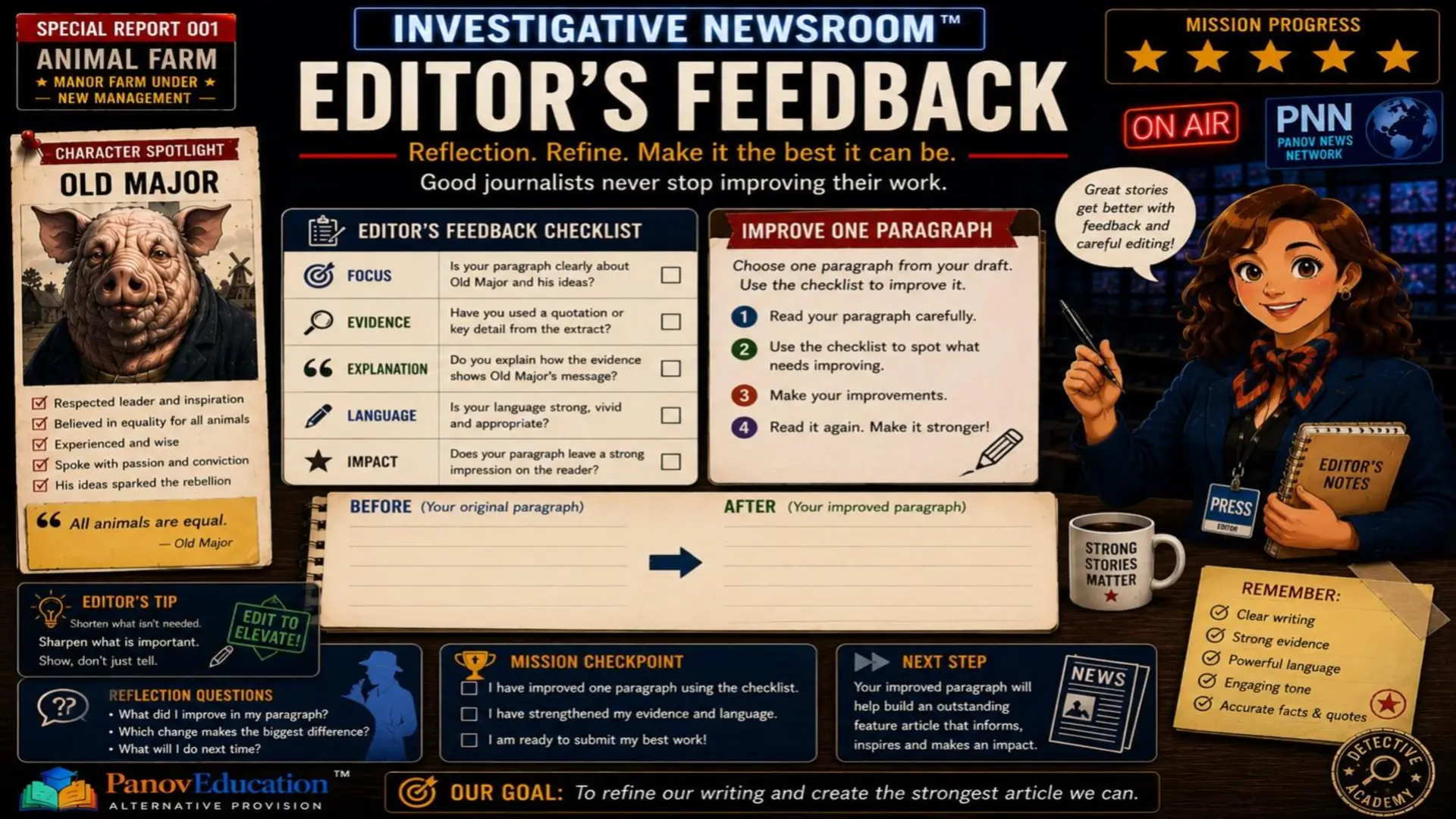
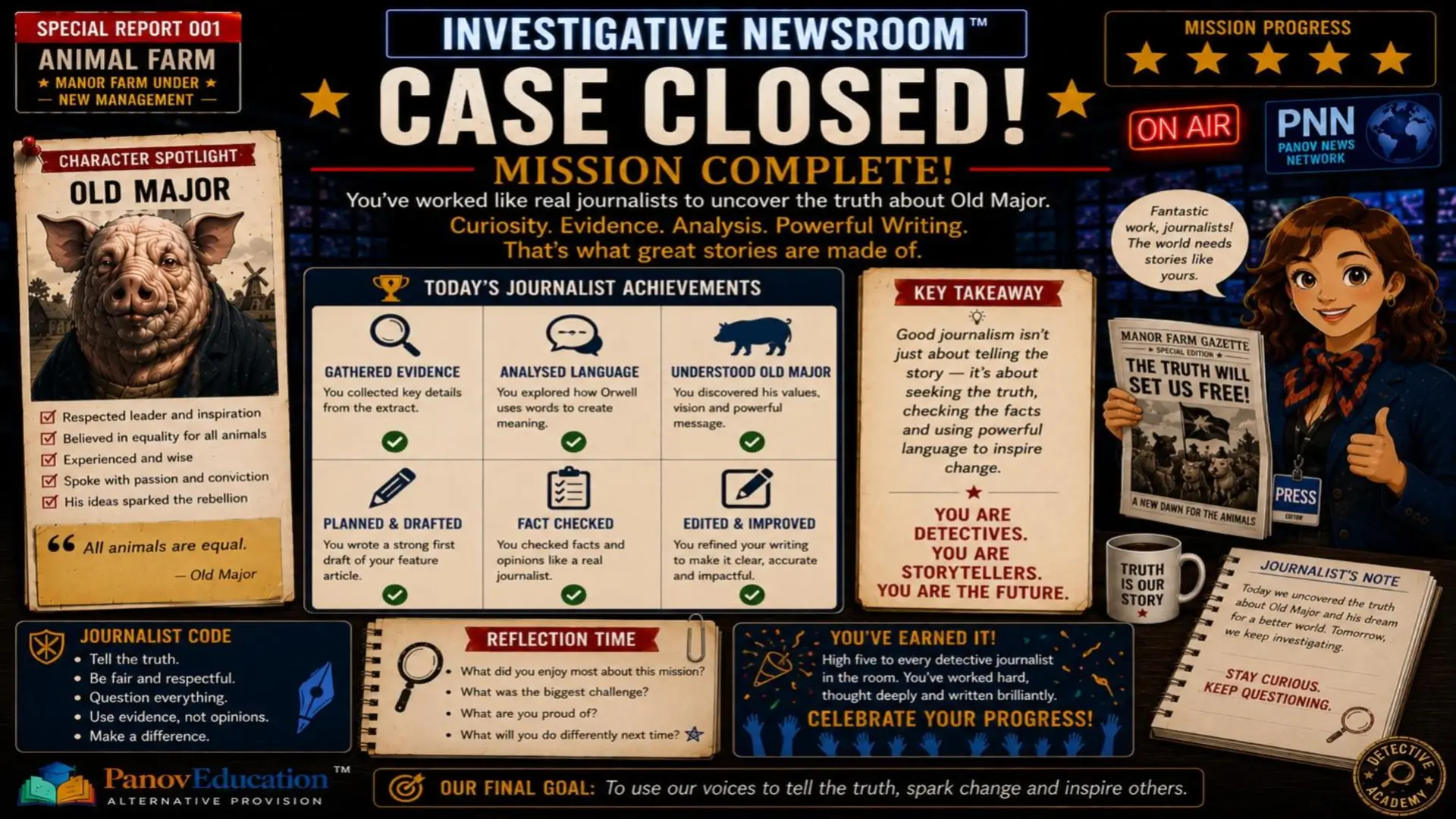
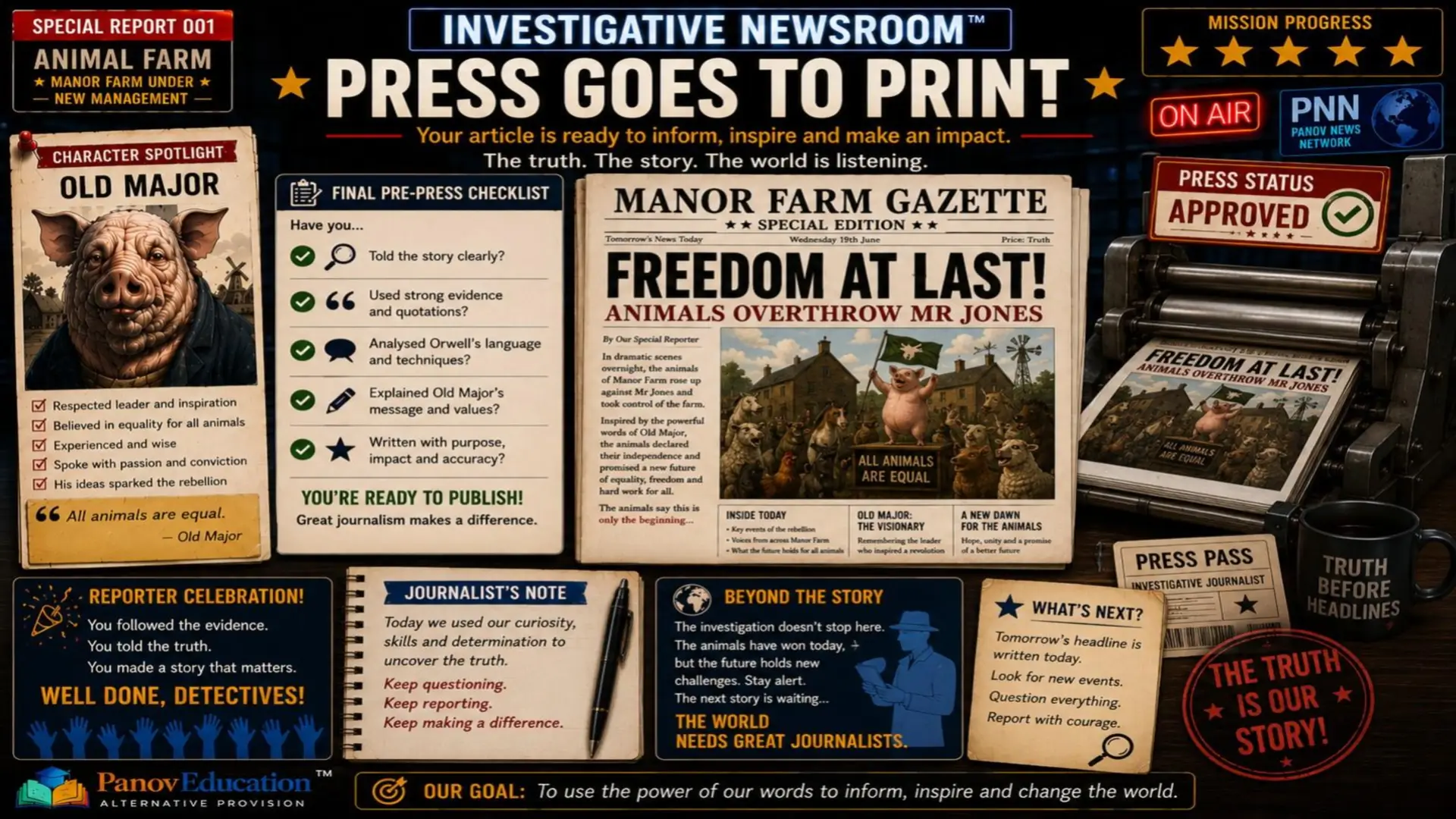
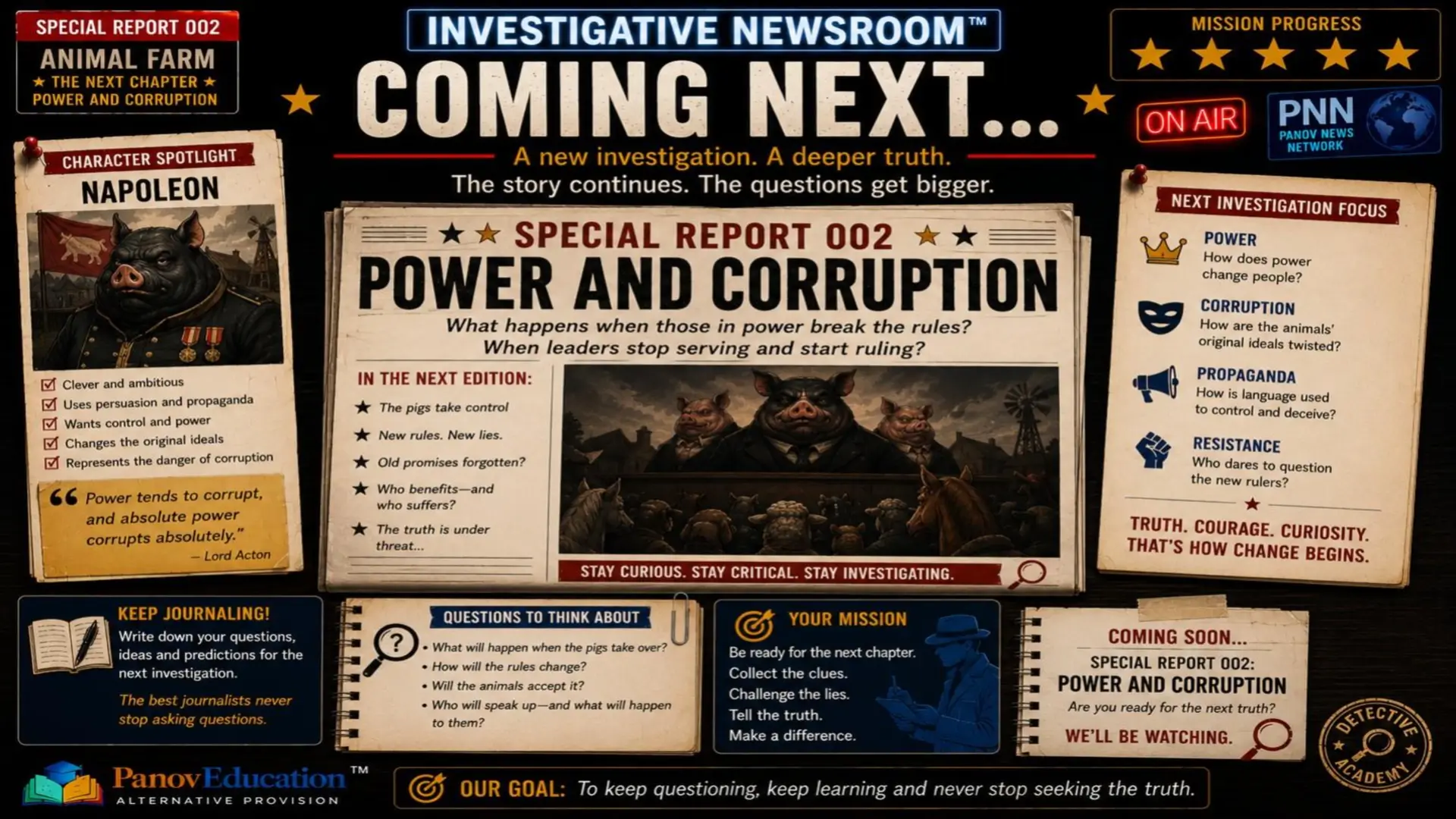
Animal Farm – Newspaper Report Writing and Evidence Analysis
Topic
GCSE English Literature
Learning Objectives
Students explore the opening events of Animal Farm by gathering textual evidence, analysing quotations, distinguishing between fact and opinion, and producing a professionally structured newspaper report. The lesson develops reading comprehension, analytical thinking, evidence selection, journalistic writing and editing skills while reinforcing GCSE Literature requirements.
Teaching Methodology
This lesson is delivered through the PanovEducation Investigative Newsroom™ methodology, where students become investigative journalists working to publish a breaking news story. Learners gather evidence from the text, interview fictional witnesses, verify information, analyse quotations and construct a newspaper report using authentic journalistic conventions. The lesson integrates explicit instruction, guided modelling, collaborative enquiry, independent writing, peer editing and reflective improvement within an immersive newsroom environment. By giving students a meaningful professional role, literary analysis becomes purposeful, engaging and memorable.
Preview the lesson in the next tab or Download it as .PPTX.


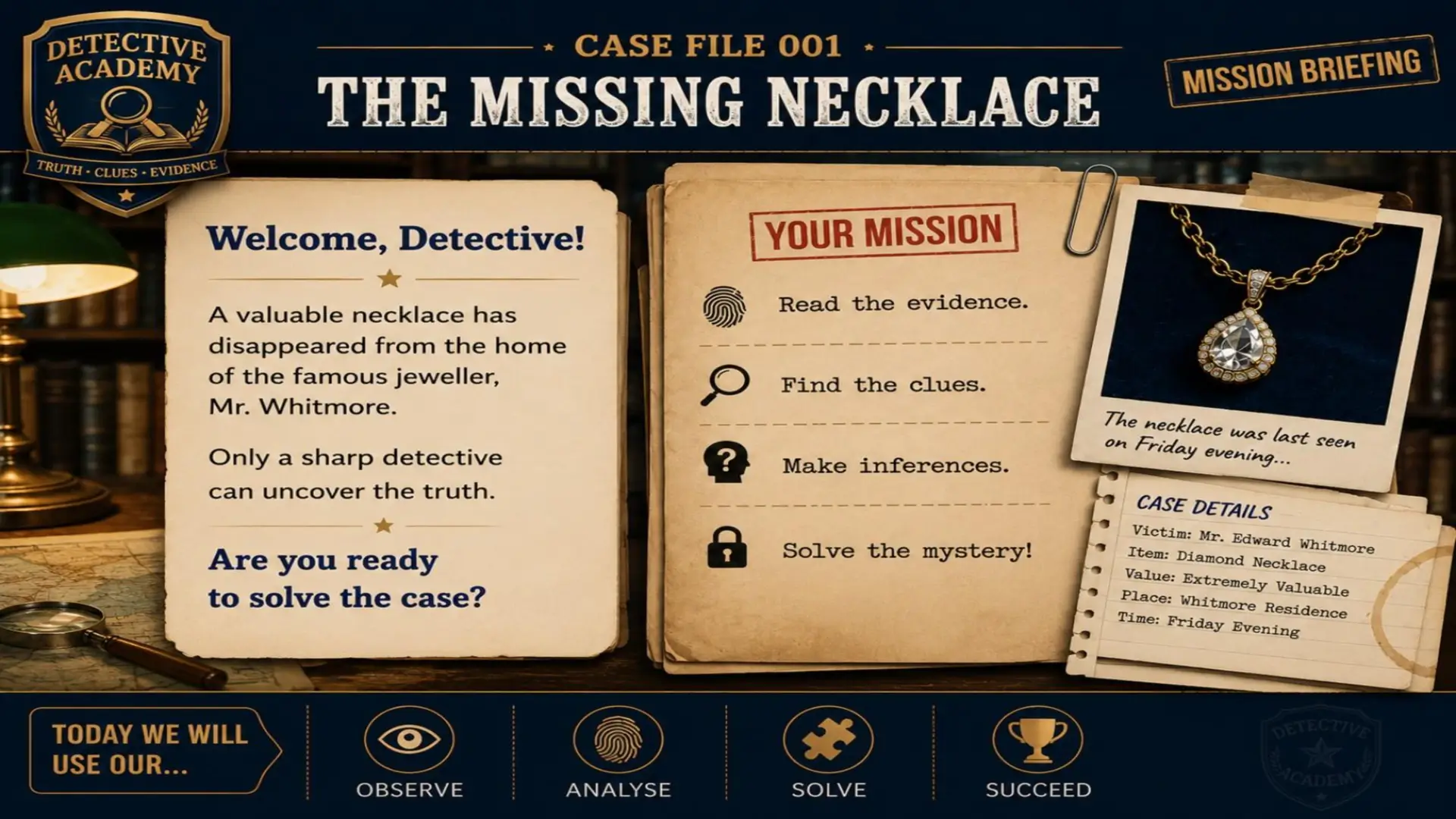
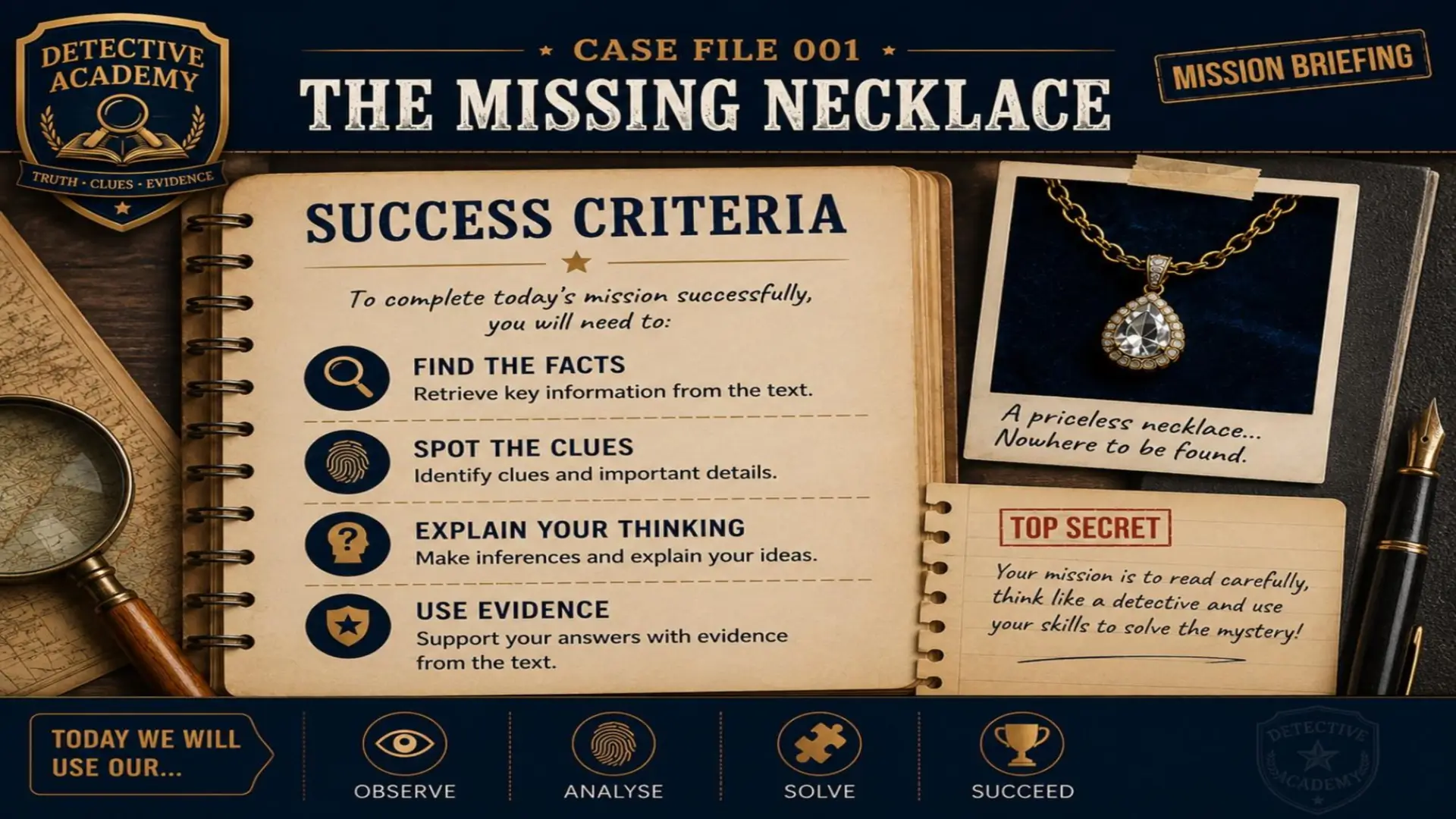
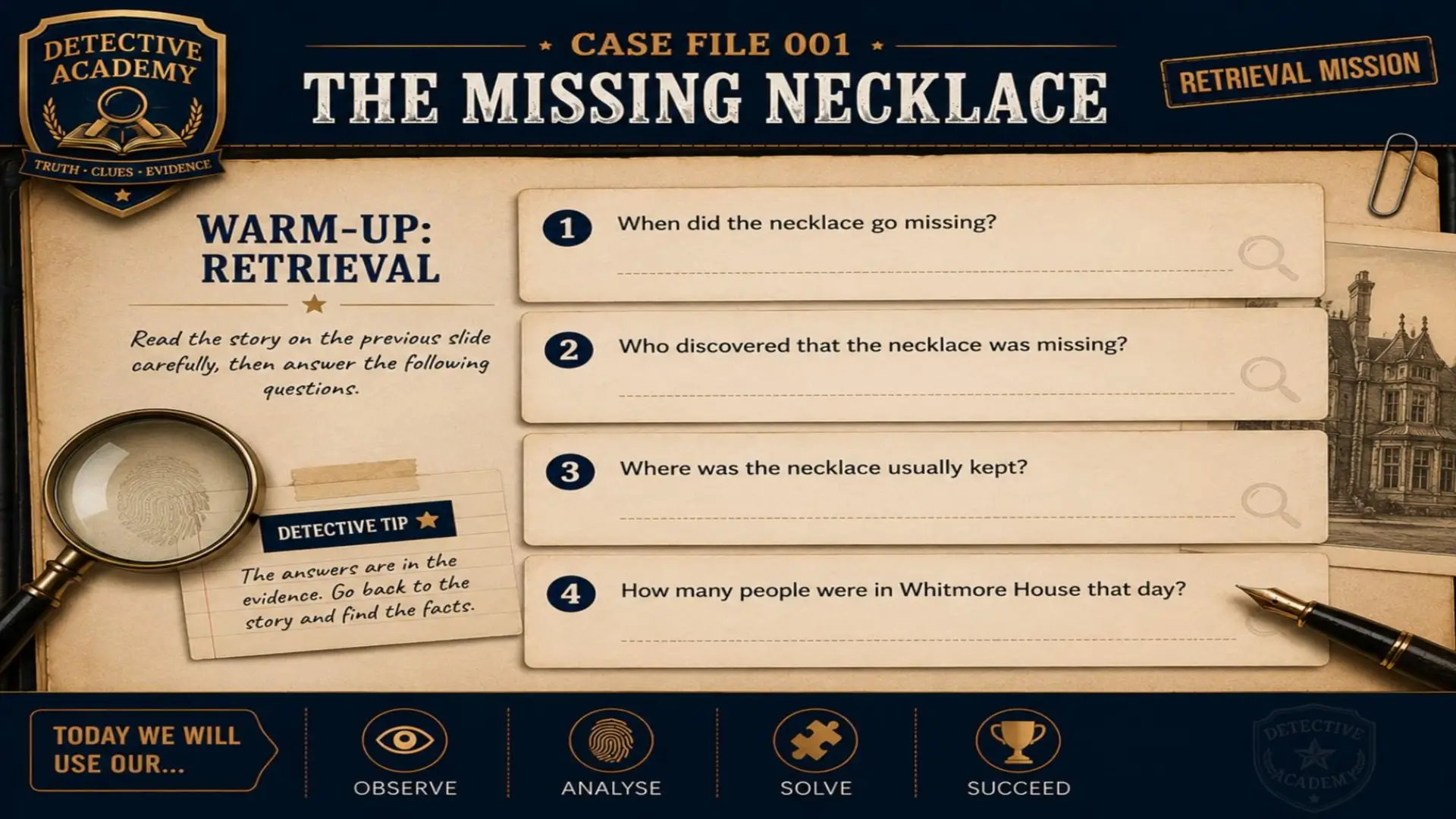
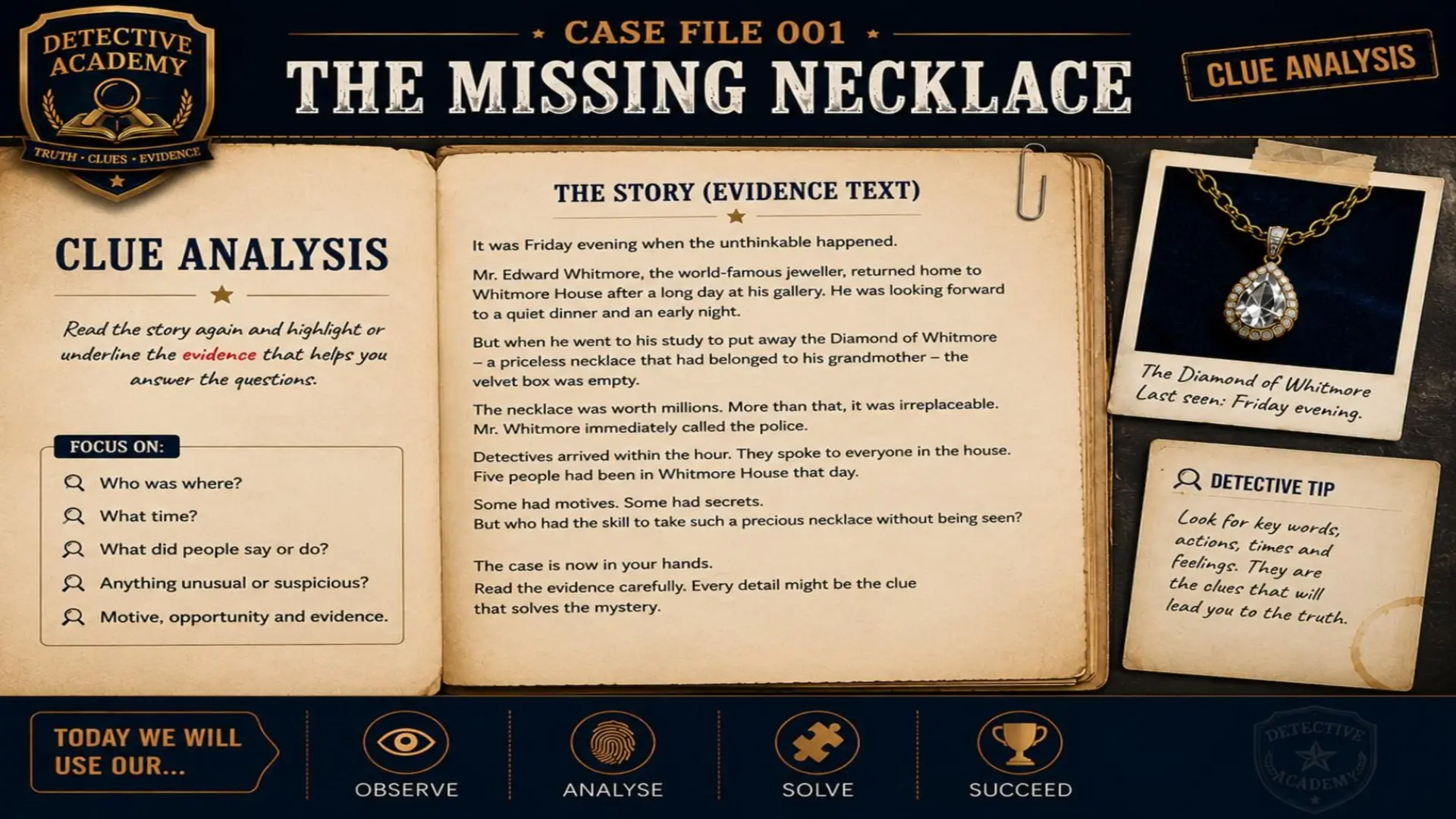
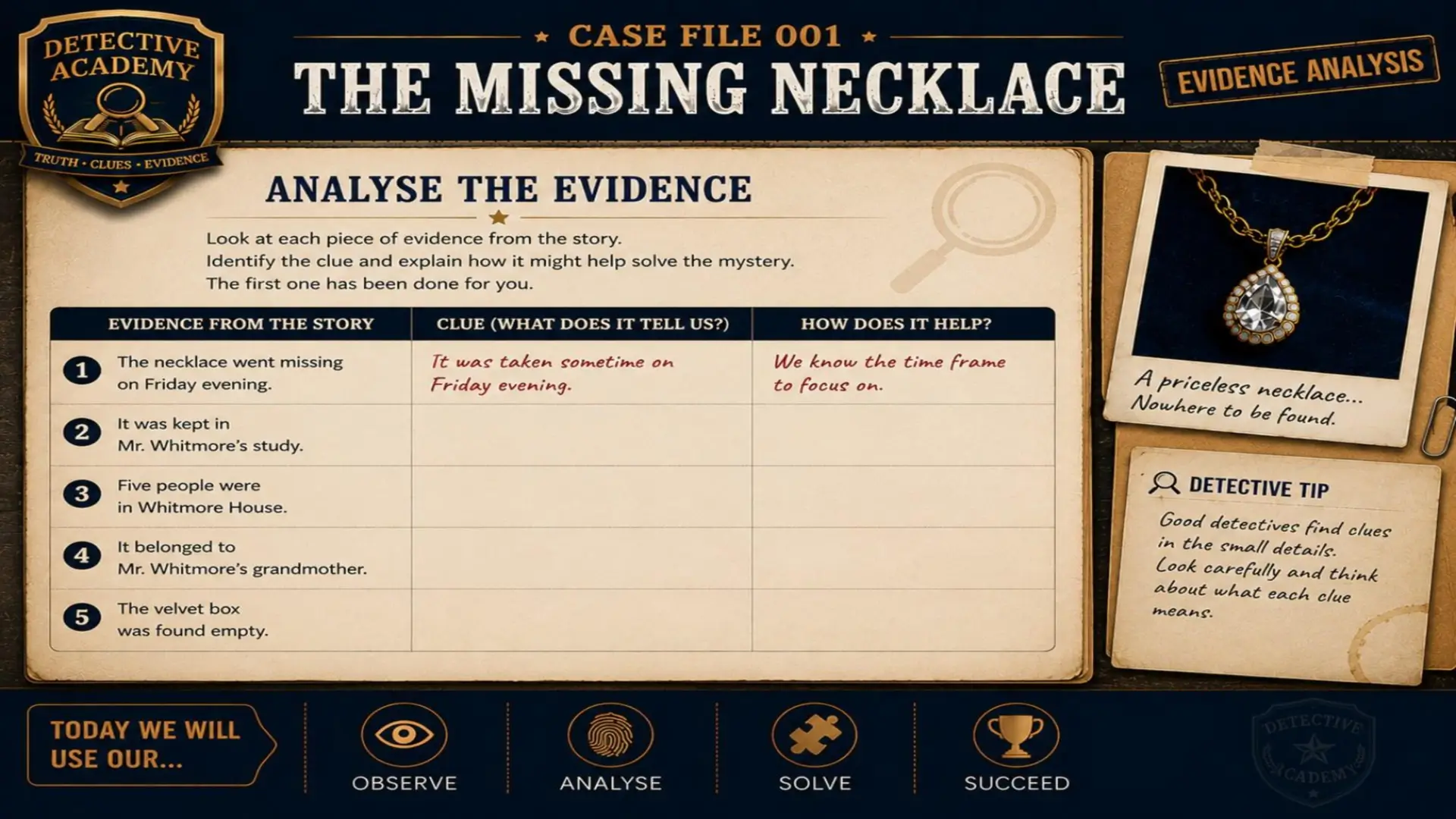
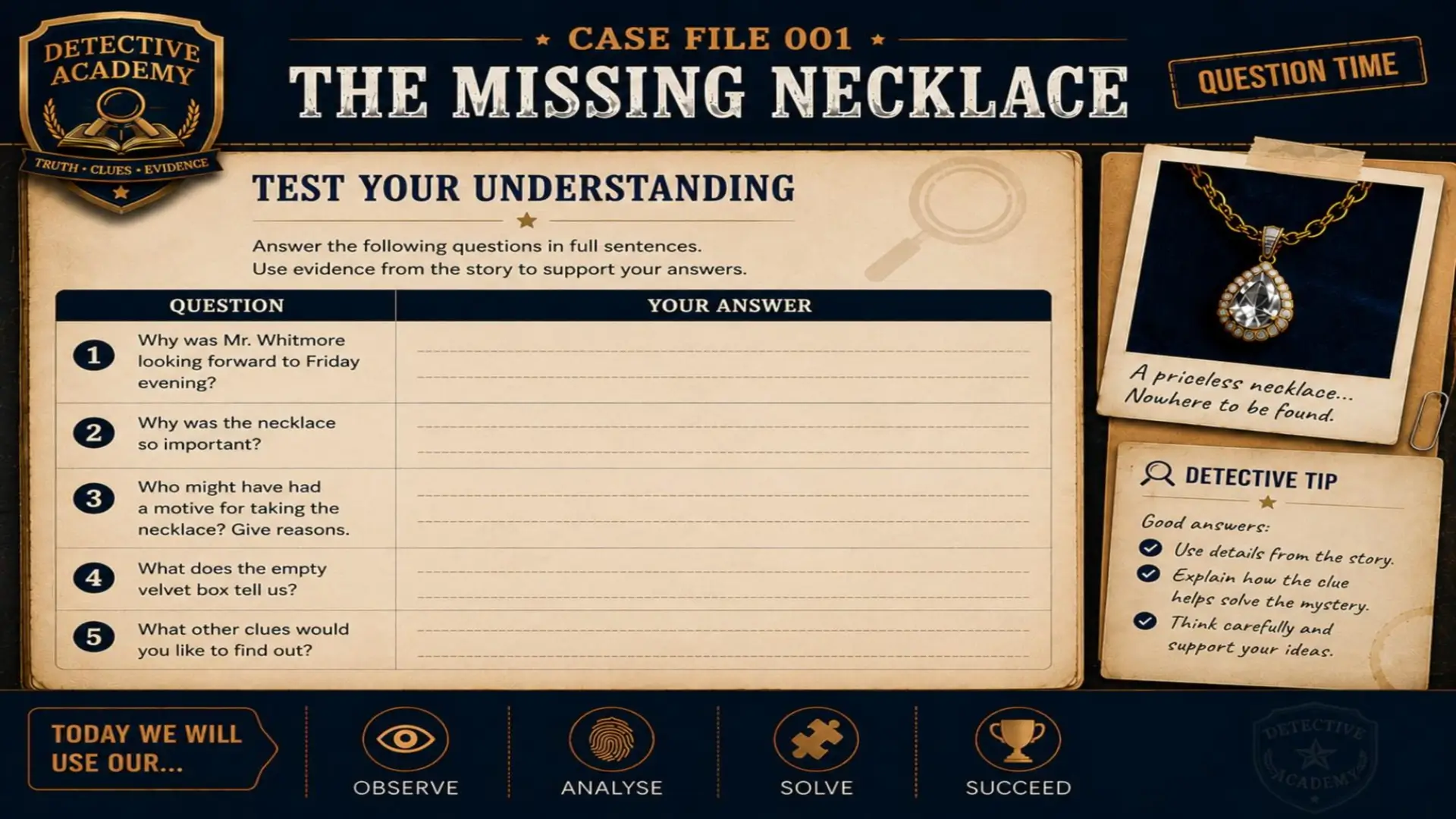
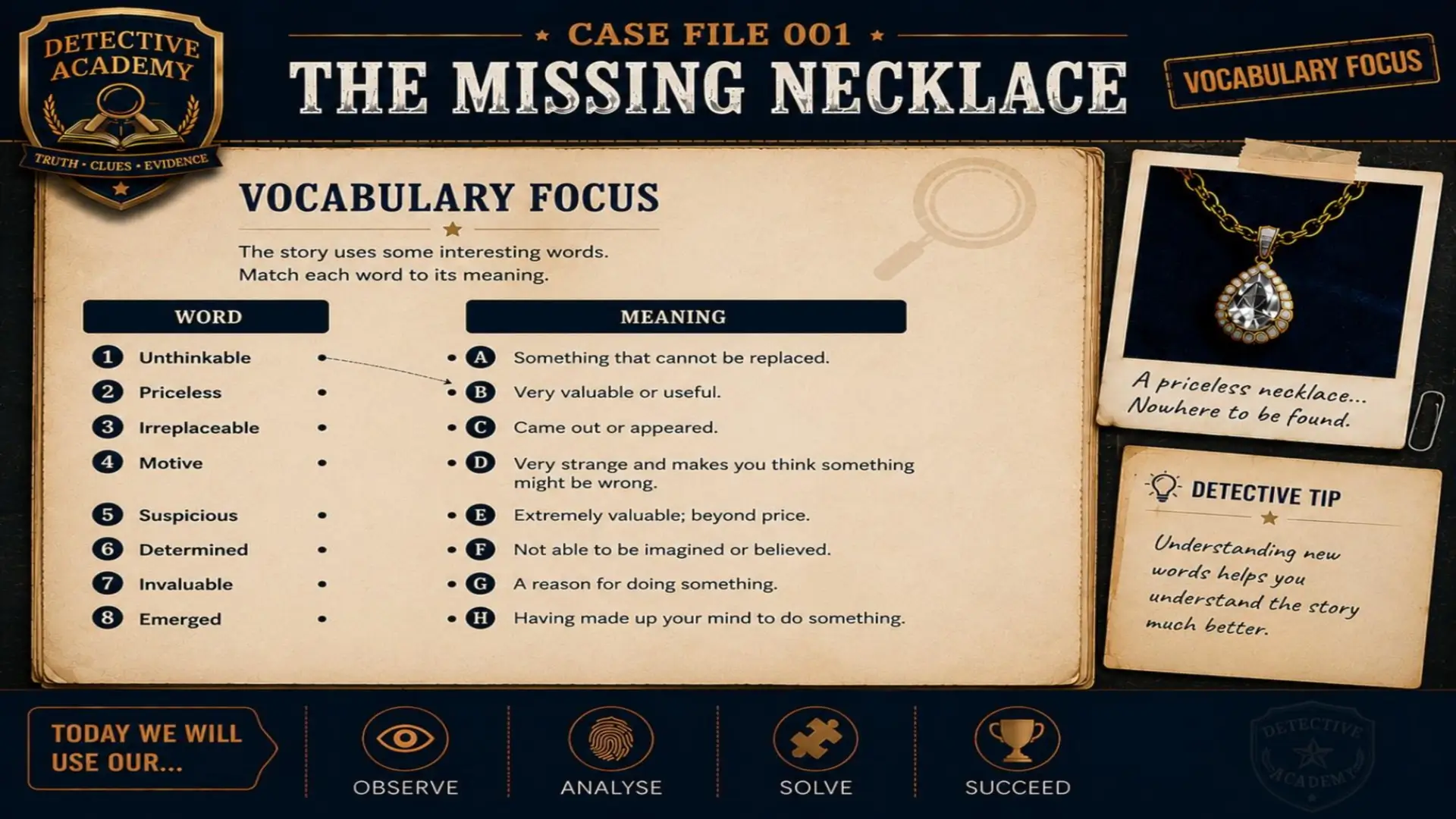
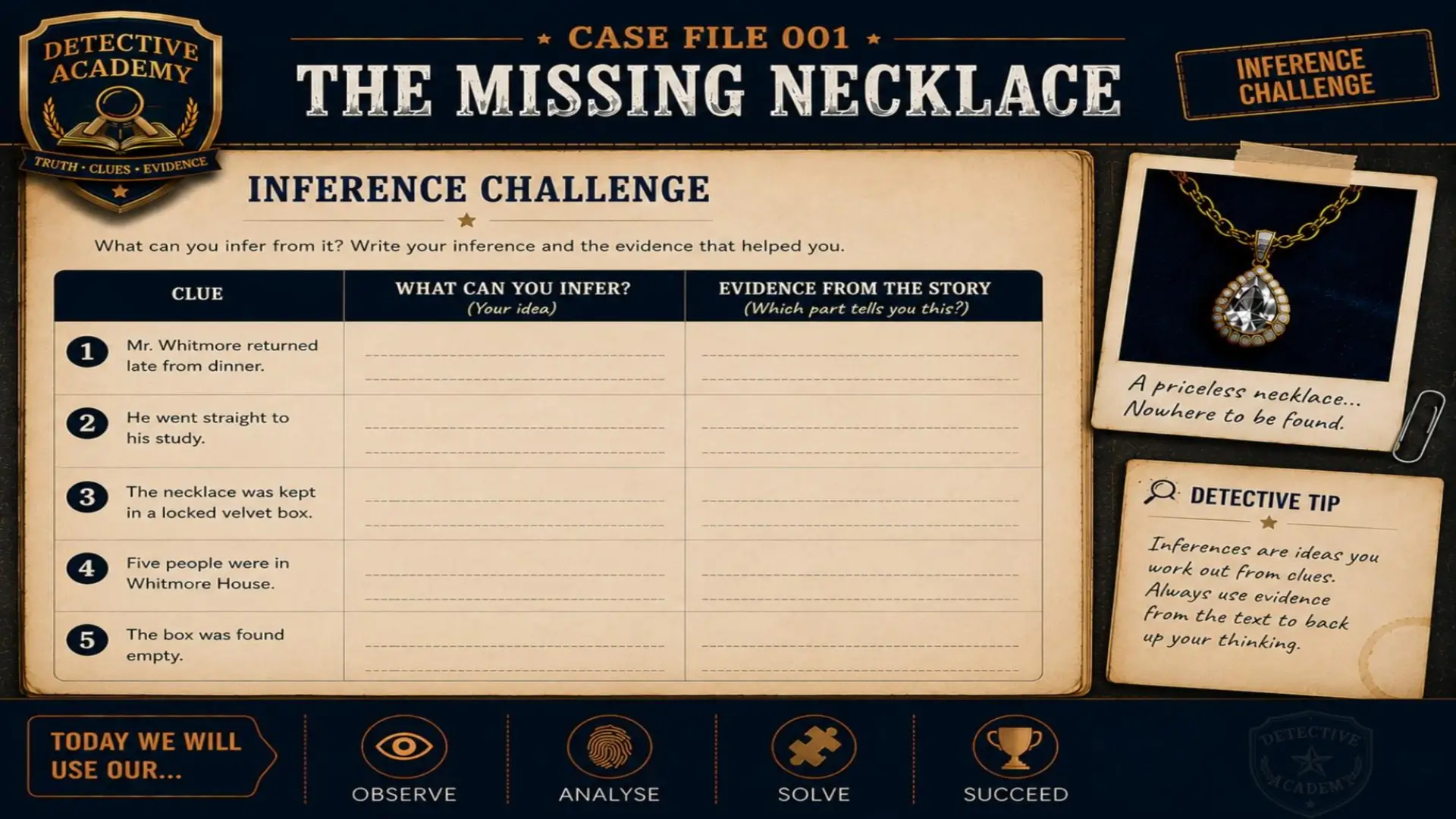
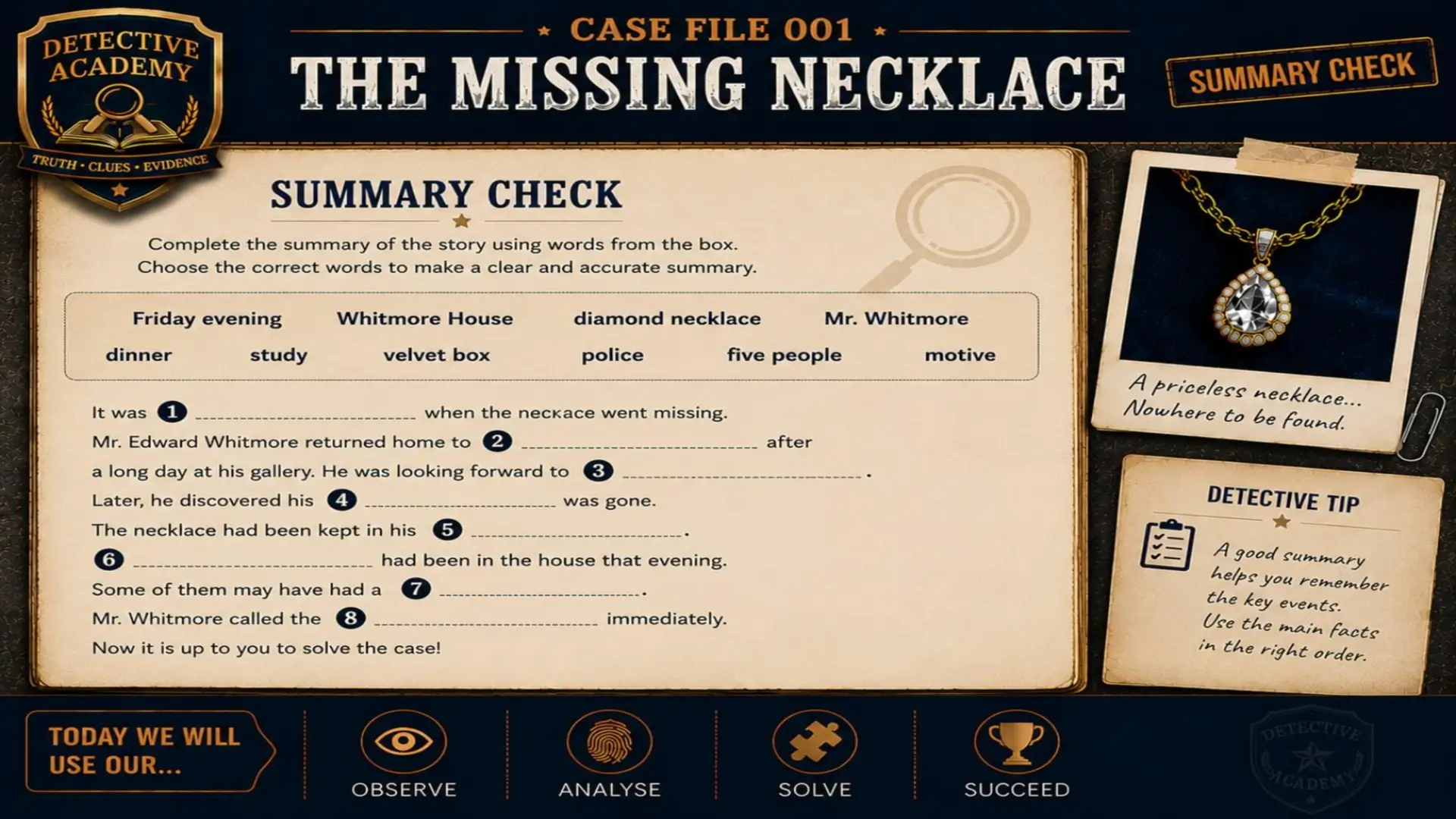
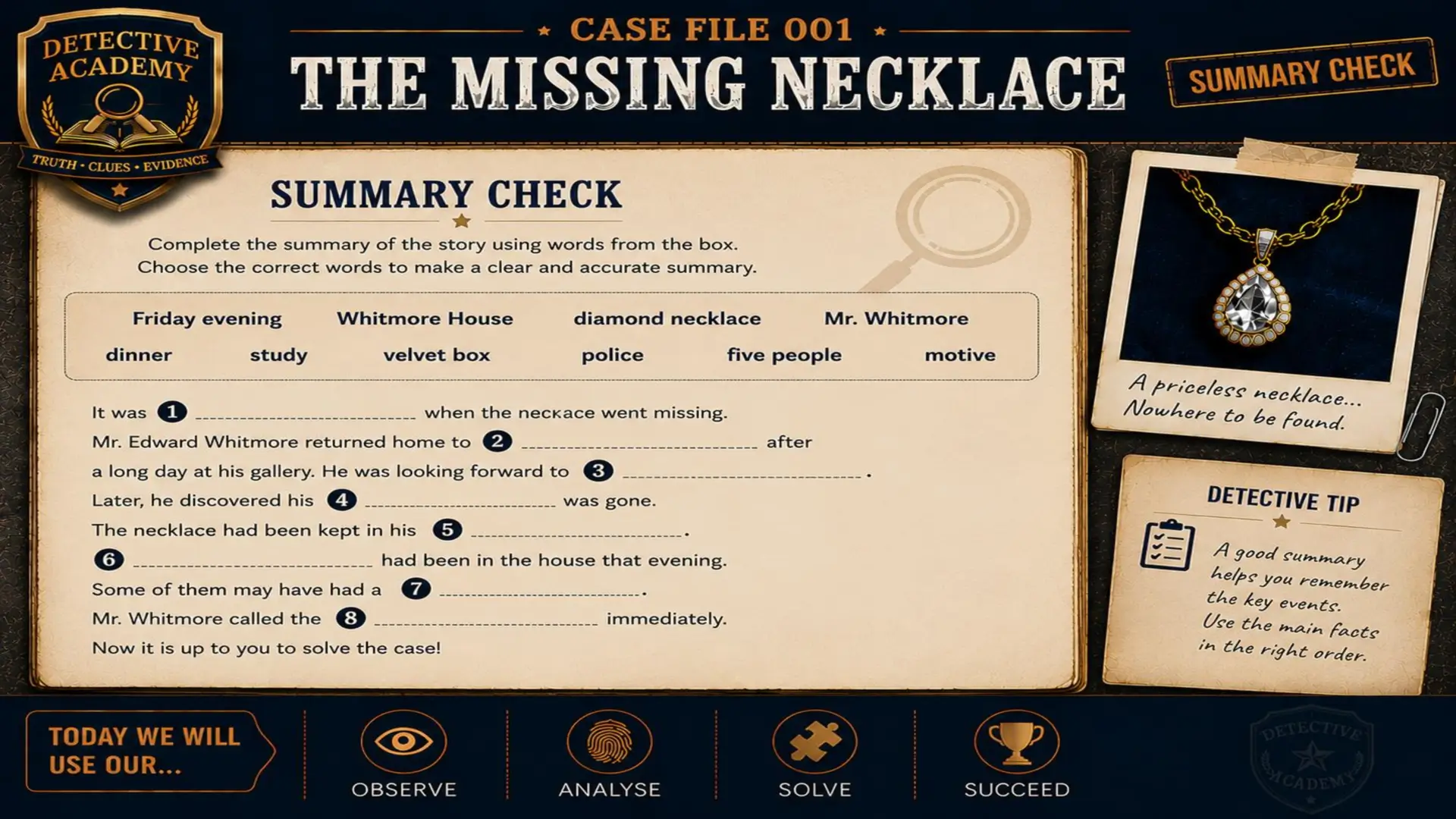
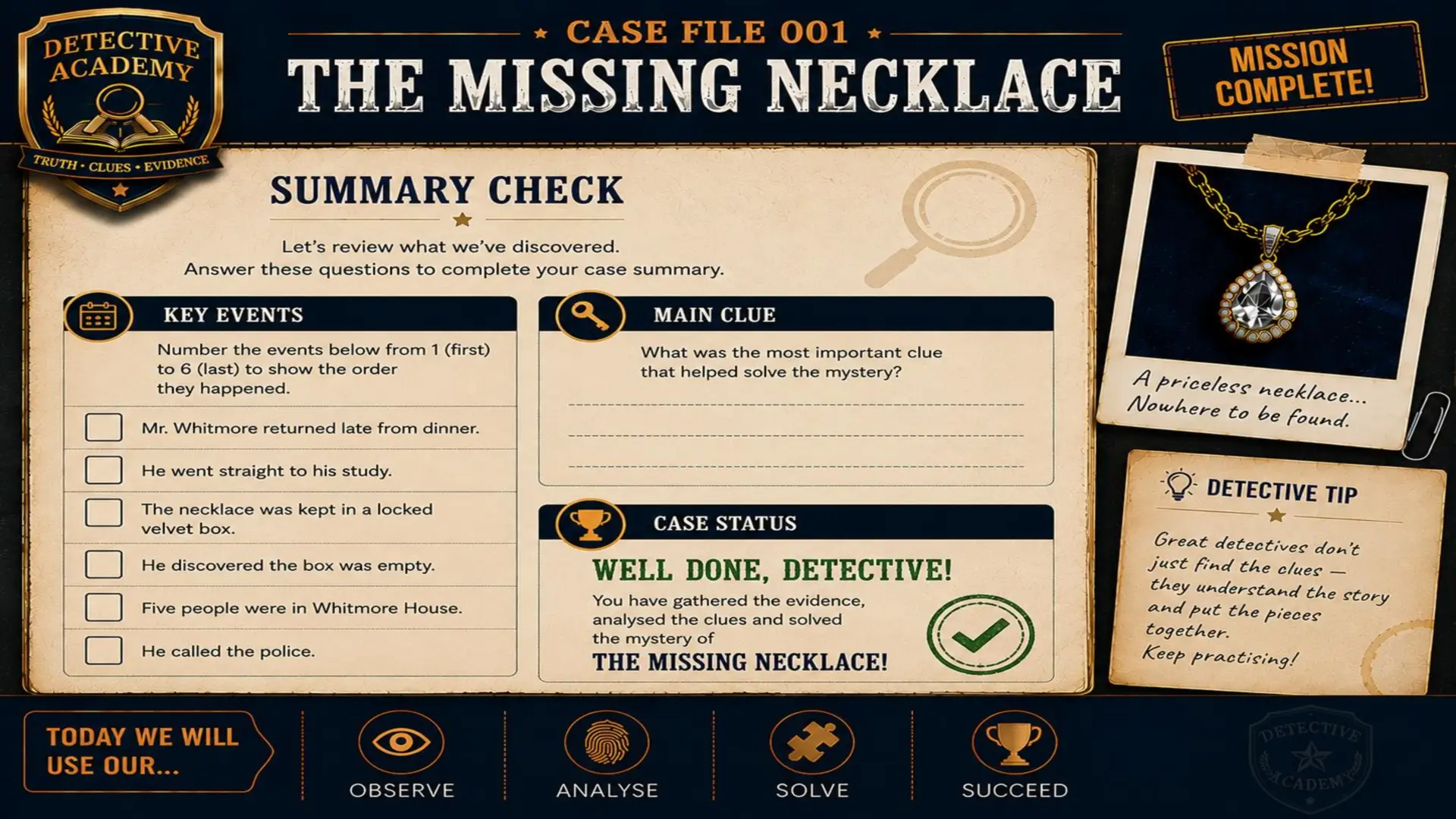
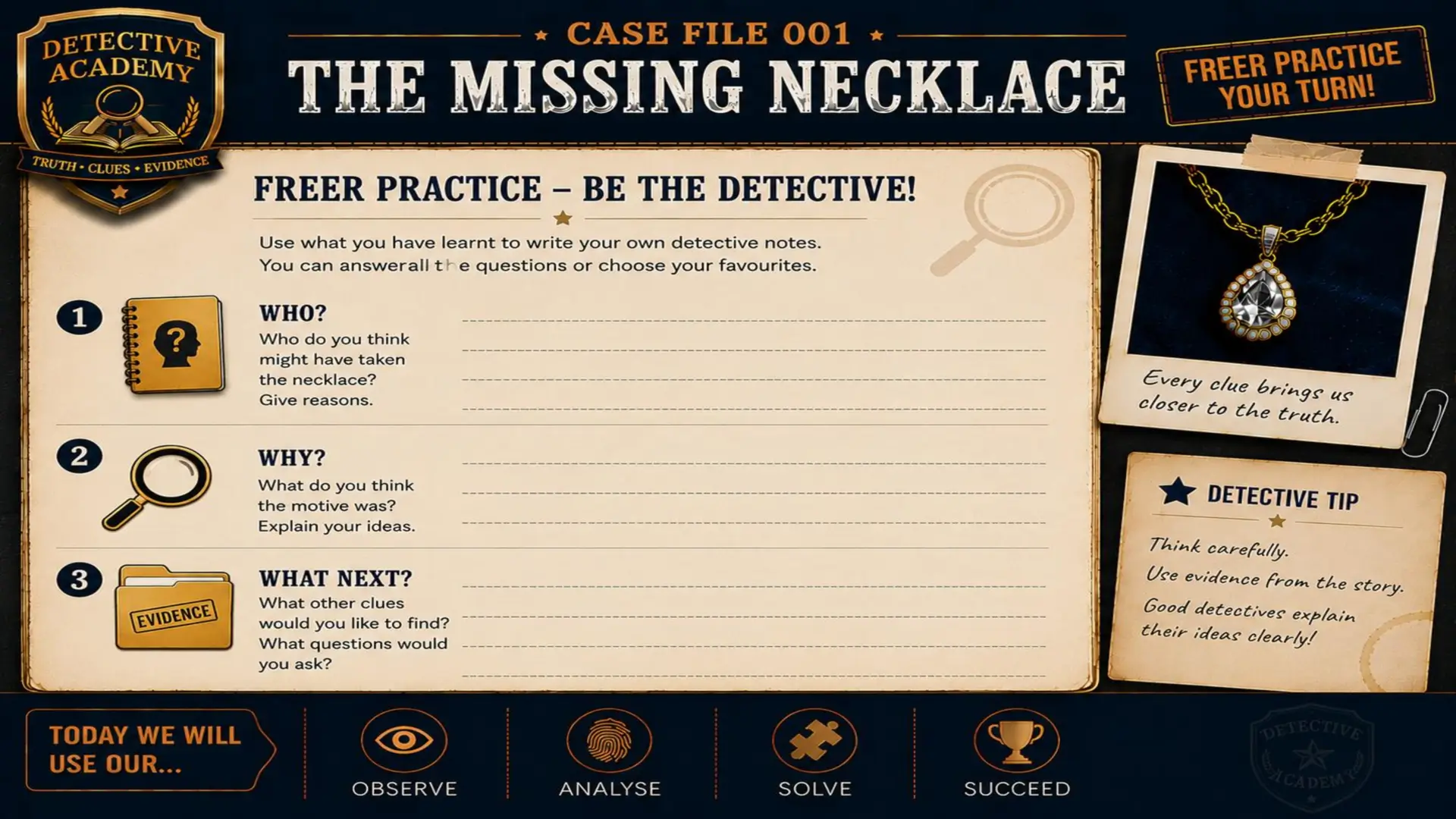
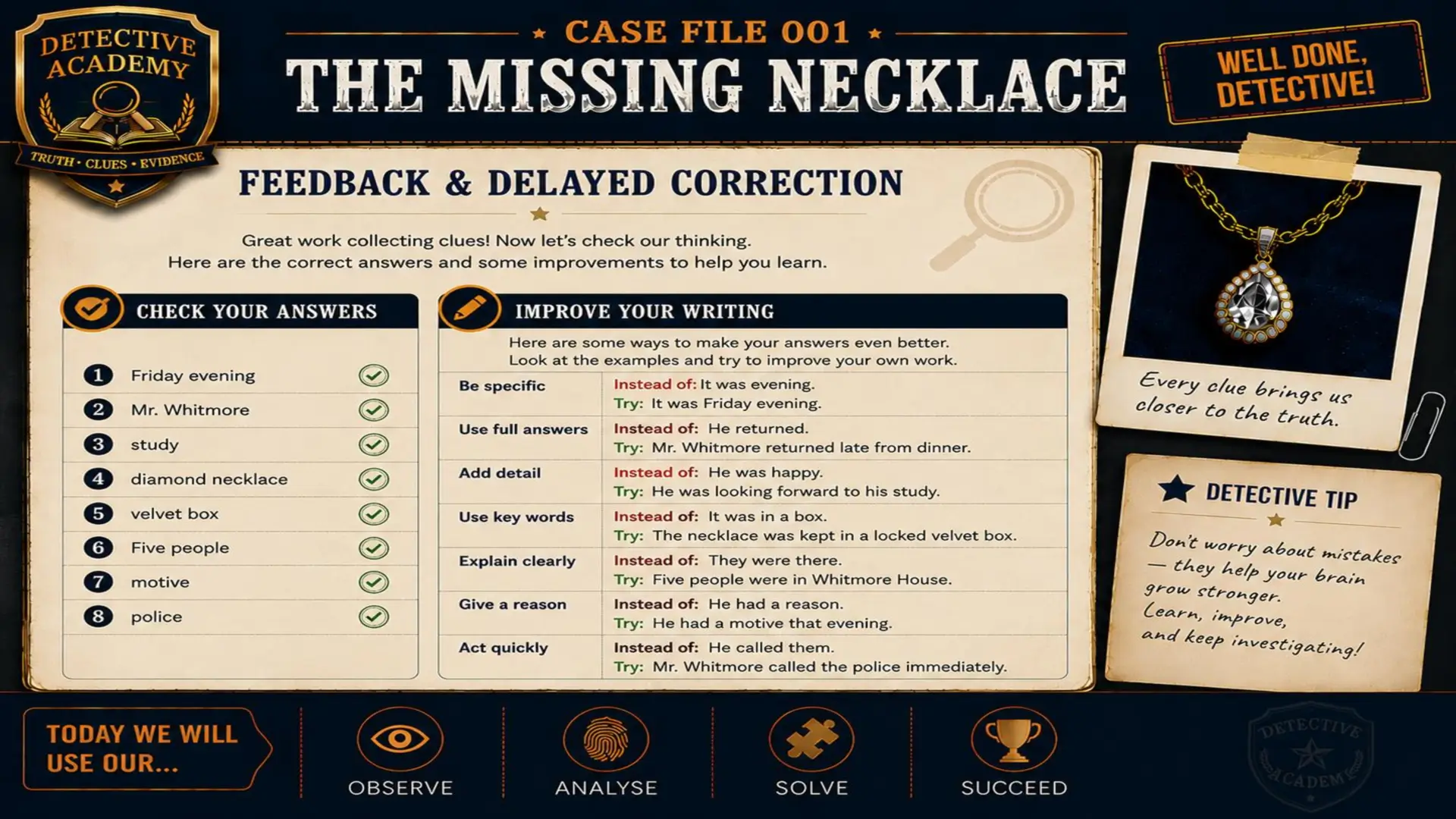
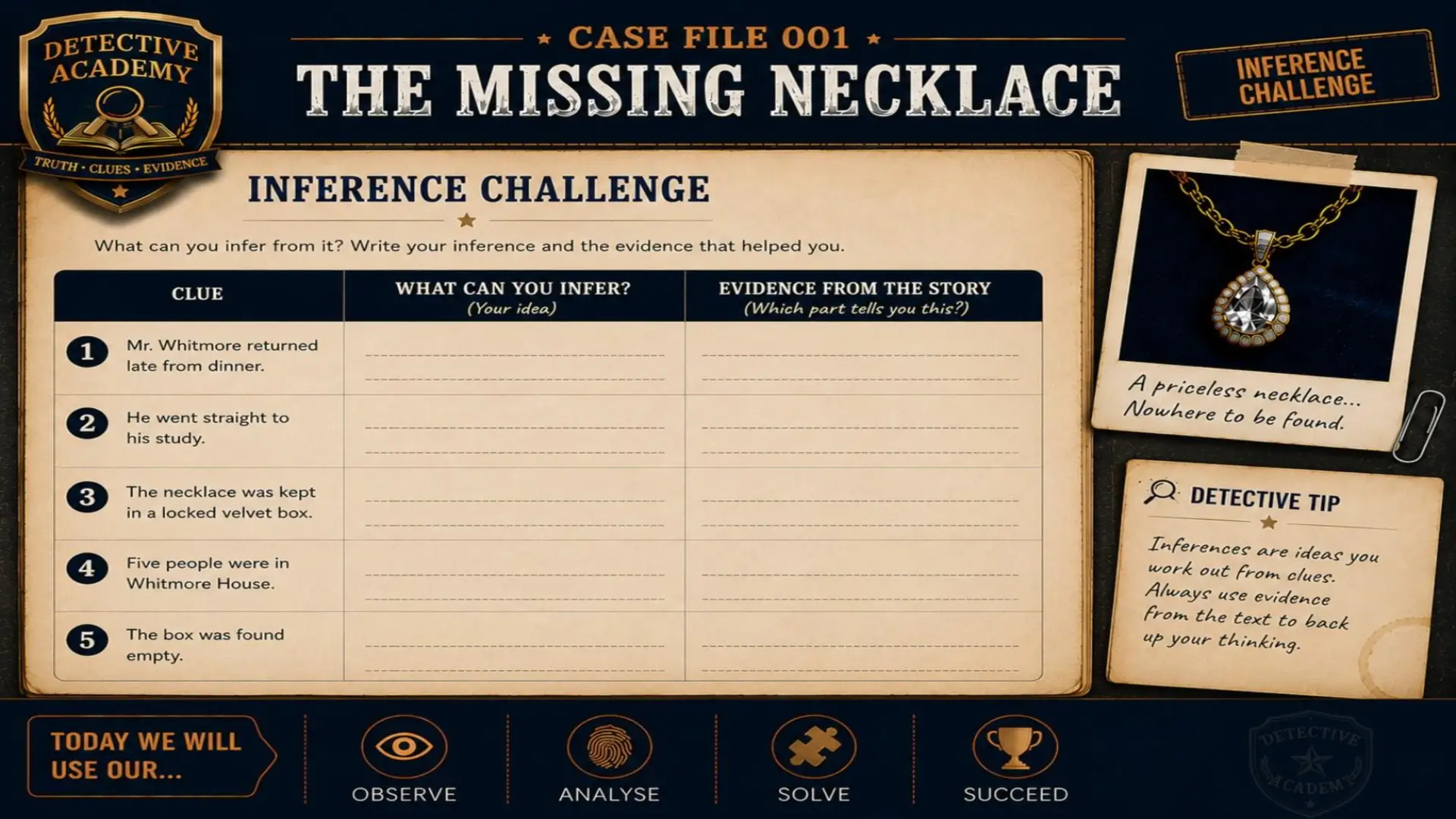
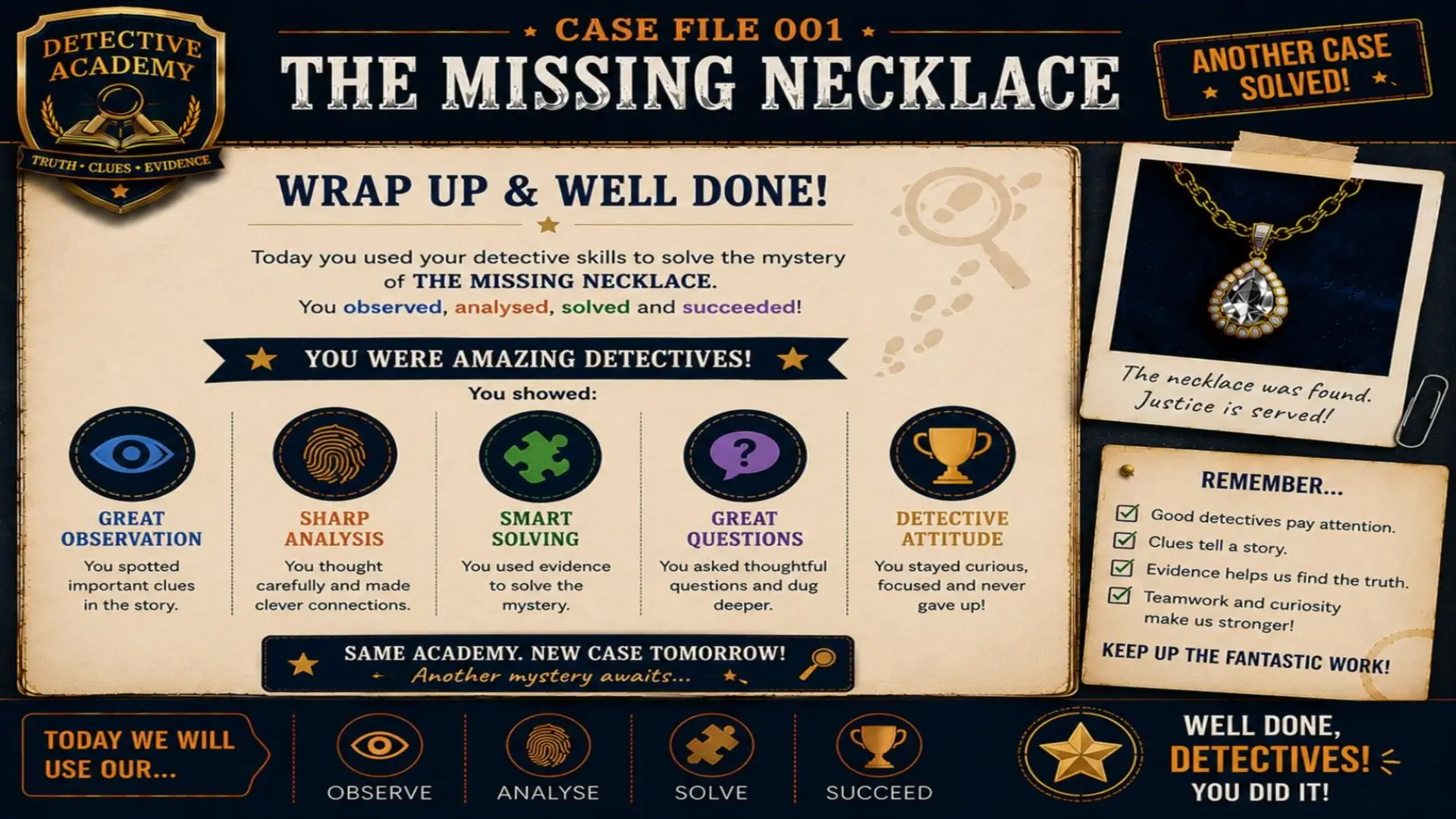
Detective Academy - Case File 001: The Missing Necklace
Overview
Students step into the role of detectives as they investigate the mysterious disappearance of a valuable necklace. By examining evidence, analysing witness statements and solving clues, they develop key English Language skills through an immersive, story-driven investigation that promotes curiosity, inference and analytical thinking.
Learning Objectives
- Retrieve explicit information from a range of evidence.
- Make justified inferences using textual clues.
- Develop analytical writing skills by supporting ideas with evidence.
- Expand topic-specific vocabulary related to crime and investigation.
- Communicate conclusions clearly using appropriate English.
Teaching Methodology
This lesson uses the PanovEducation immersive learning approach. Students learn through purpose by becoming detectives responsible for solving an authentic mystery. The lesson combines guided discovery, explicit teaching, collaborative discussion and independent investigation, gradually reducing support as learners build confidence and apply their reading and analytical skills.
Skills Developed
- Reading comprehension
- Retrieval
- Inference
- Analytical writing
- Vocabulary development
- Critical thinking
- Problem-solving
- Speaking and discussion
Suitable For
- KS3 English
- Alternative Provision
- SEND
- Students requiring confidence-building through immersive learning
- Small group or one-to-one tuition
Resources Included
- Fully editable PowerPoint presentation
- Detective case materials
- Investigation activities
- Teacher guidance
- Independent practice tasks
- Opportunities for discussion and reflection
Preview the lesson in the next tab or Download it as .PPTX.

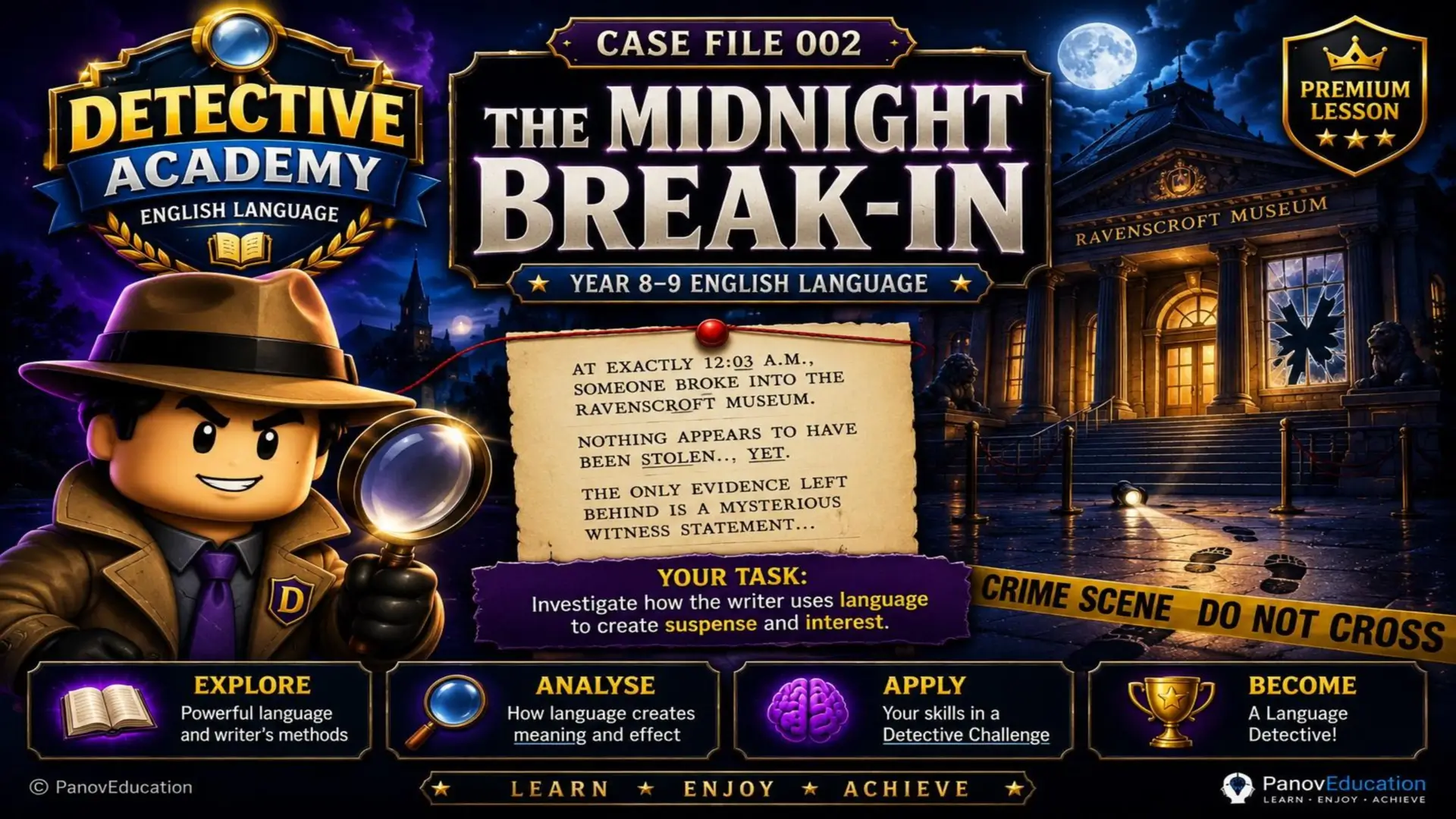
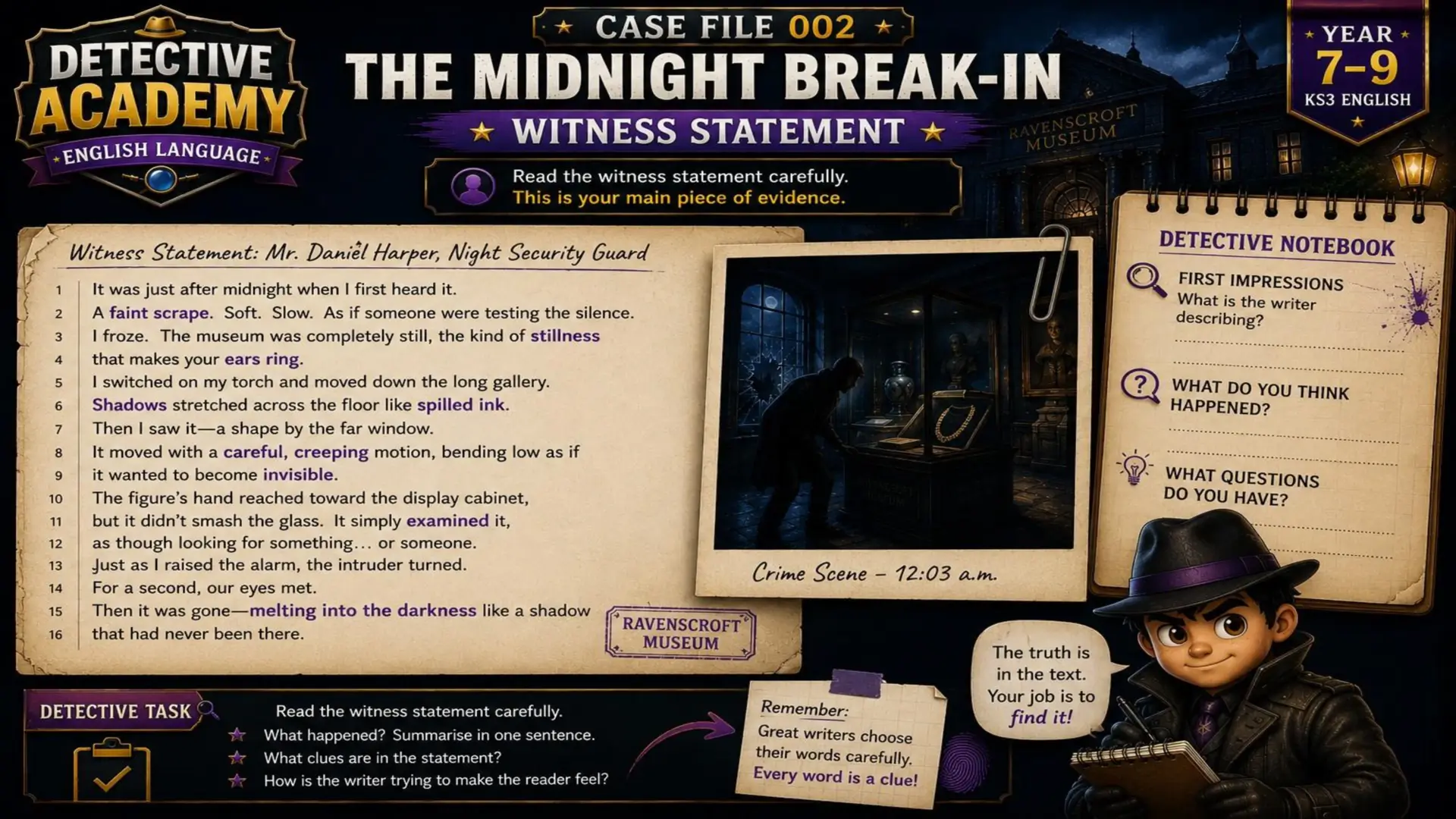
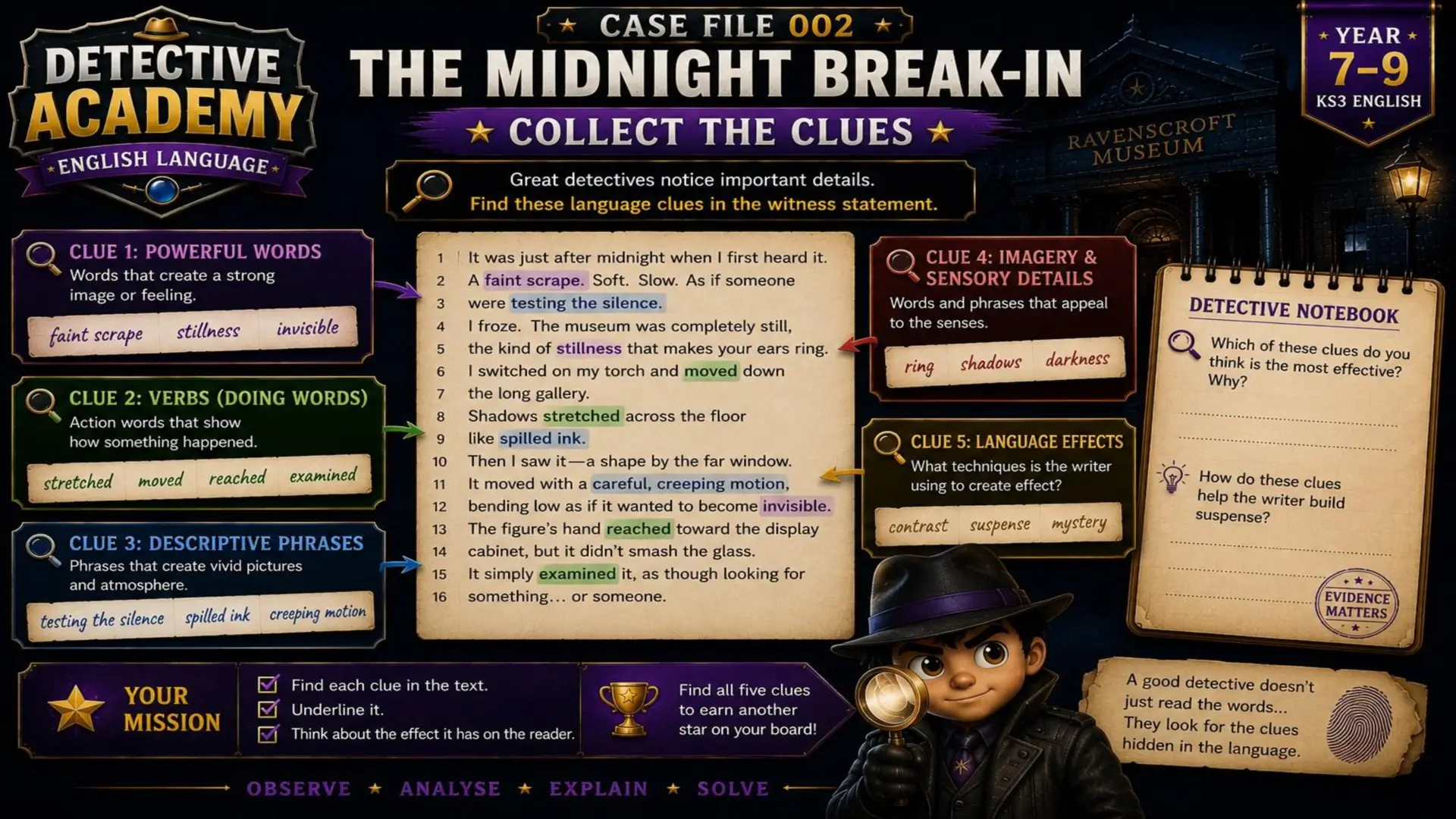
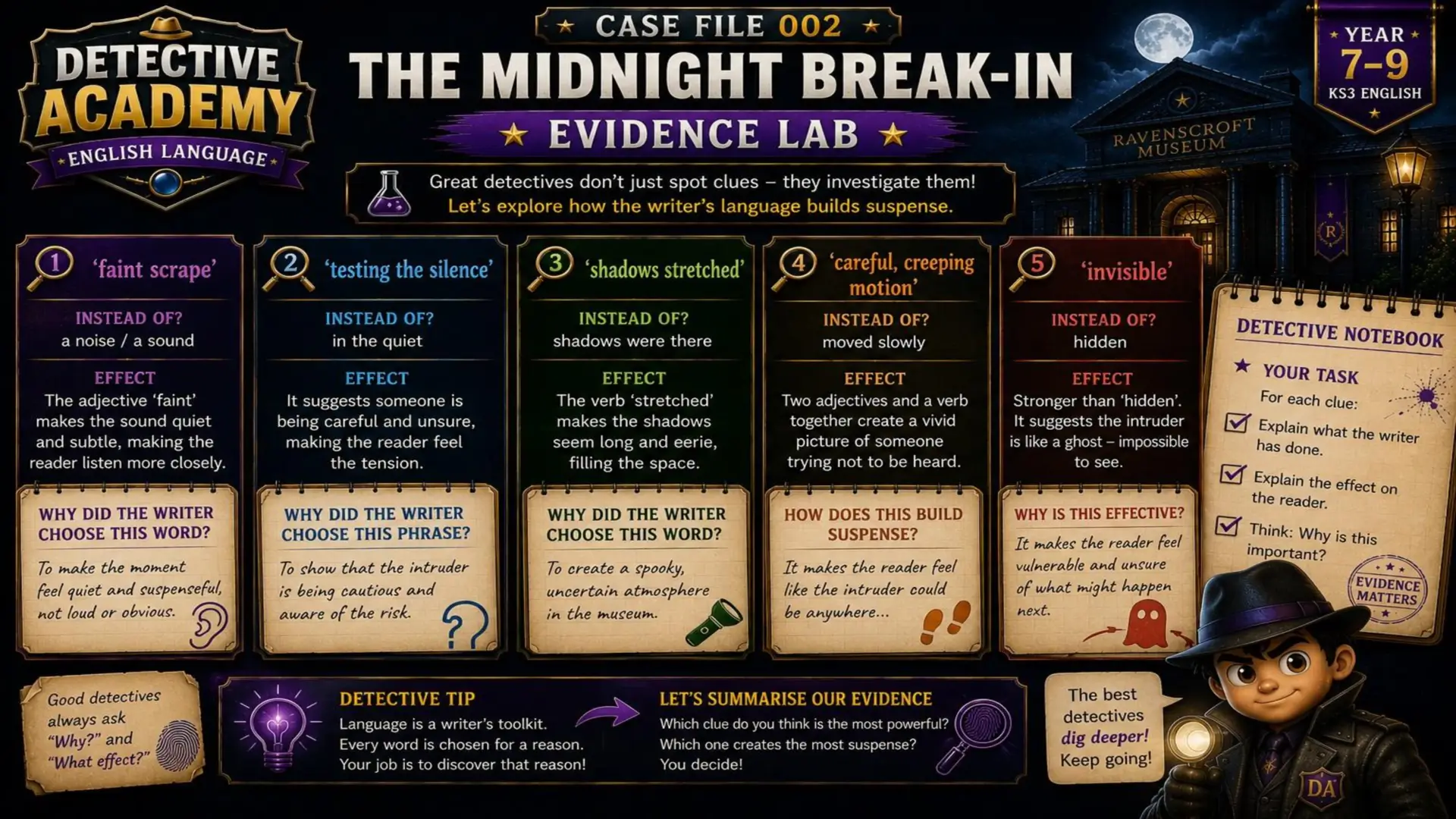
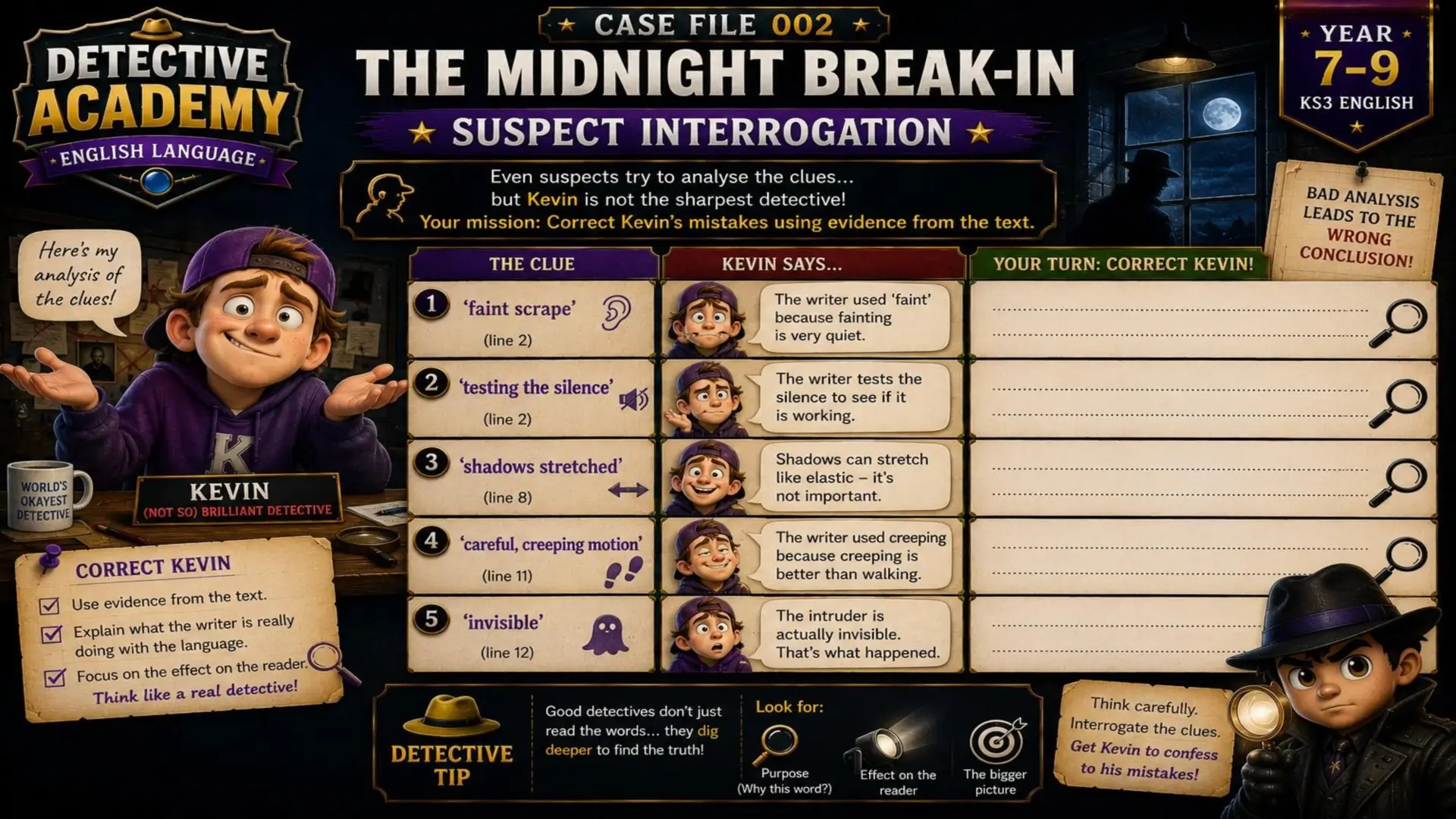
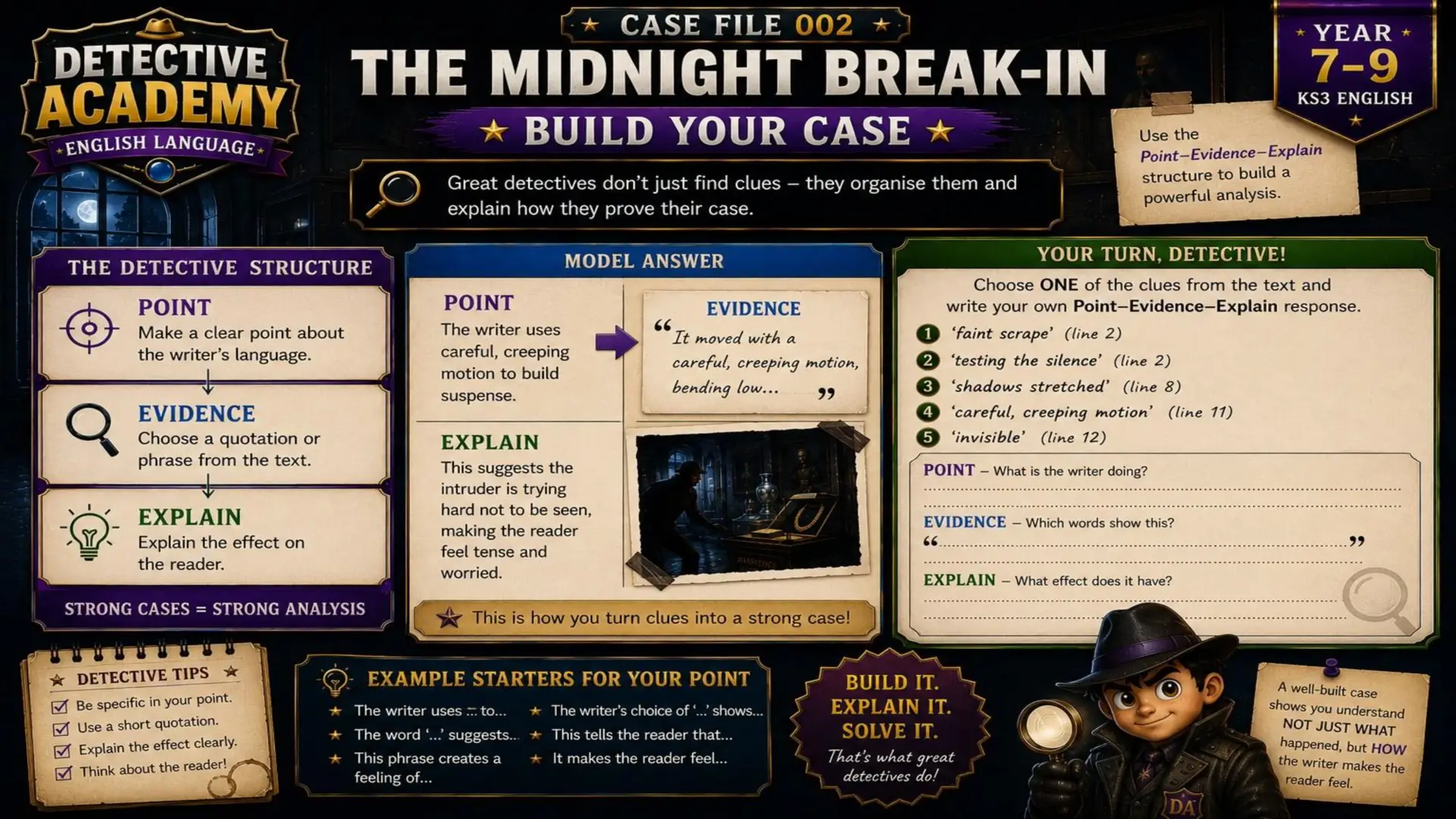
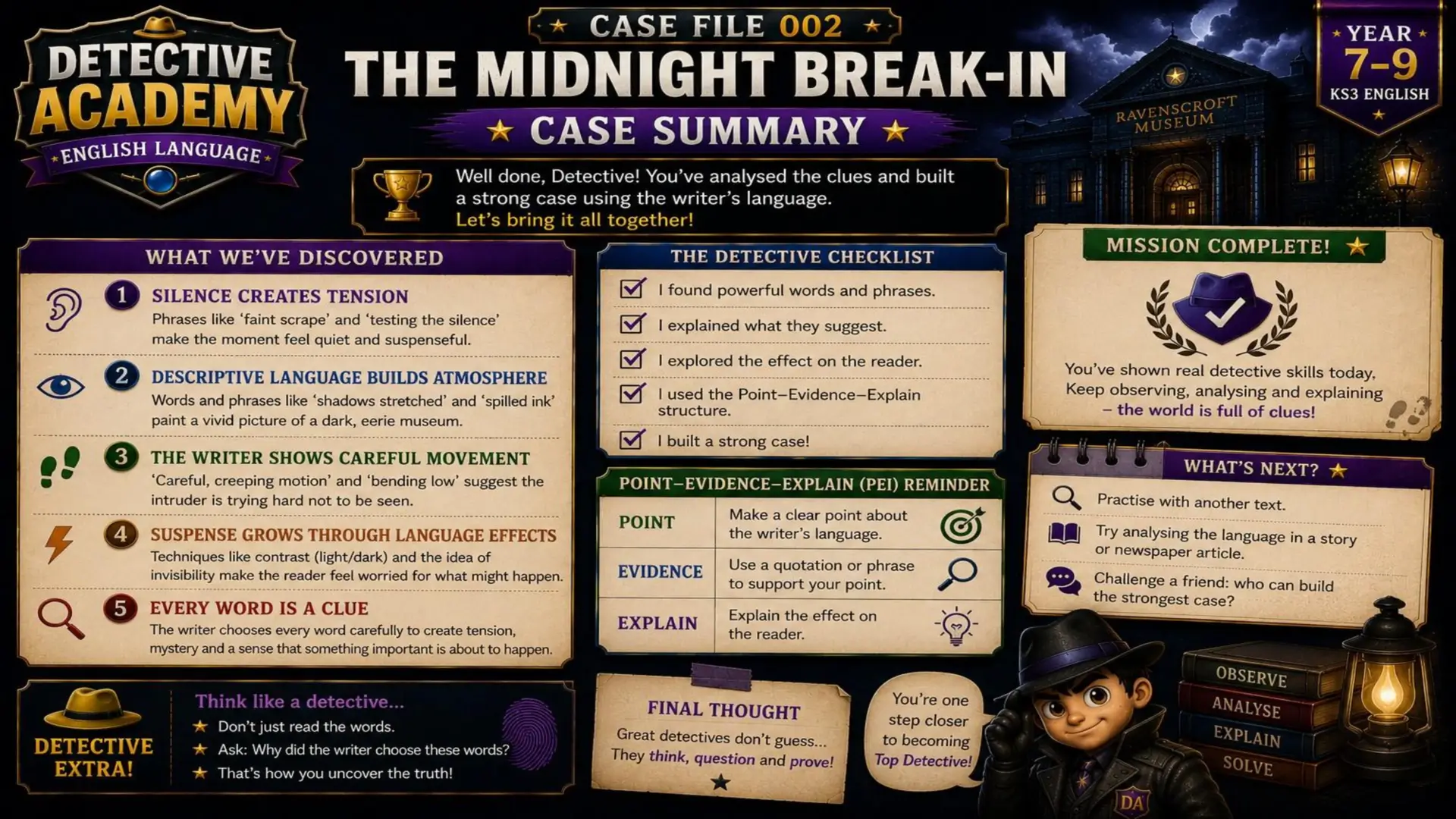
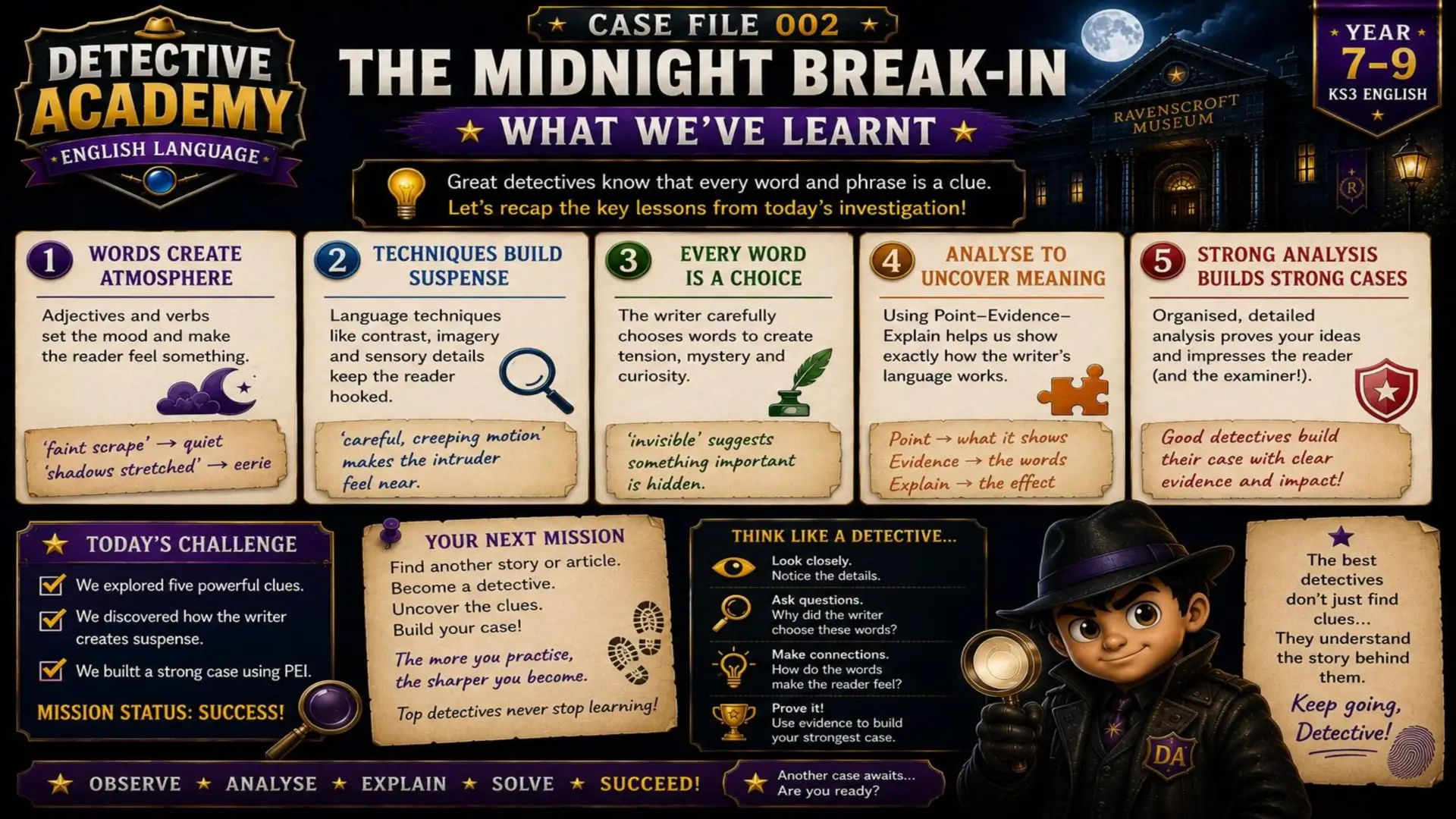
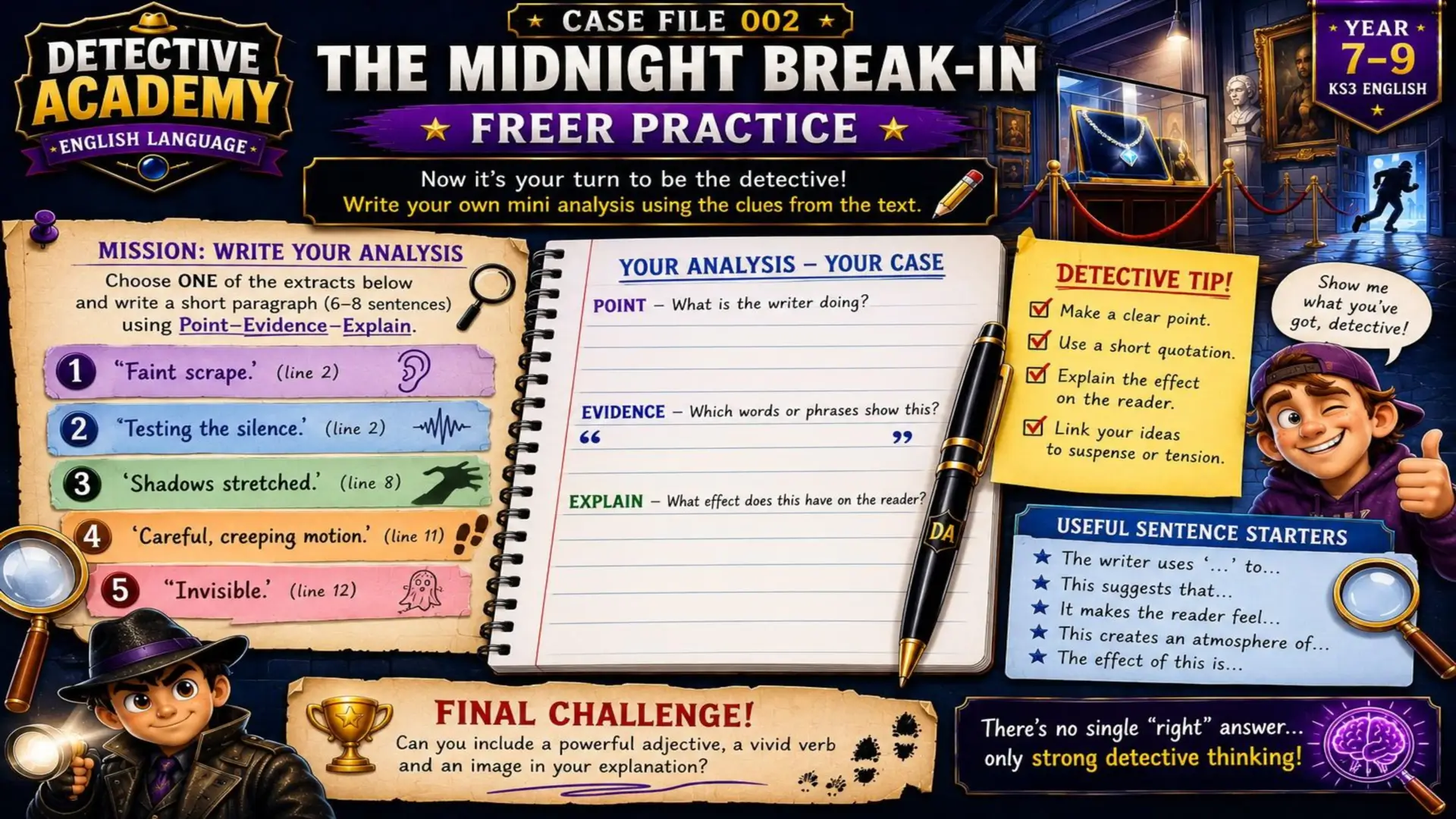
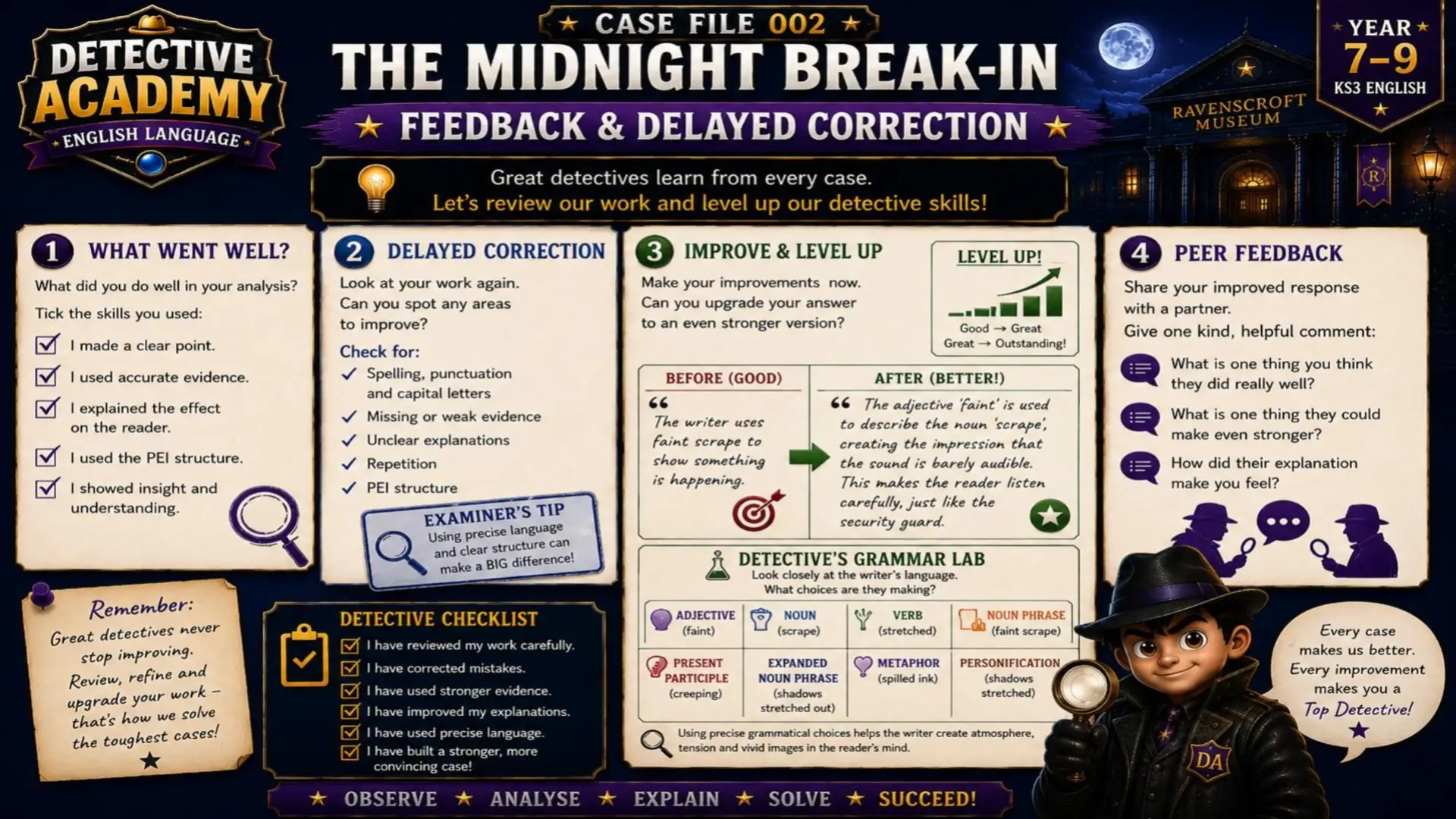
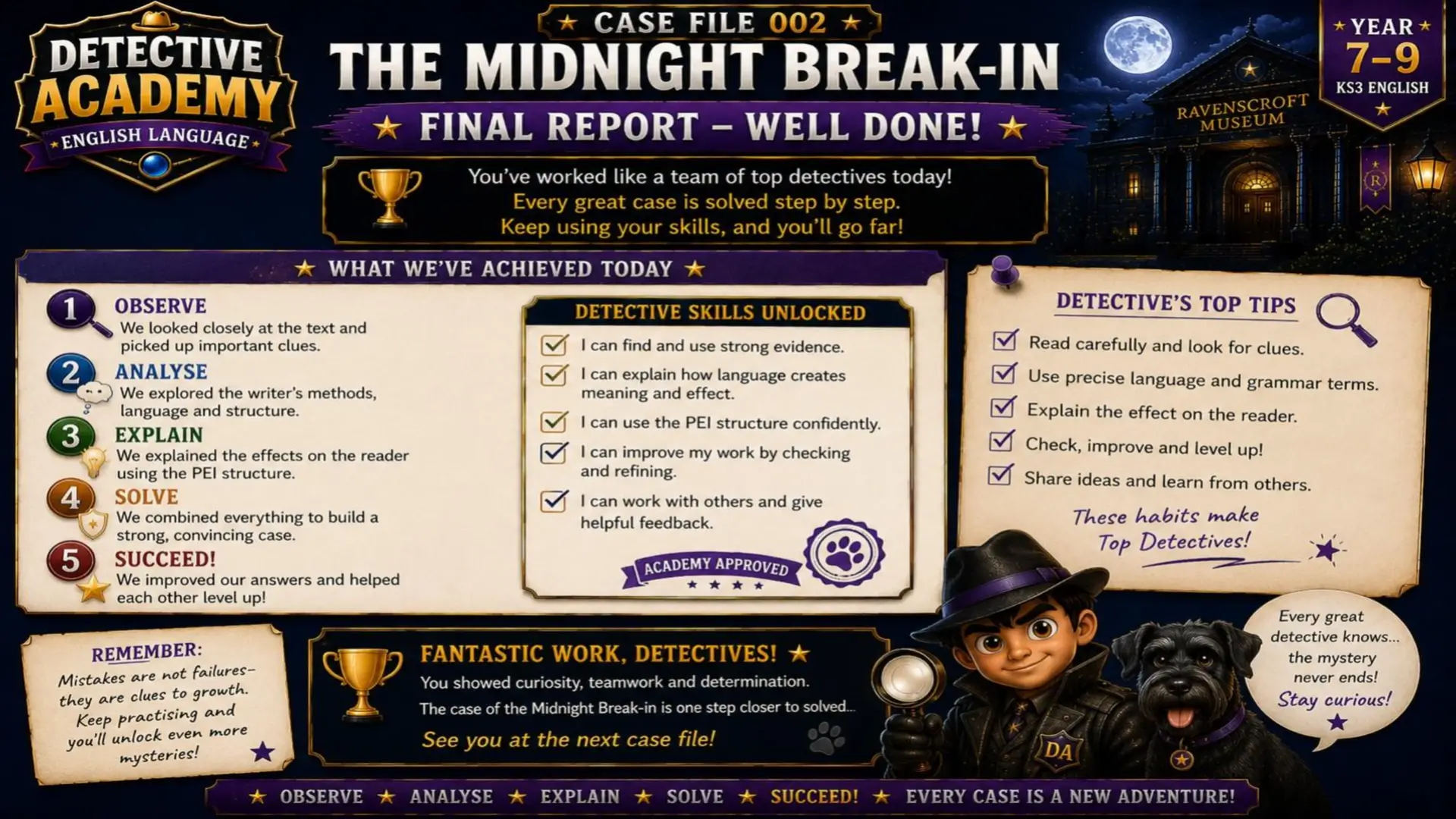
Detective Academy - Case File 002: The Midnight Break In
Topic
English Language – Language Analysis (KS3 Years 7–9)
Students investigate how writers use carefully chosen words and phrases to create atmosphere, suspense and meaning. Through a detective-themed investigation, they learn to identify language techniques, analyse their effects, and construct well-supported analytical responses.
Learning Objectives
By the end of this lesson, learners will be able to:
- Identify and select effective words and phrases from a text.
- Recognise language features such as powerful verbs, adjectives, noun phrases, imagery, metaphor and personification.
- Explain how language choices influence the reader's thoughts and feelings.
- Use accurate subject terminology when discussing a writer's methods.
- Construct analytical responses using the Point–Evidence–Explain (PEI) structure.
- Reflect on, improve and refine their work through self-assessment, peer feedback and delayed correction.
Teaching Methodology
This lesson is built around the PanovEducation Detective Academy™ methodology, an immersive, enquiry-based approach that transforms English Language into a detective investigation.
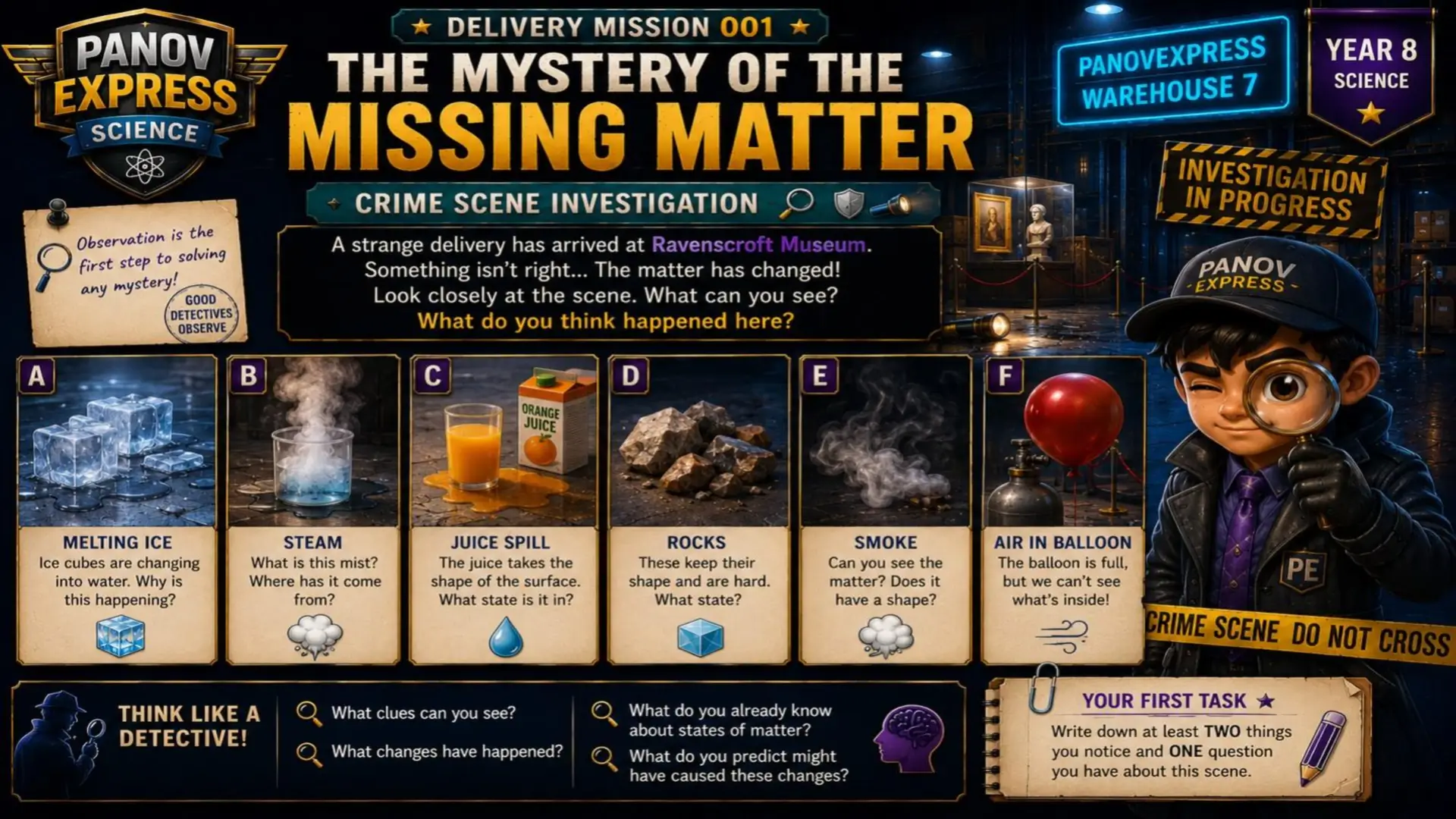
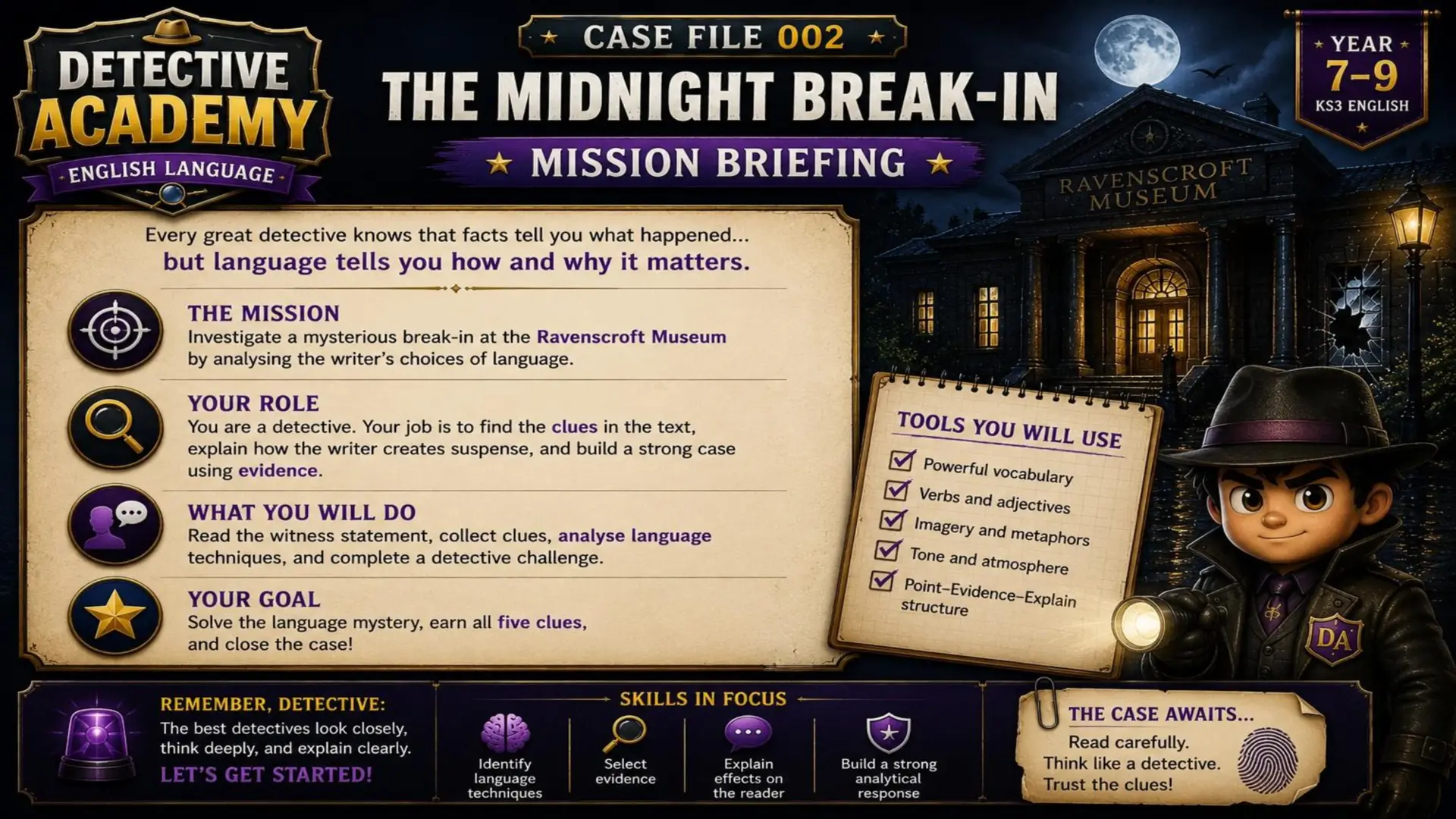
Learners assume the role of detectives investigating a mysterious break-in at Ravenscroft Museum. Rather than simply identifying techniques, they gather evidence, interrogate clues, evaluate a writer's language choices and build a convincing analytical "case" supported by textual evidence.
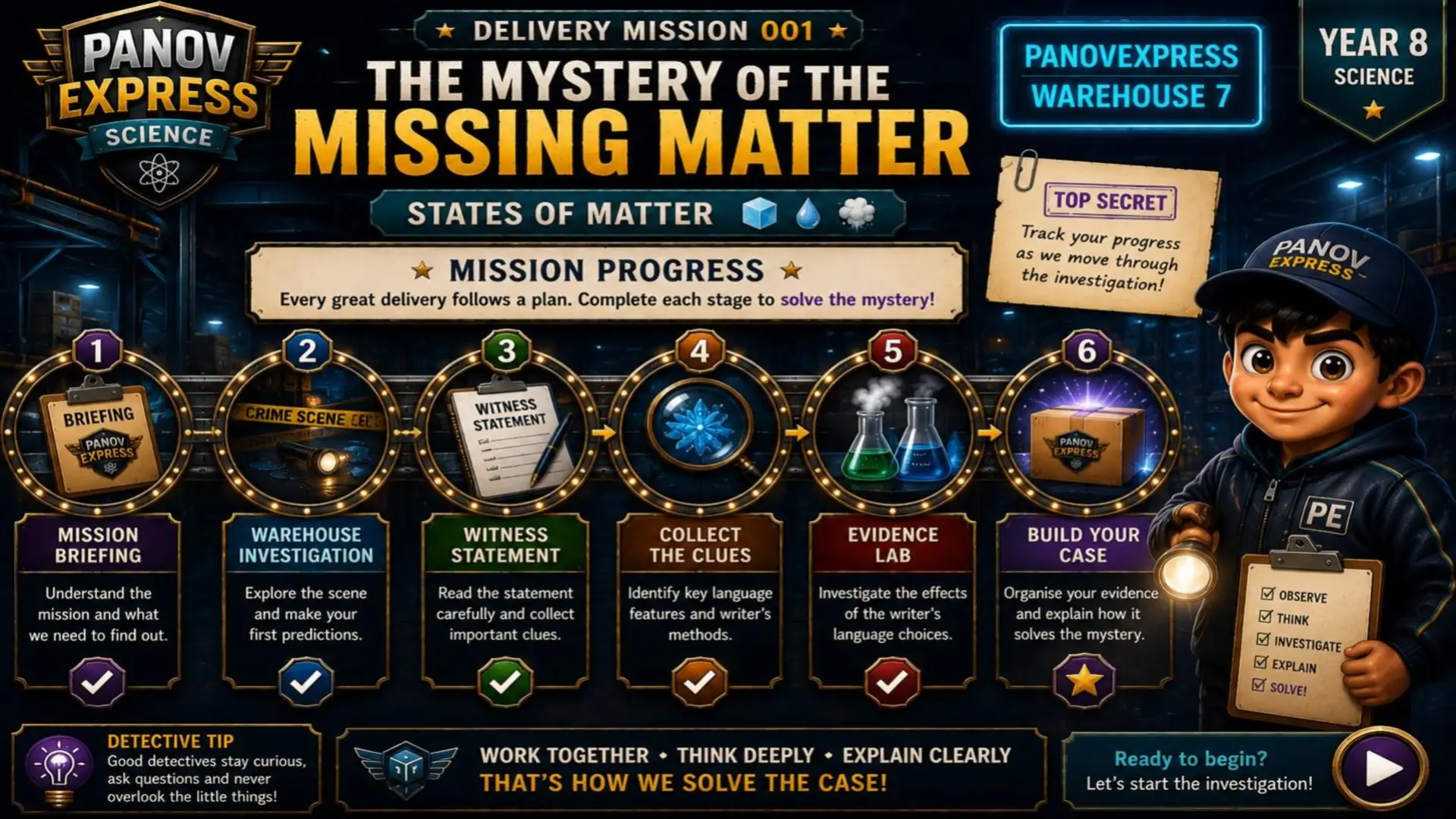
The lesson follows a carefully scaffolded sequence:
- Mission Briefing – establishing the investigation and learning purpose.
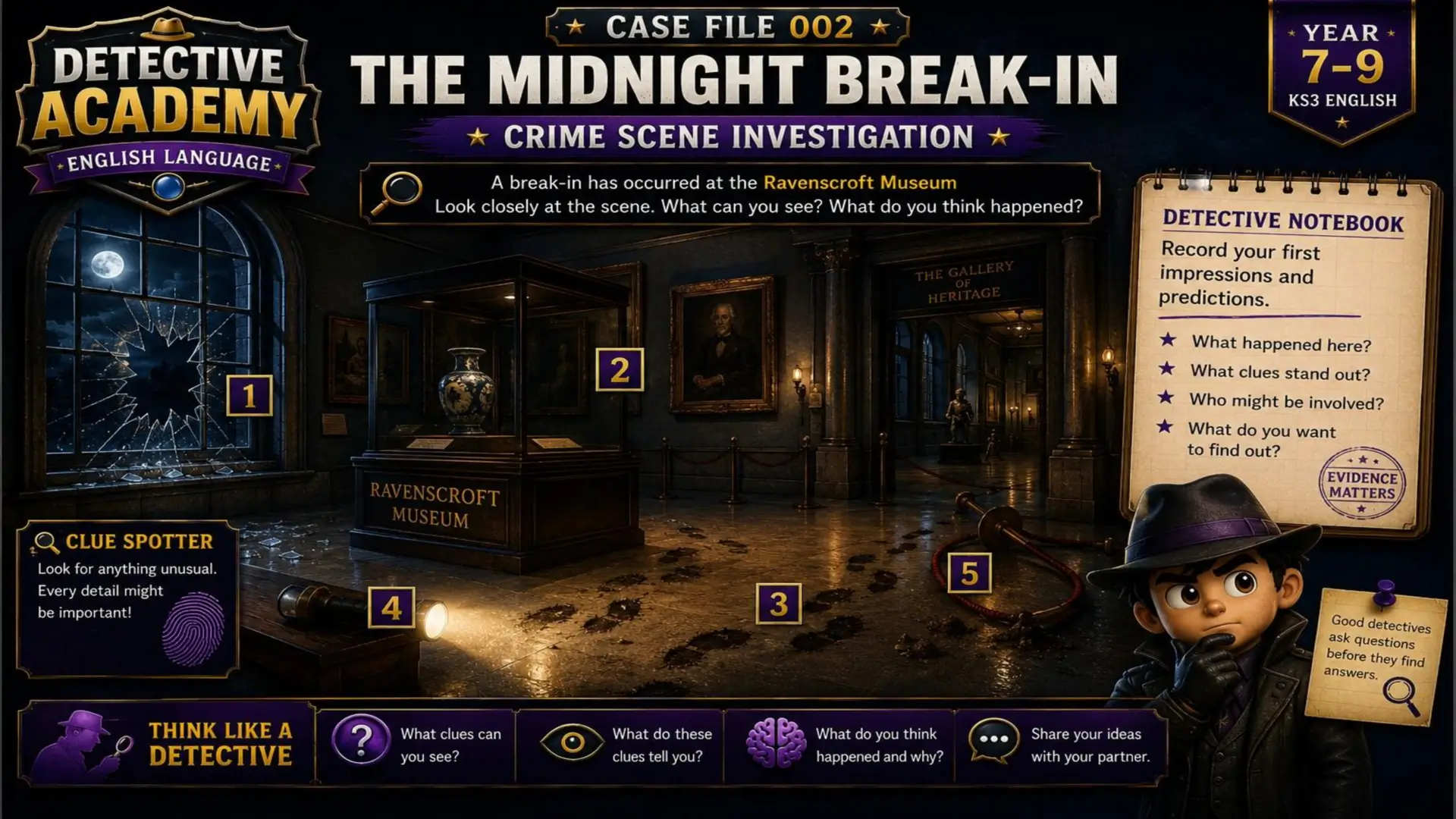
- Crime Scene Investigation – prediction and inference from visual evidence.
- Witness Statement – close reading of the text.
- Collect the Clues – identifying language features and writer's methods.
- Evidence Lab – exploring the effects of specific language choices.
- Suspect Interrogation – correcting misconceptions through discussion.
- Build Your Case – modelling and applying the Point–Evidence–Explain structure.
- Independent Detective Challenge – extended analytical writing.
- Feedback & Delayed Correction – refining responses using precise grammatical and literary terminology.
- Final Report – reflection, celebration of achievement and consolidation of learning.
The lesson combines explicit teaching, guided practice, independent application, retrieval, metacognition, and peer collaboration within a highly engaging narrative. By placing learners in the role of investigators, complex analytical skills become purposeful, memorable and enjoyable while maintaining high academic expectations.
Estimated lesson duration: 60–75 minutes
Suitable for: Years 7–9 (adaptable for GCSE Foundation and Higher)
Curriculum focus: Reading, language analysis, analytical writing, grammar and subject terminology, feedback and self-improvement.
Preview the lesson in the next tab or Download it as .PPTX.
Mathematics – Battle Royale
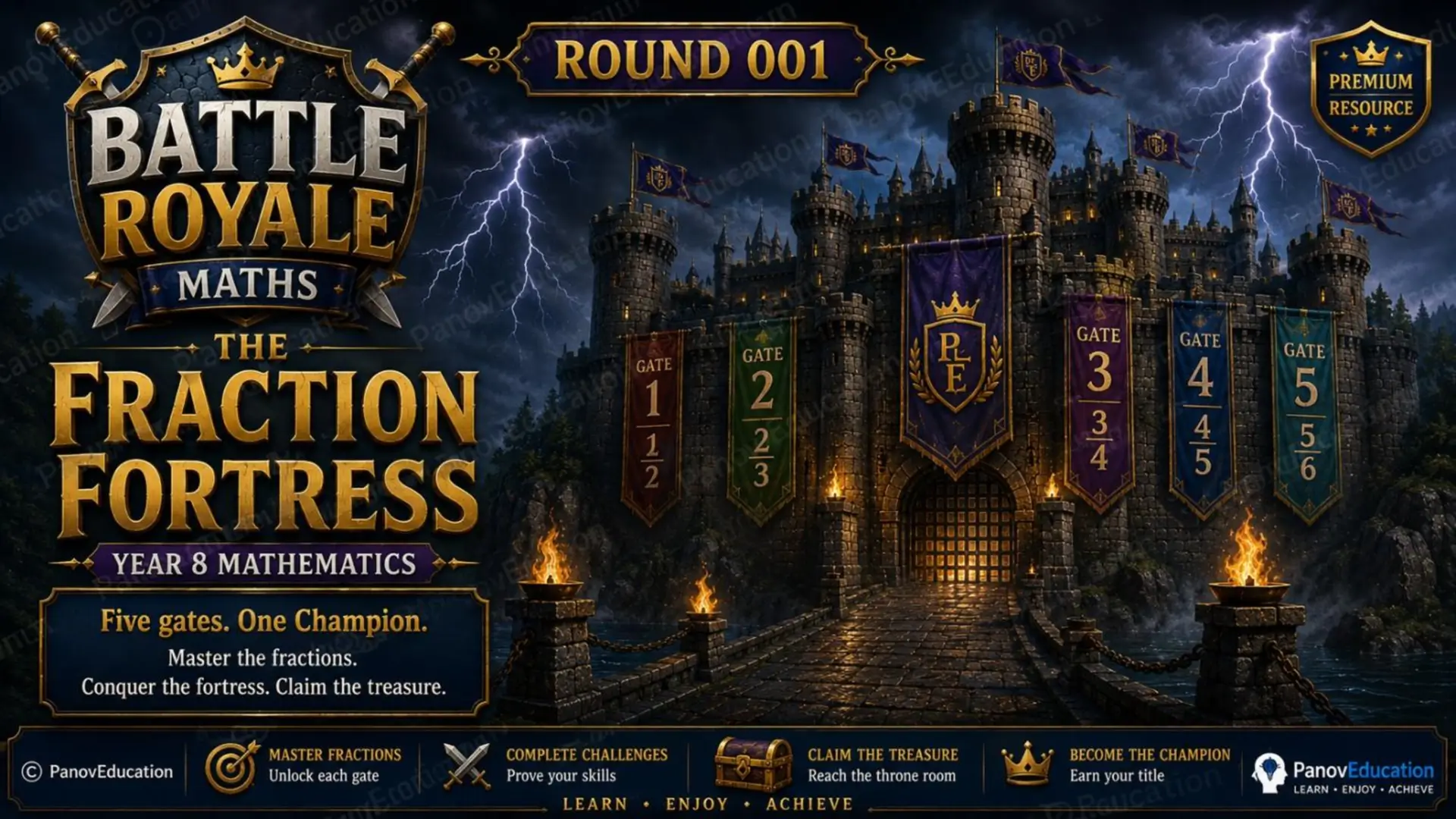
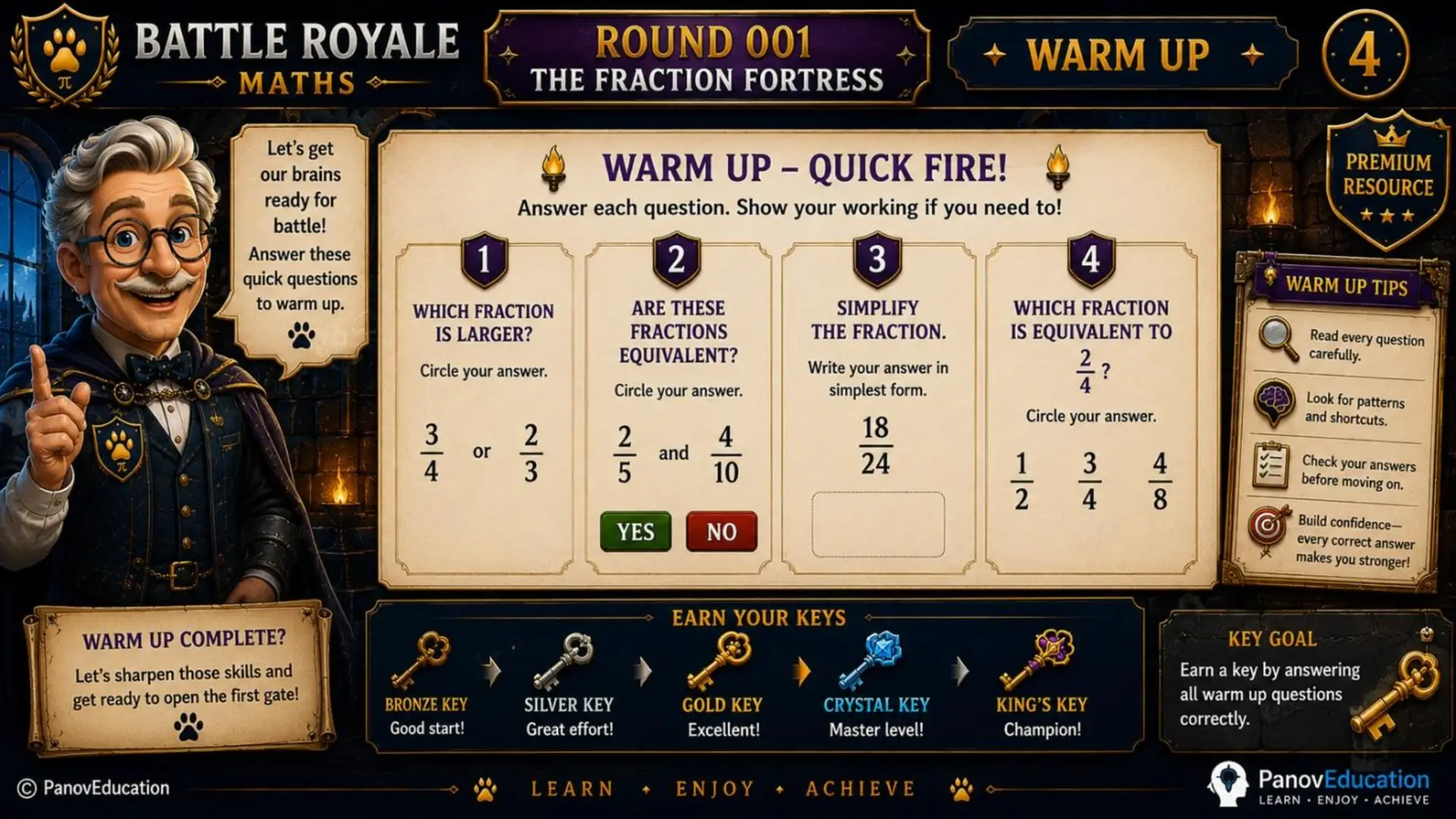
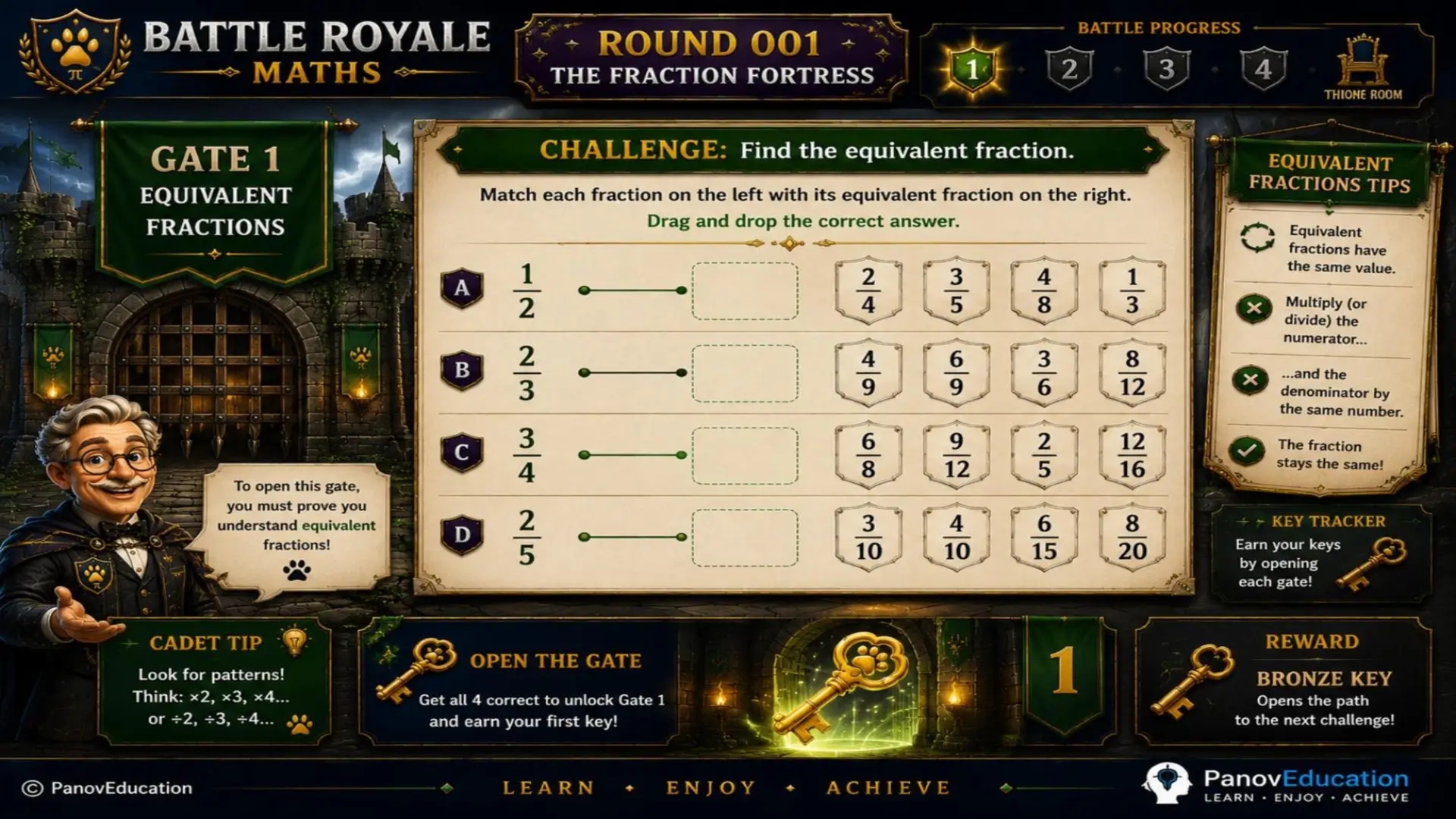
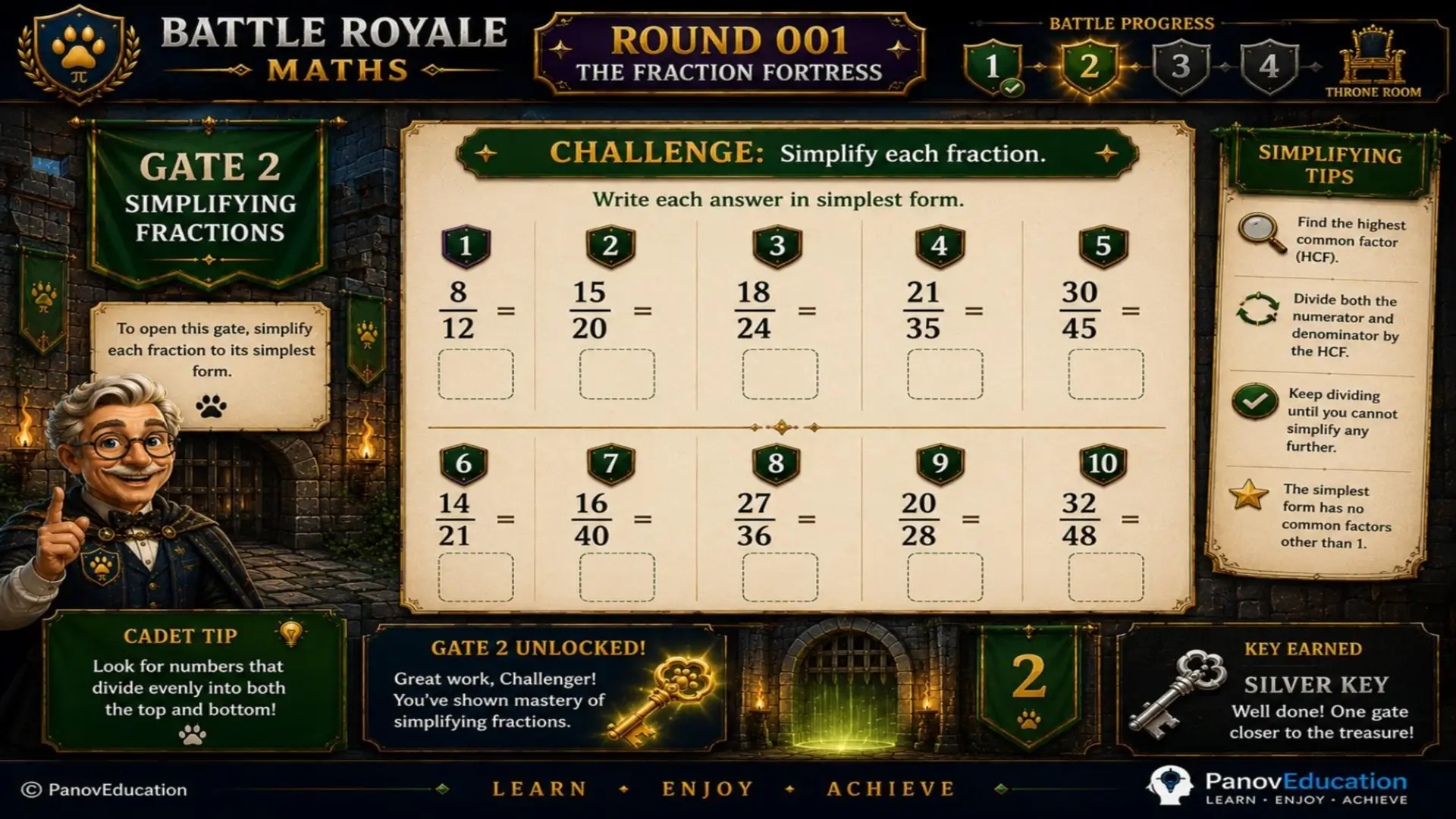
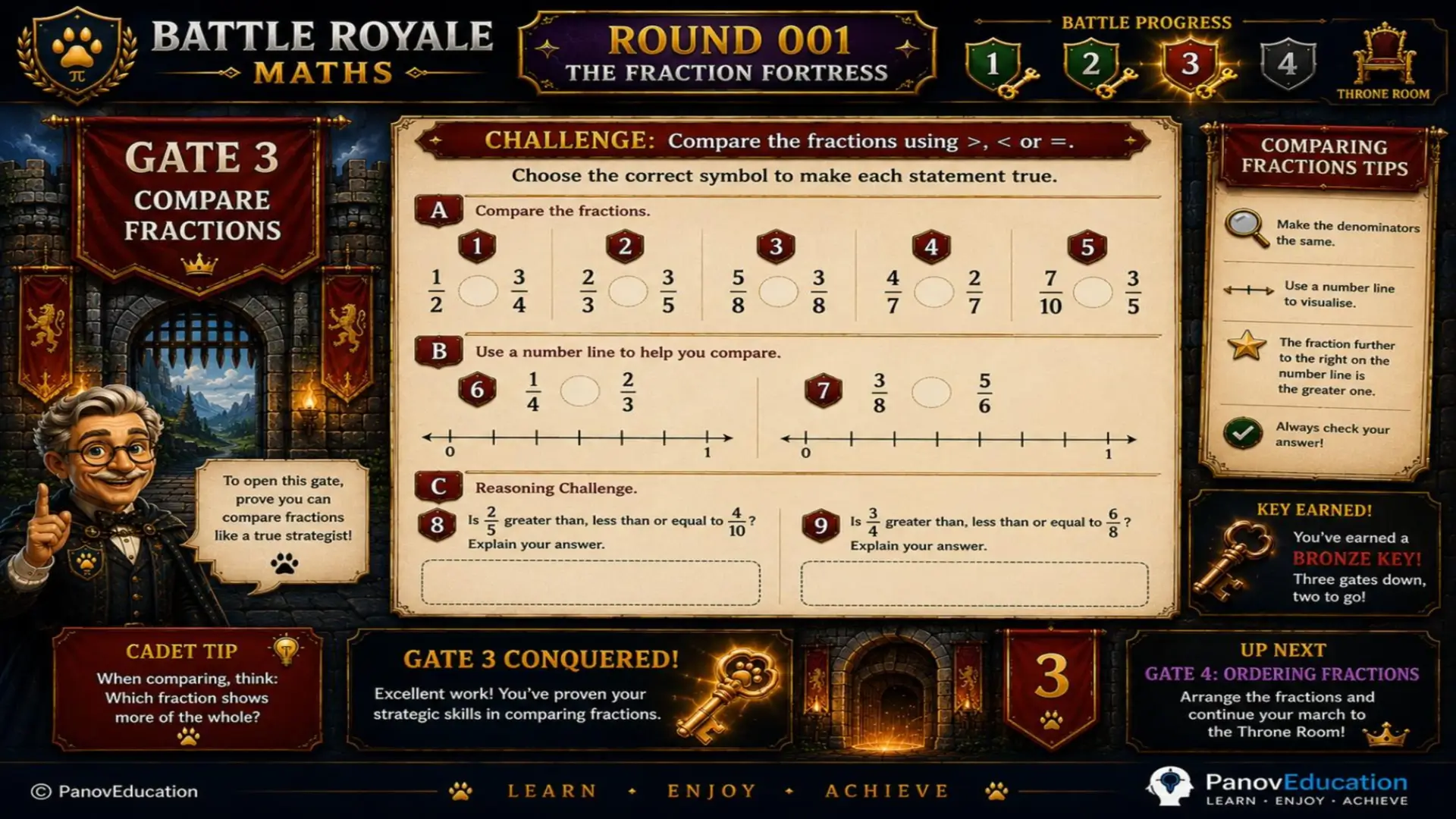
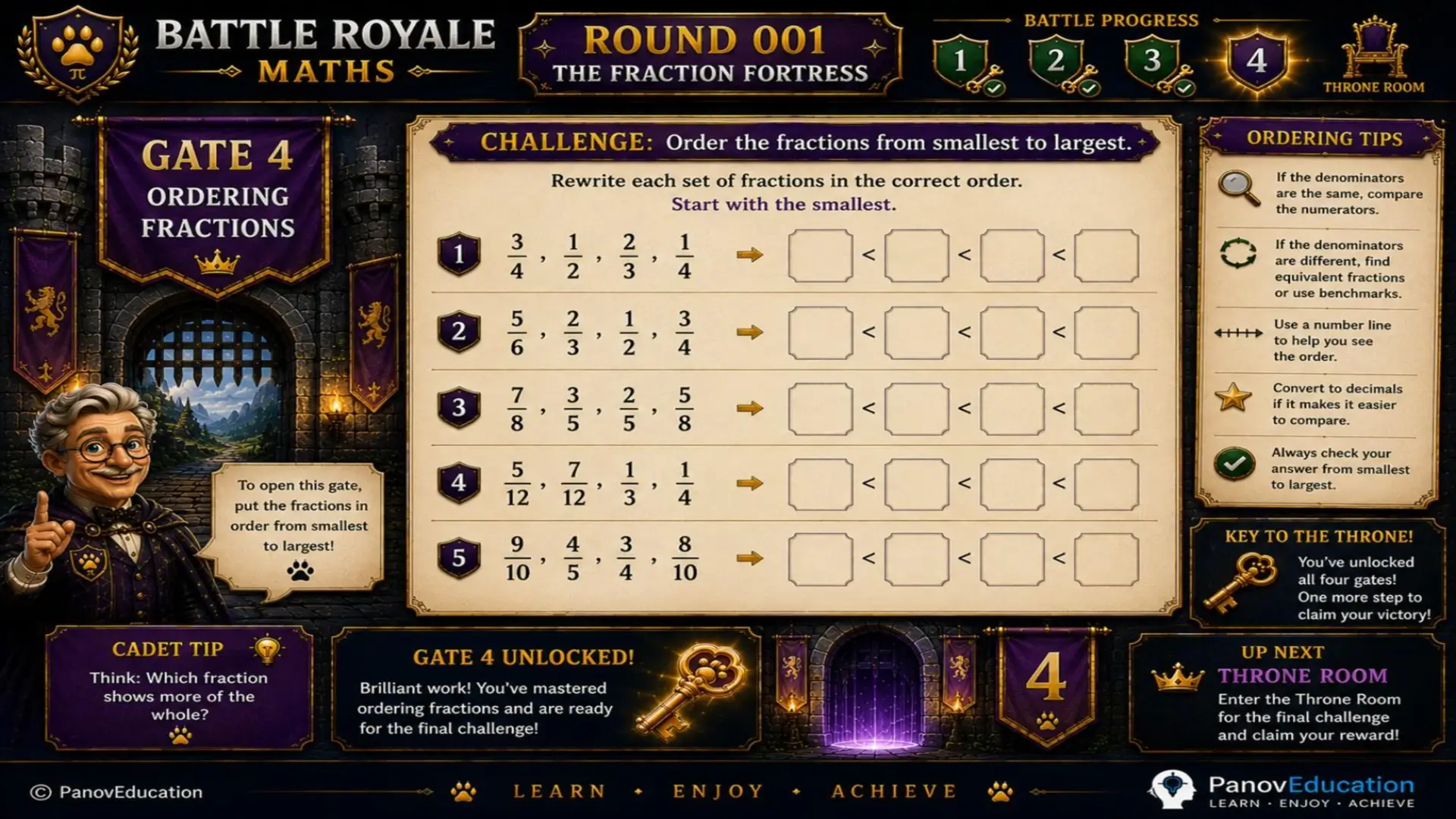
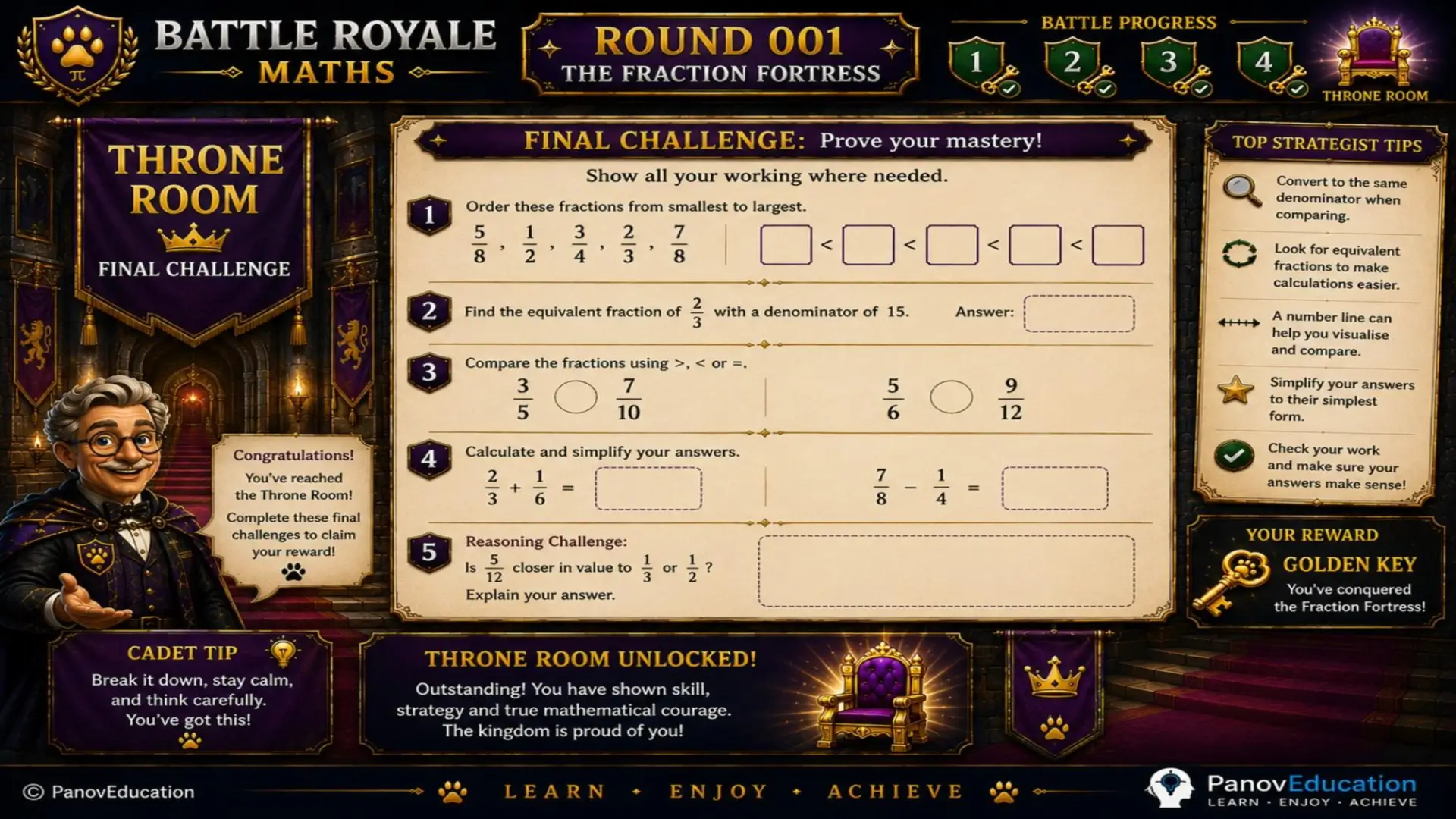
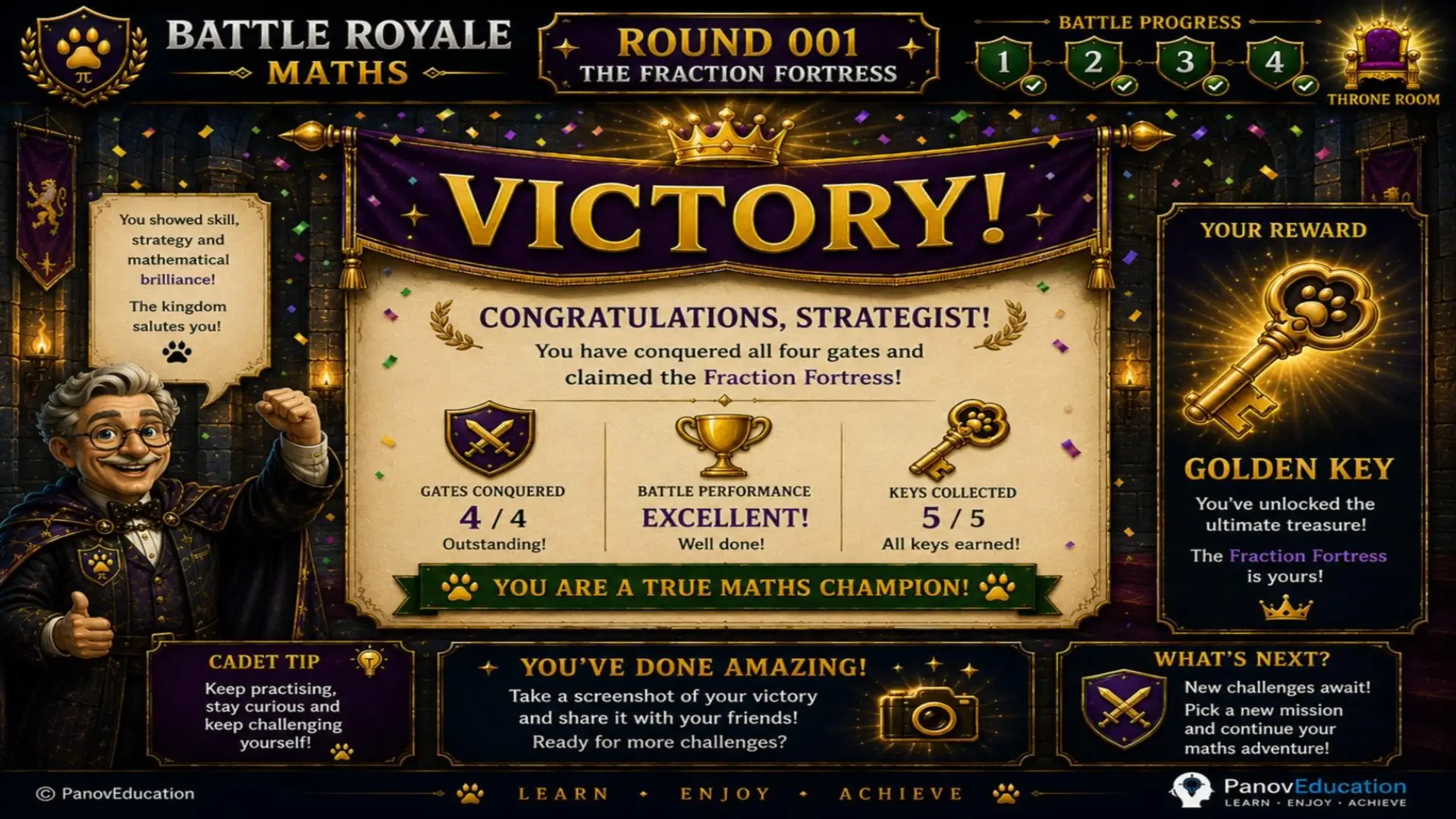
Battle Royale Maths - Round 001: The Fraction Fortress
Subject
Mathematics
Age Group
Year 8 (also suitable for Year 7 revision and Year 9 intervention)
Topic
Fractions
Learning Objectives
By the end of this lesson, learners will be able to:
- Identify and generate equivalent fractions.
- Simplify fractions to their lowest terms.
- Compare fractions using mathematical reasoning.
- Order fractions from smallest to largest.
- Solve mixed fraction problems confidently.
- Explain mathematical thinking using appropriate vocabulary.
Curriculum Links
Aligned with the English National Curriculum (Key Stage 3 Mathematics).
Teaching Methodology
This lesson is built using the PanovEducation Battle Royale™ methodology, where mathematics is taught through an immersive, game-inspired adventure.
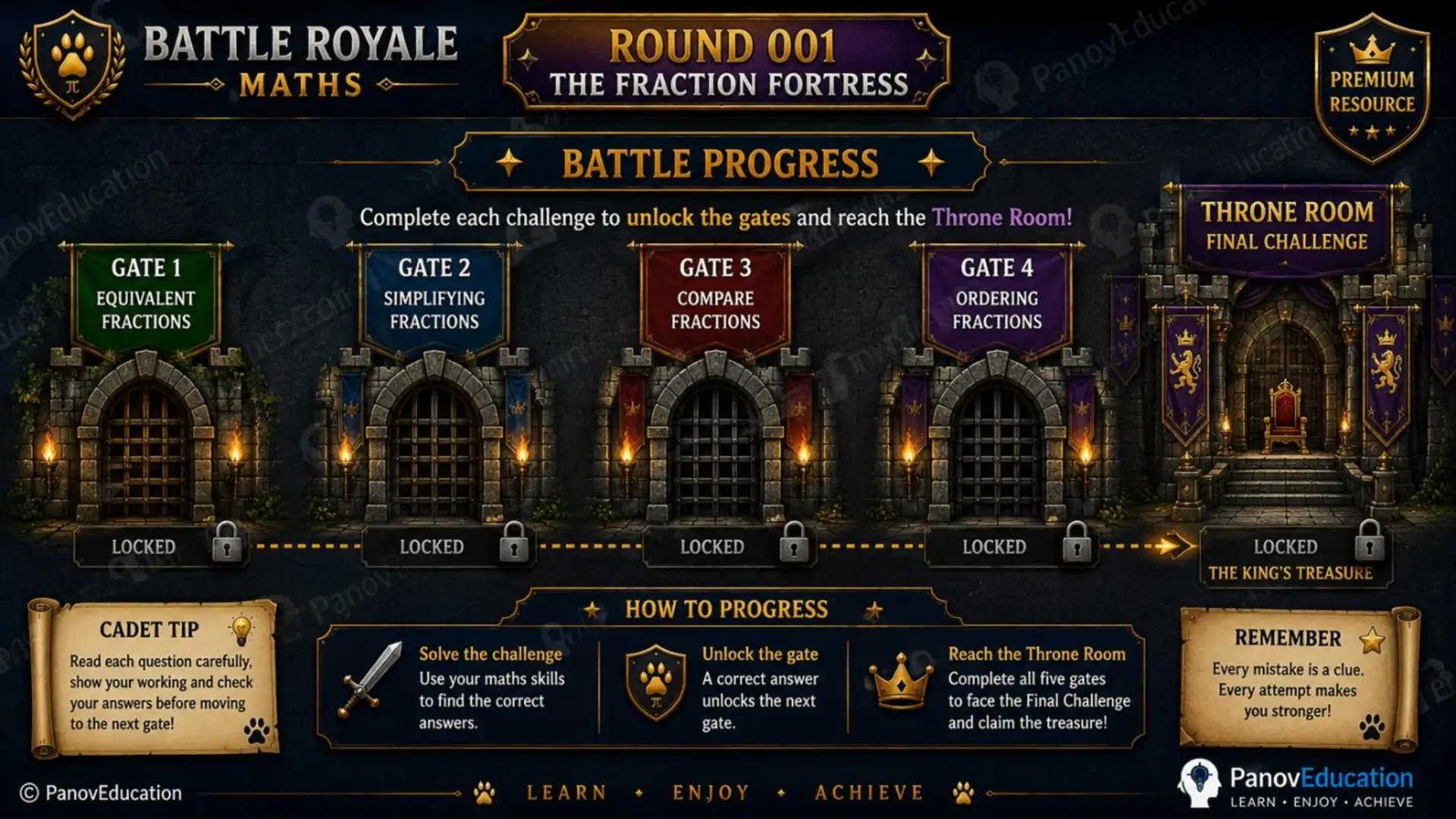
Learners progress through a series of themed "gates", each representing a key mathematical skill. Every completed challenge unlocks the next stage, encouraging persistence, independent thinking and a growth mindset. The lesson combines explicit instruction, guided practice, retrieval activities, reasoning tasks and immediate application within a motivating narrative framework.
Skills Developed:
- Fluency
- Mathematical reasoning
- Problem solving
- Independent learning
- Accuracy and checking strategies
- Resilience and confidence
Lesson Structure:
- Warm-Up Challenge
- Gate 1 – Equivalent Fractions
- Gate 2 – Simplifying Fractions
- Gate 3 – Comparing Fractions
- Gate 4 – Ordering Fractions
- Throne Room Final Challenge
- Victory Screen & Reflection
Estimated Lesson Length: 45–60 minutes
Resources Required: Pencil, Paper or exercise book
Optional: mini whiteboard
Calculator: not required
Suitable For:
- Classroom teaching
- One-to-one tuition
- Alternative Provision
- Home Education
- Intervention
Preview the lesson in the next tab or Download it as .PPTX.

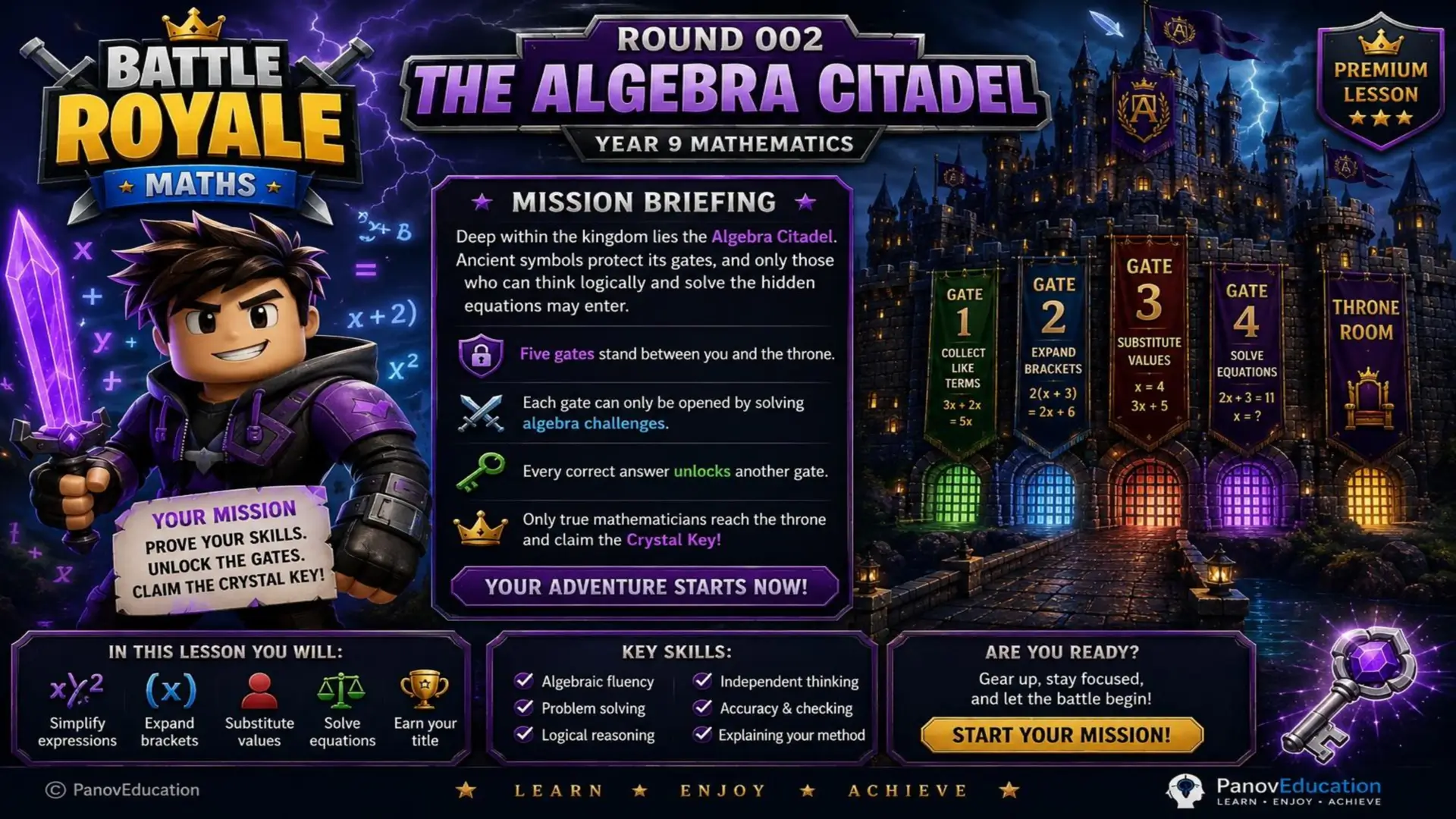
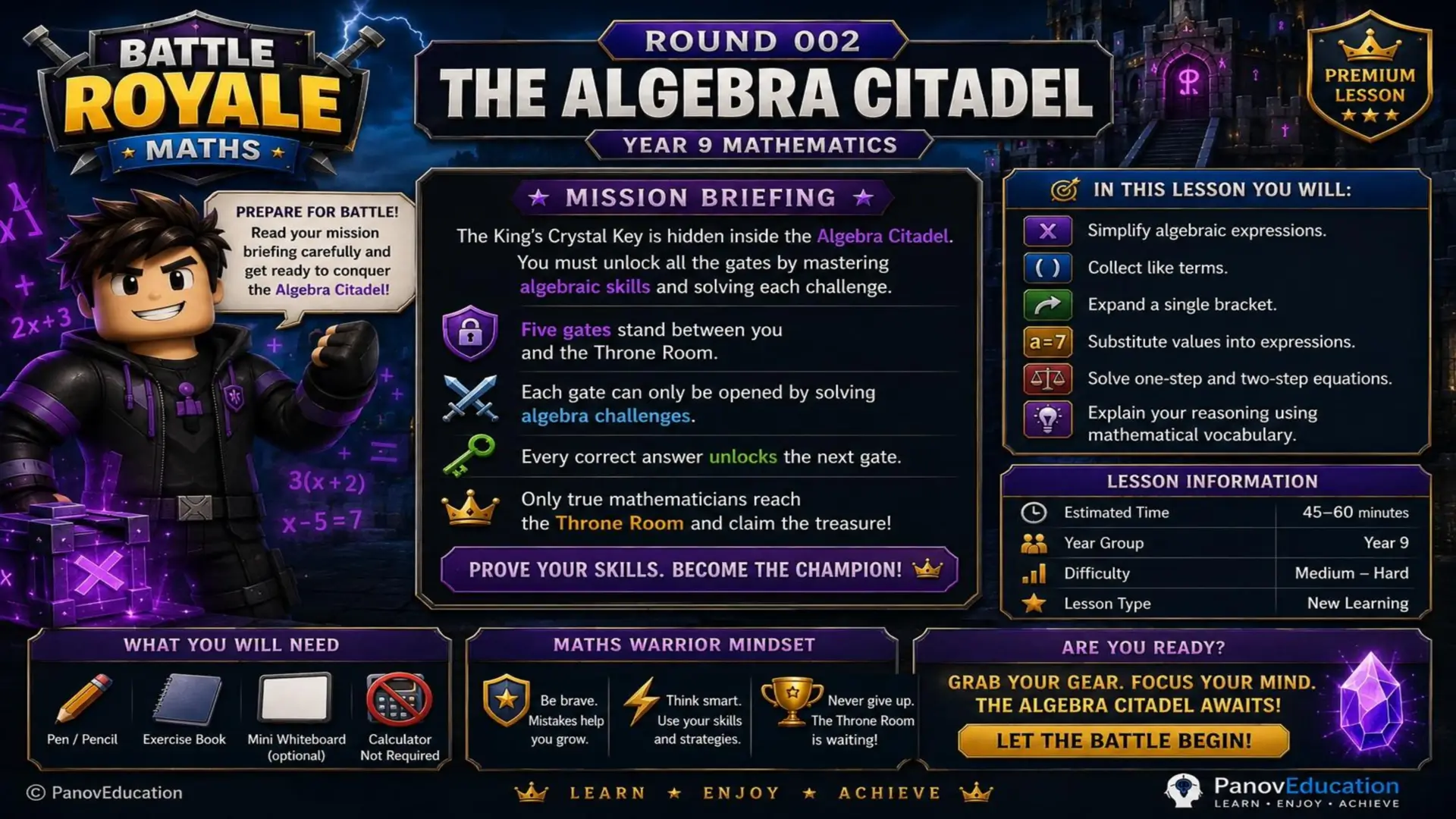
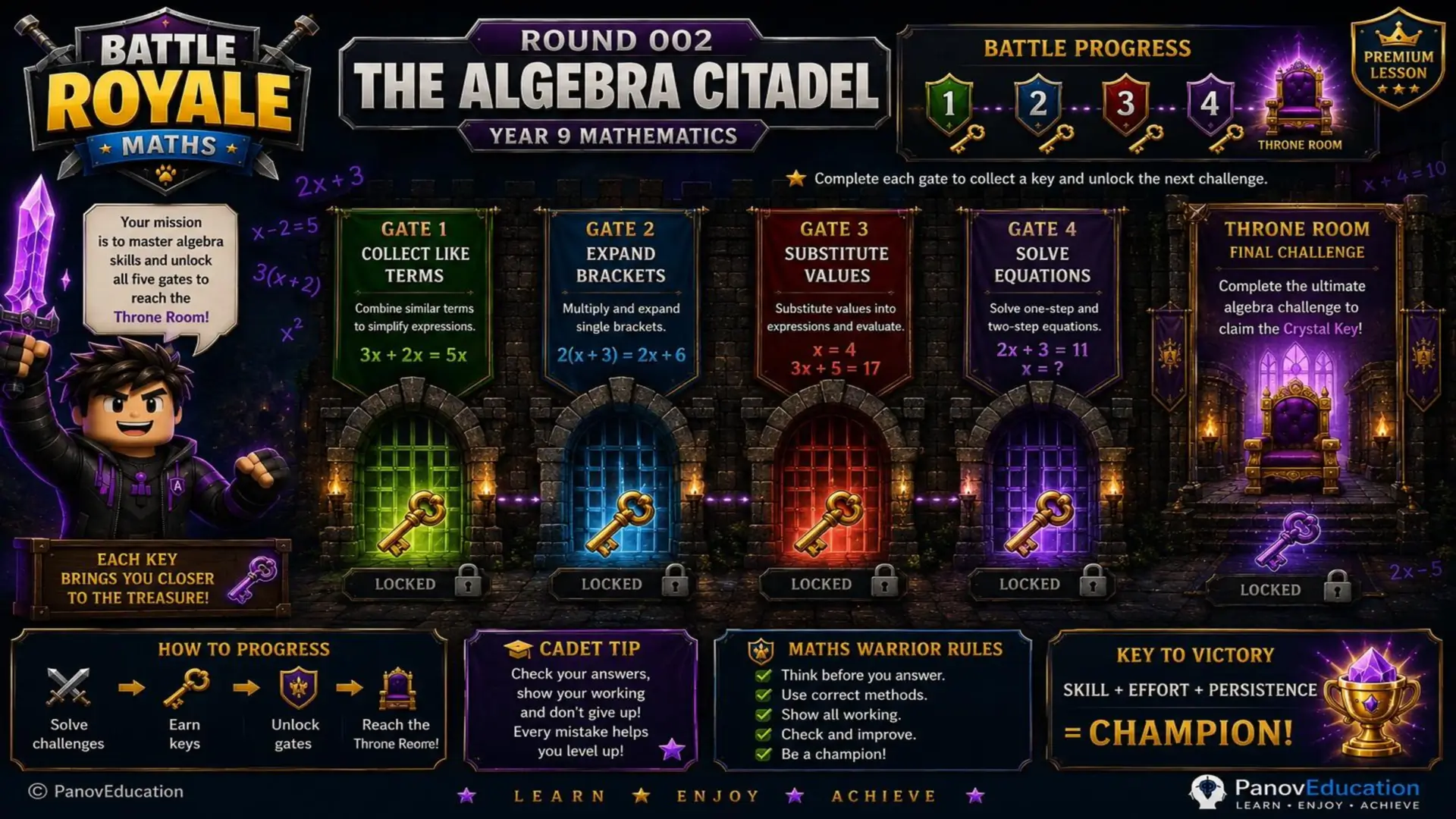
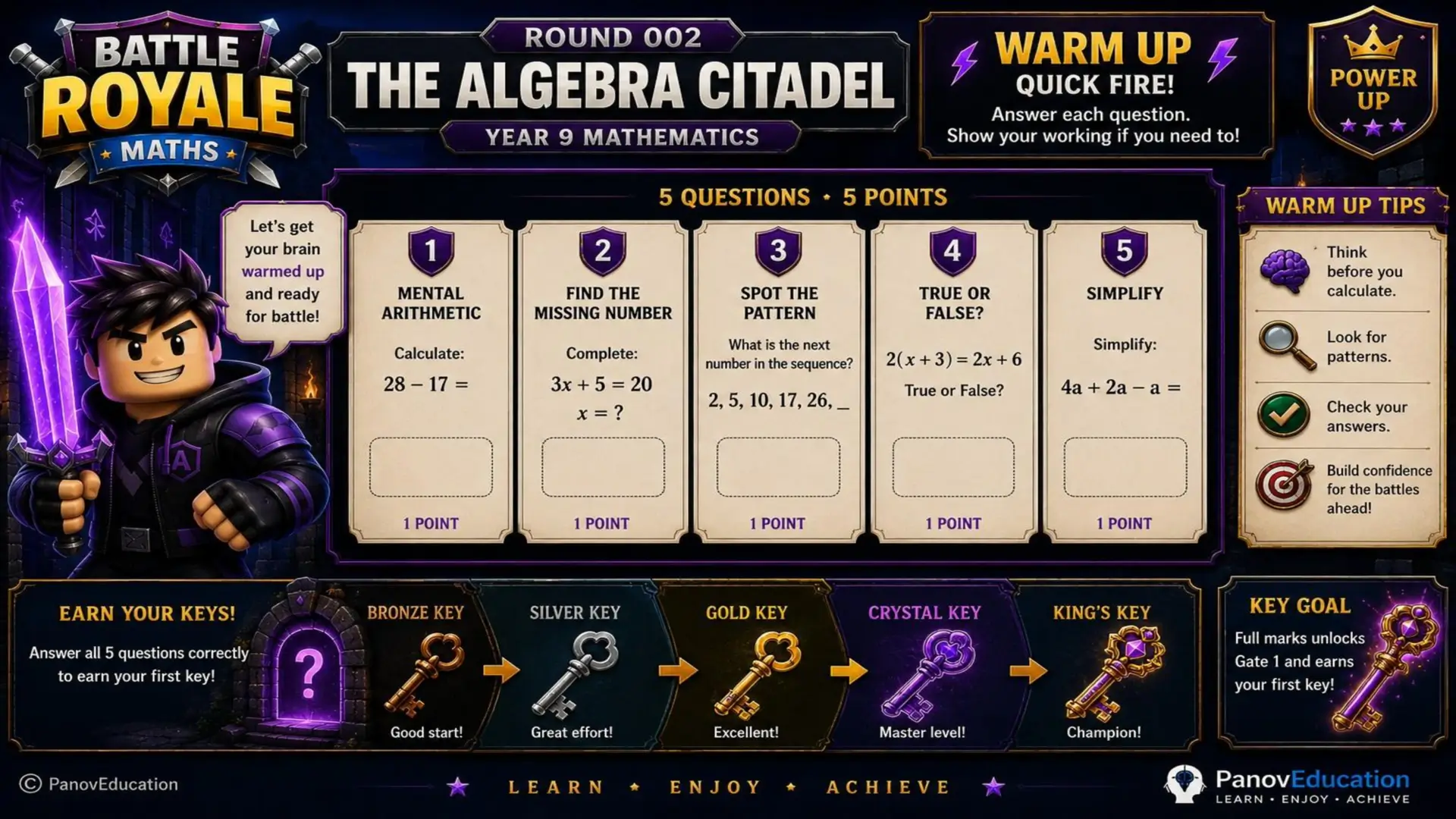
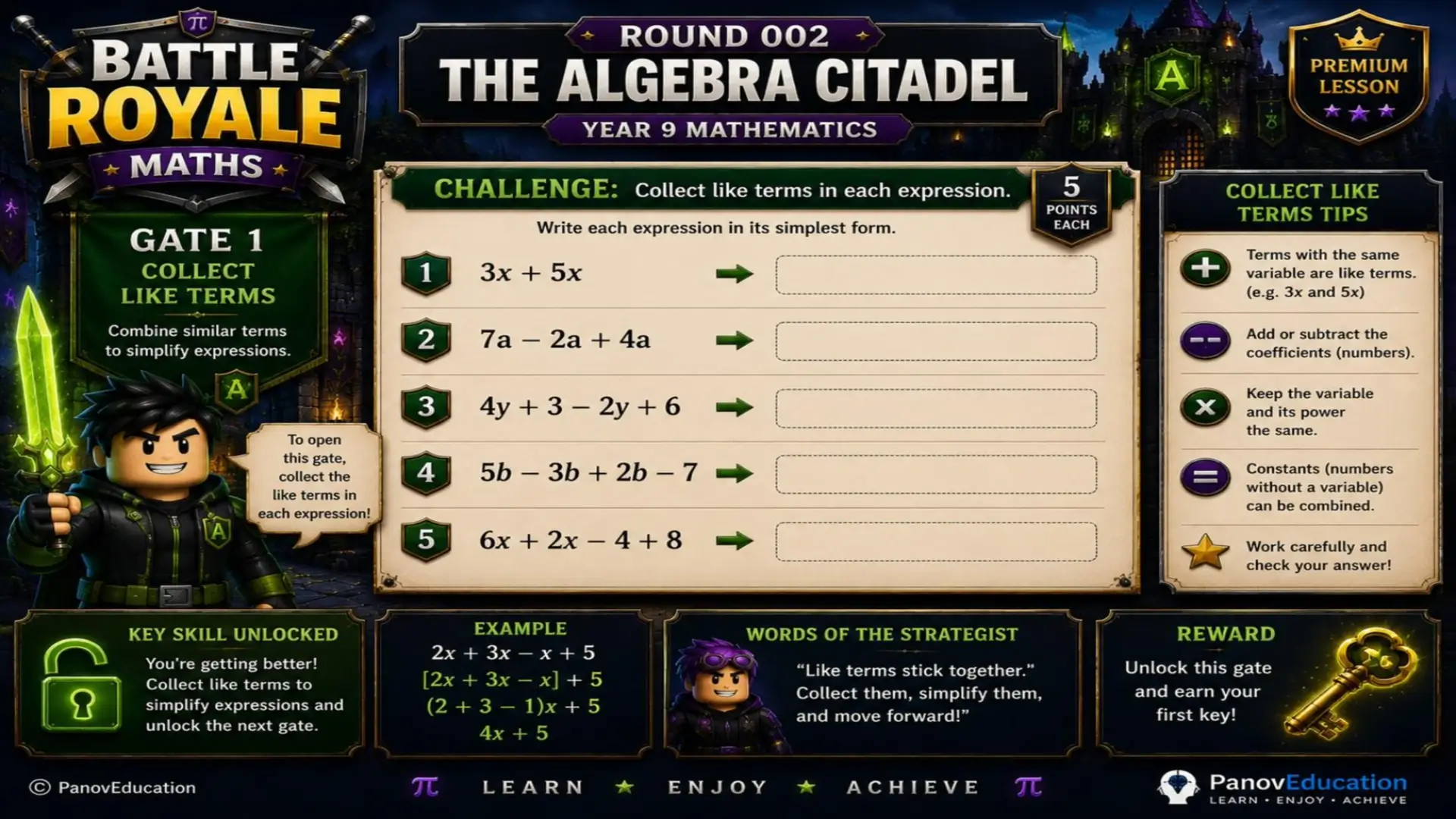
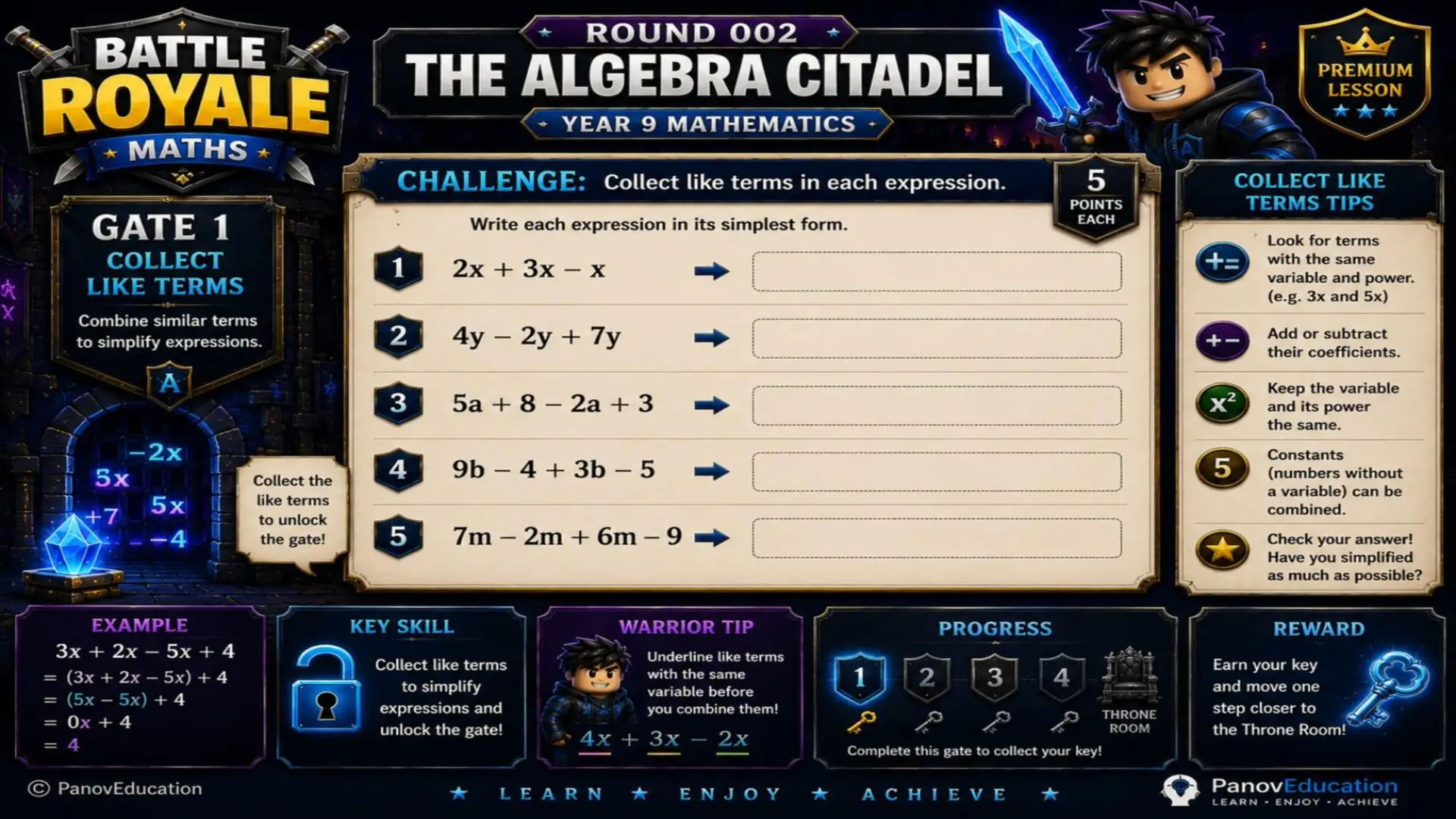
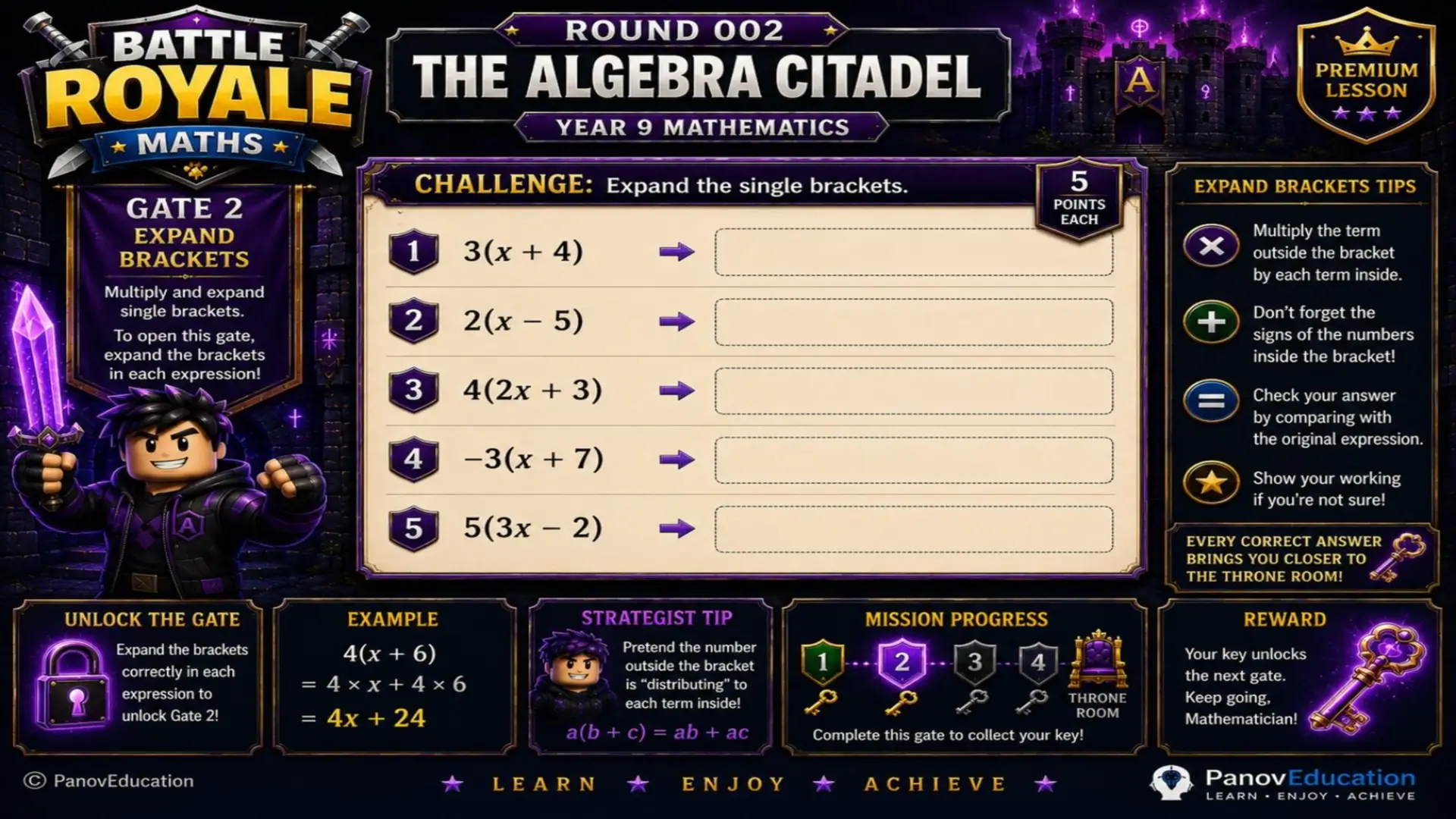
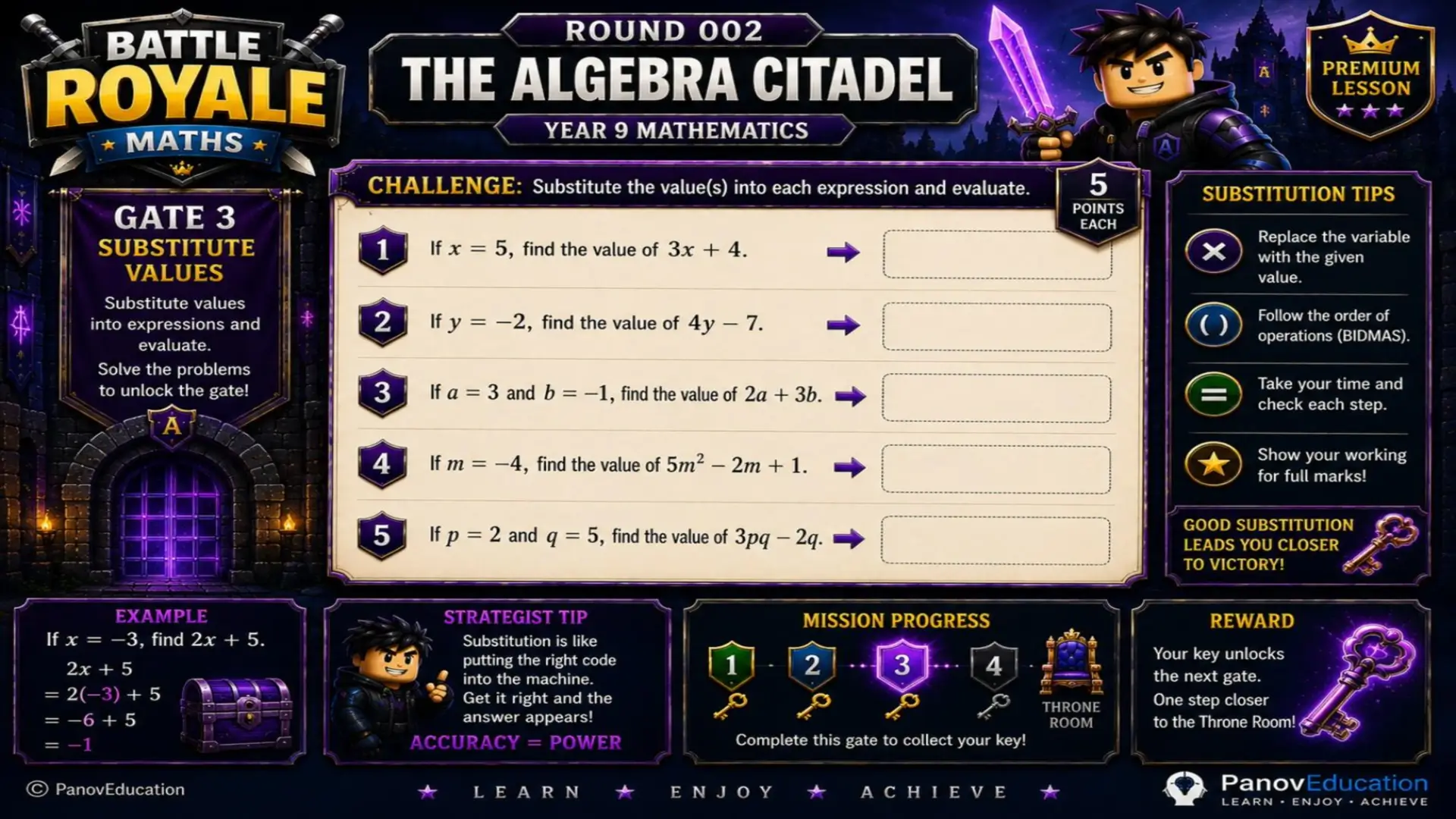
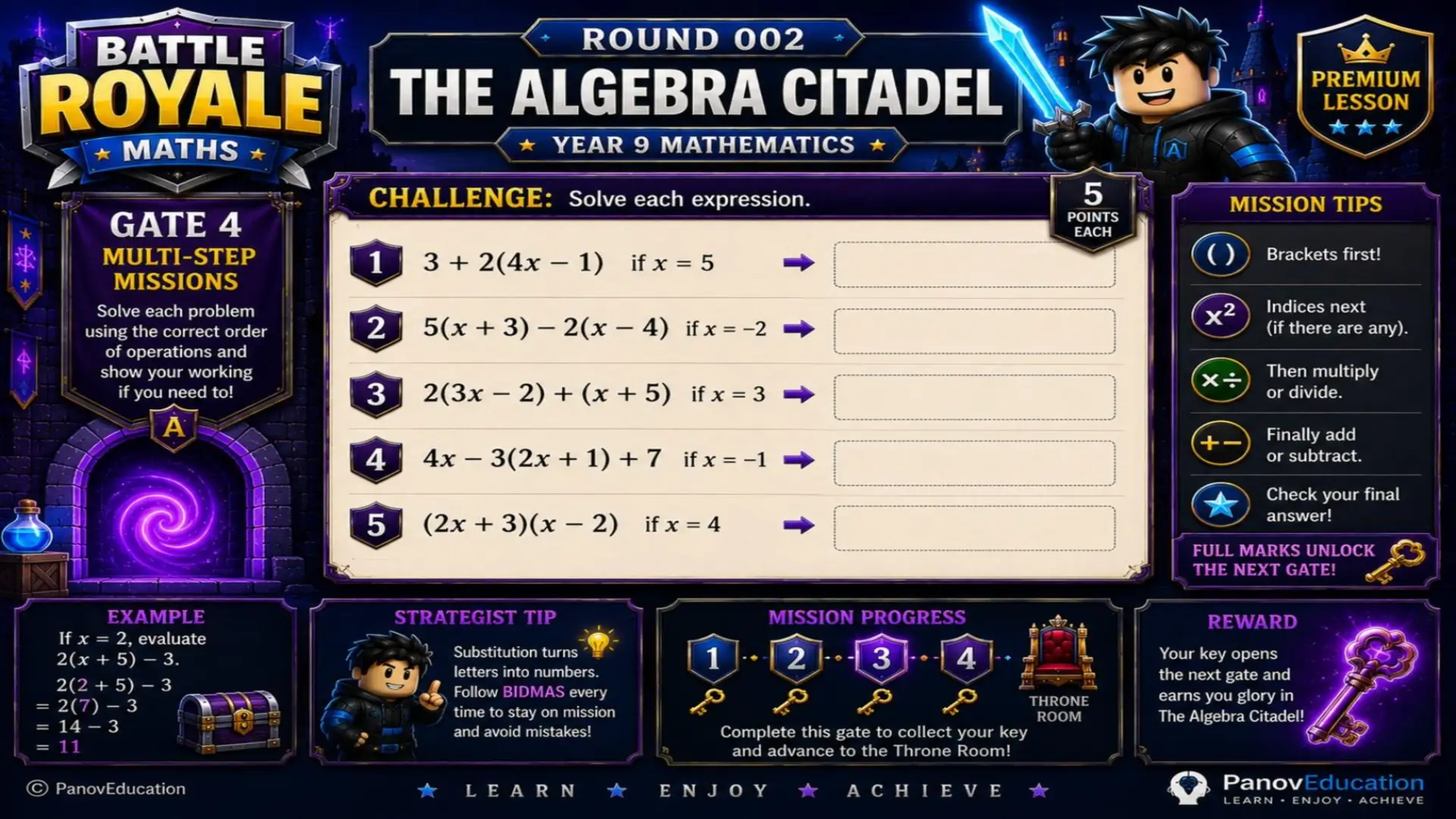
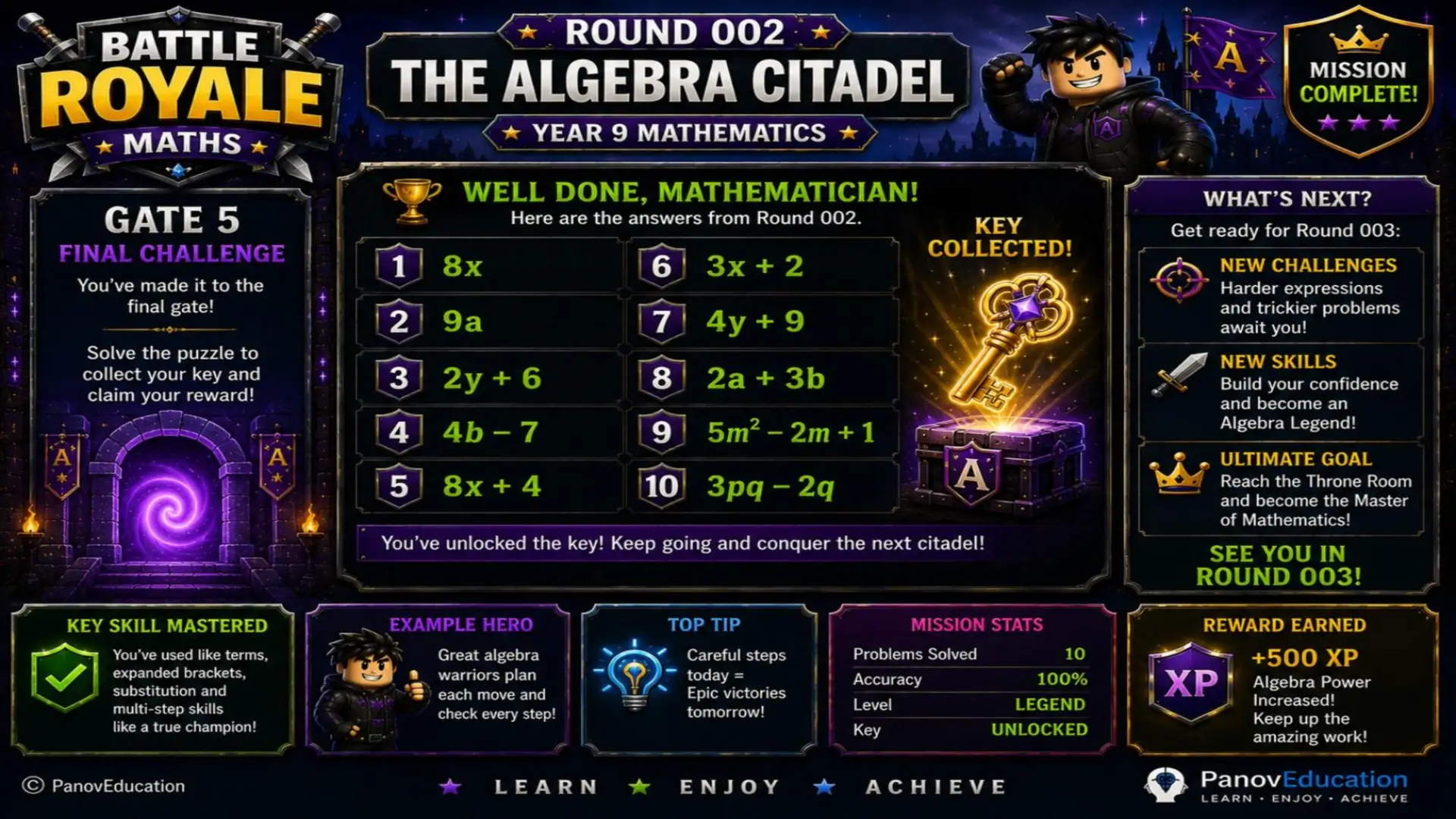
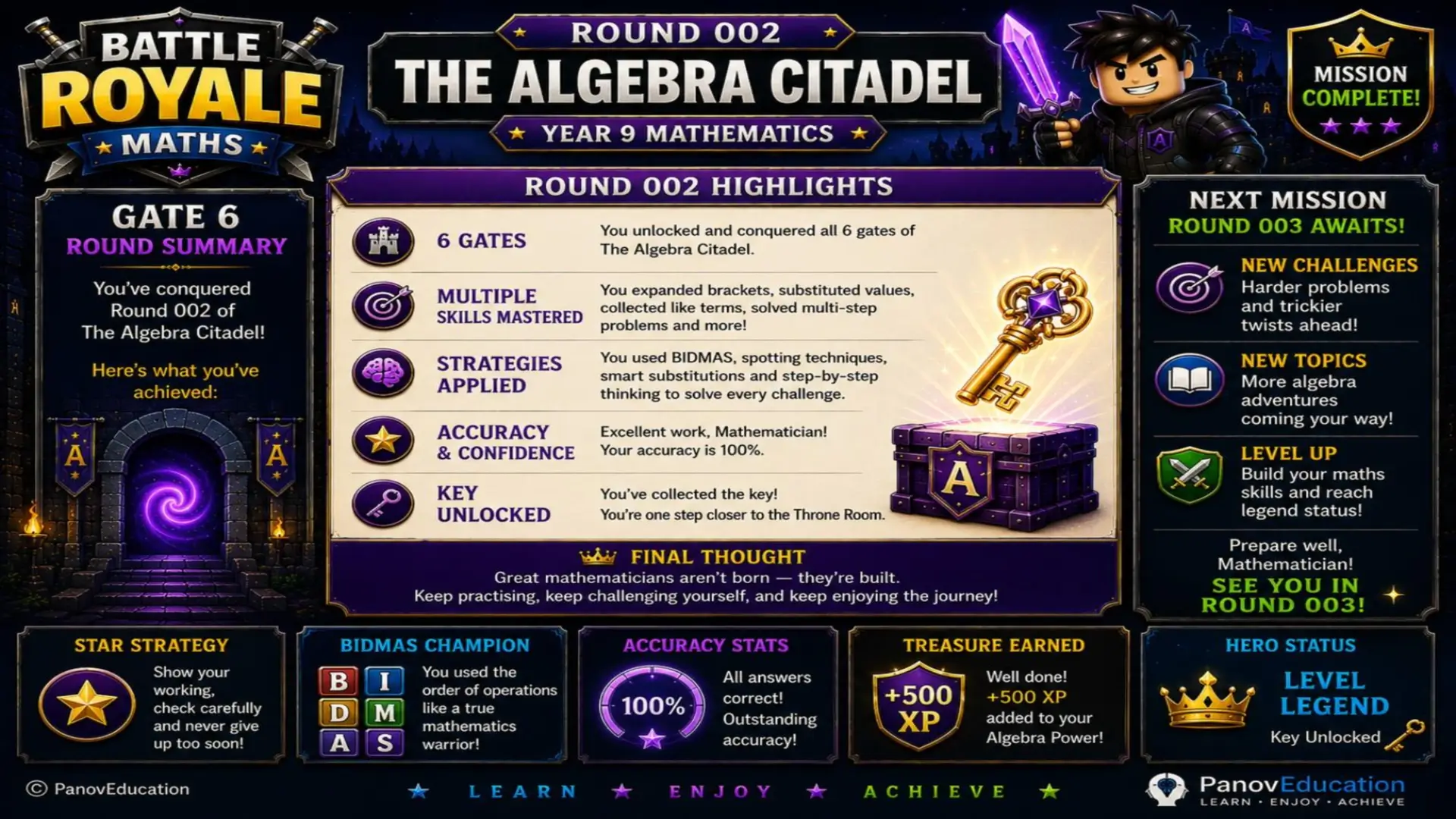
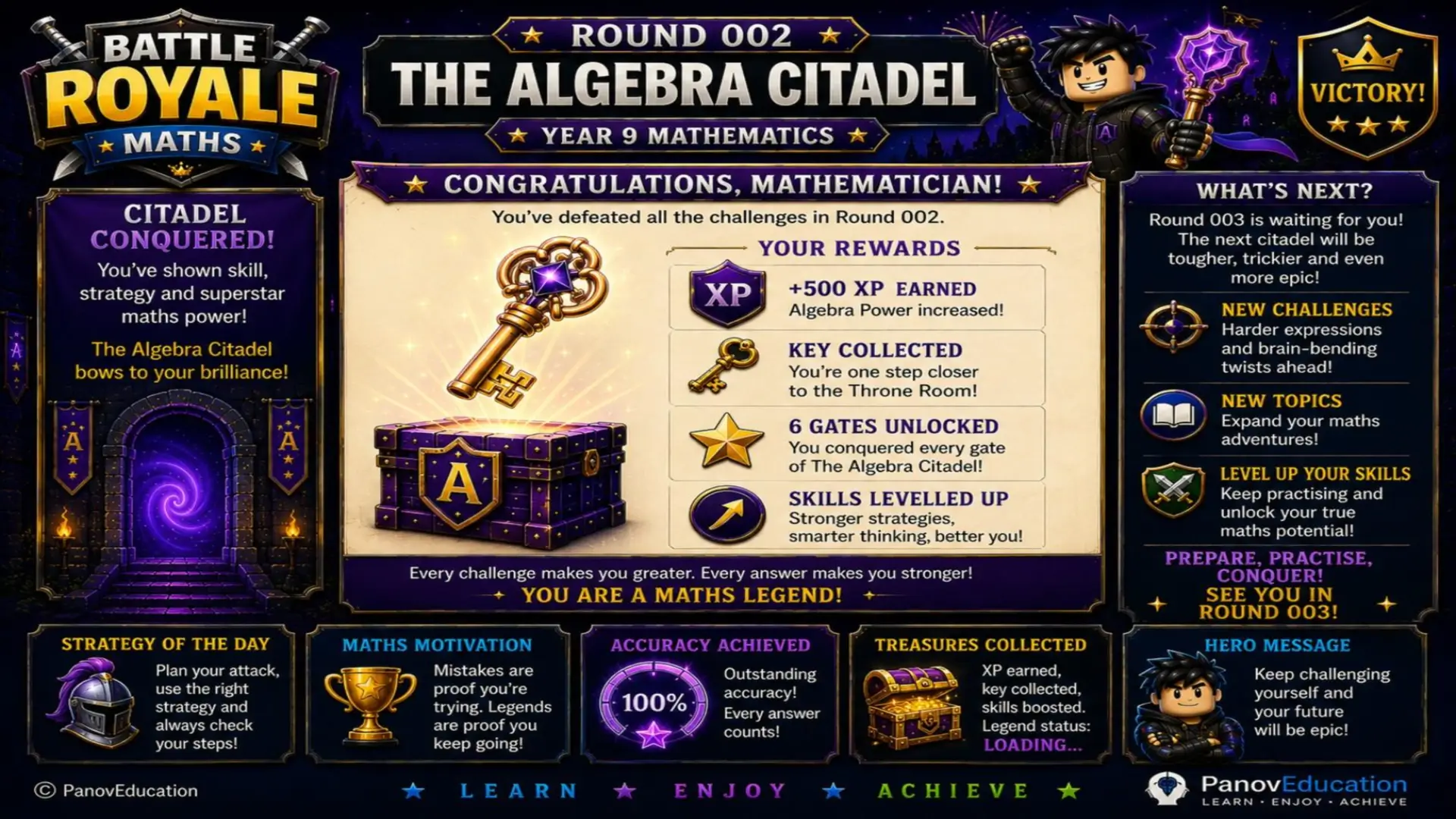
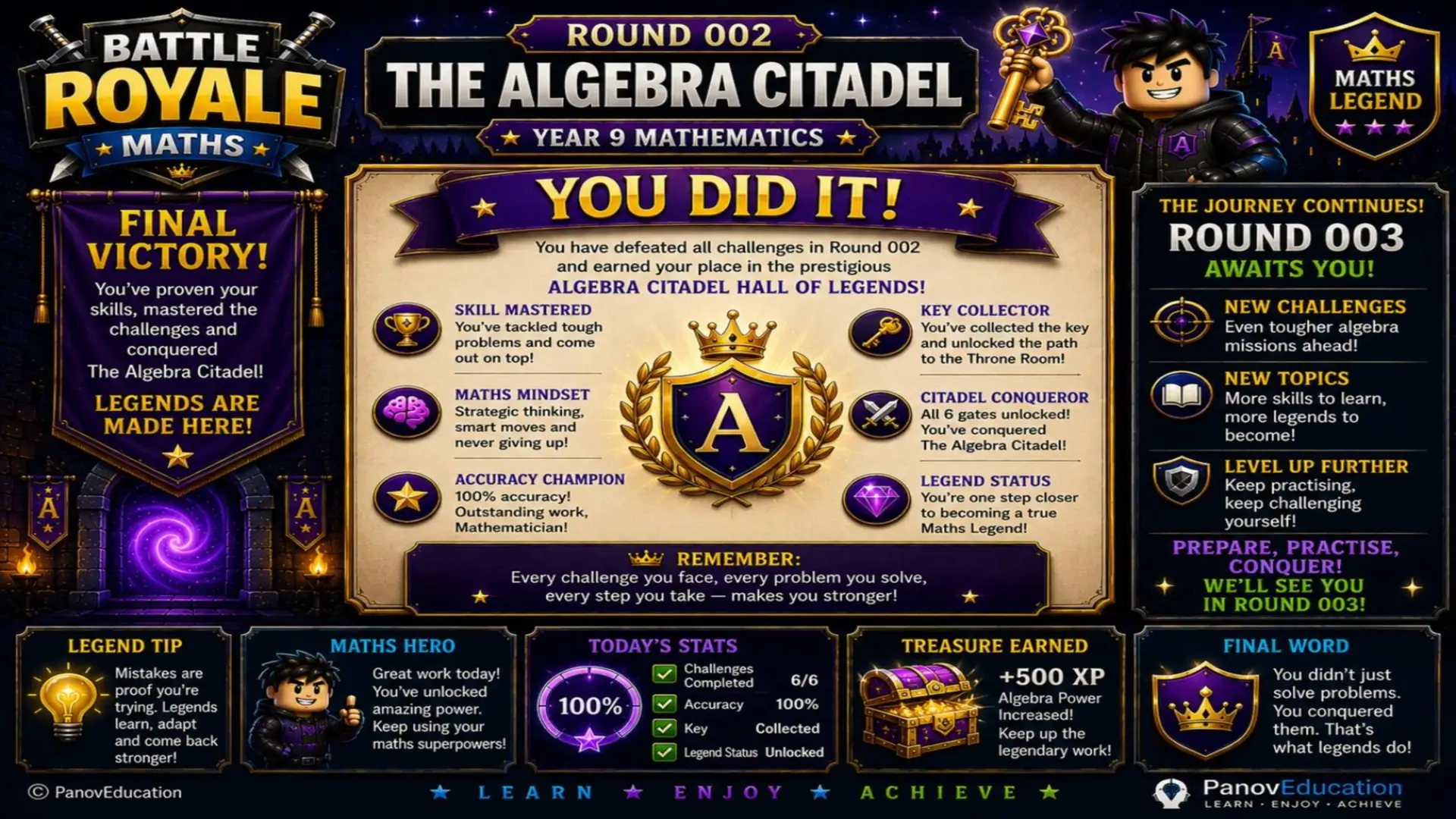
Battle Royale Maths - Round 002: Algebra Citadel
Year 9
Topic
Algebra – Simplifying Expressions, Expanding Brackets, Substitution and Solving Equations
Learning Objectives
By the end of this lesson, learners will be able to:
- Collect and simplify like terms.
- Expand single brackets accurately.
- Substitute values into algebraic expressions.
- Solve one-step and two-step equations.
- Apply algebraic skills to multi-step problems using the correct mathematical methods.
Teaching Methodology
This lesson uses PanovEducation's Battle Royale™ methodology, transforming mathematics into an immersive adventure where students progress through a series of interactive "gates." Each challenge builds on the previous one, encouraging logical thinking, resilience, and problem-solving while maintaining high levels of engagement.
The lesson follows a carefully scaffolded sequence:
- Mission Briefing – introducing the learning journey.
- Warm-Up Challenge – activating prior knowledge.
- Four Skill Gates – guided practice with increasing difficulty.
- Final Challenge – applying all newly learned skills.
- Victory & Reflection – celebrating success and reinforcing learning.
The design combines explicit instruction, guided practice, retrieval, immediate application, and gamification to build confidence while ensuring mastery of key Year 9 algebra concepts.
Estimated lesson time: 45–60 minutes
Suitable for: Year 9 (KS3) Mathematics
Difficulty: Medium–Hard
Preview the lesson in the next tab or Download it as .PPTX.
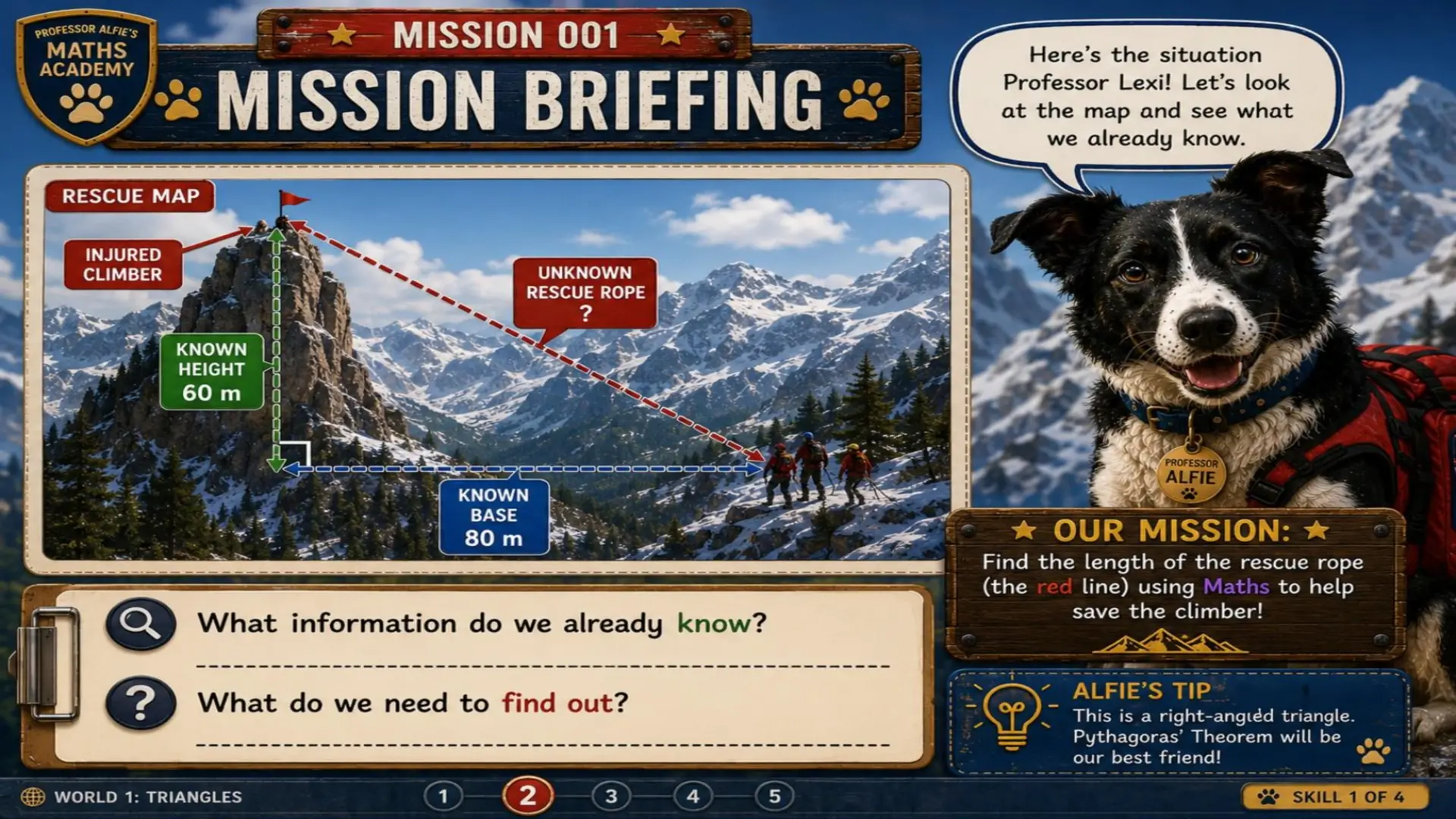
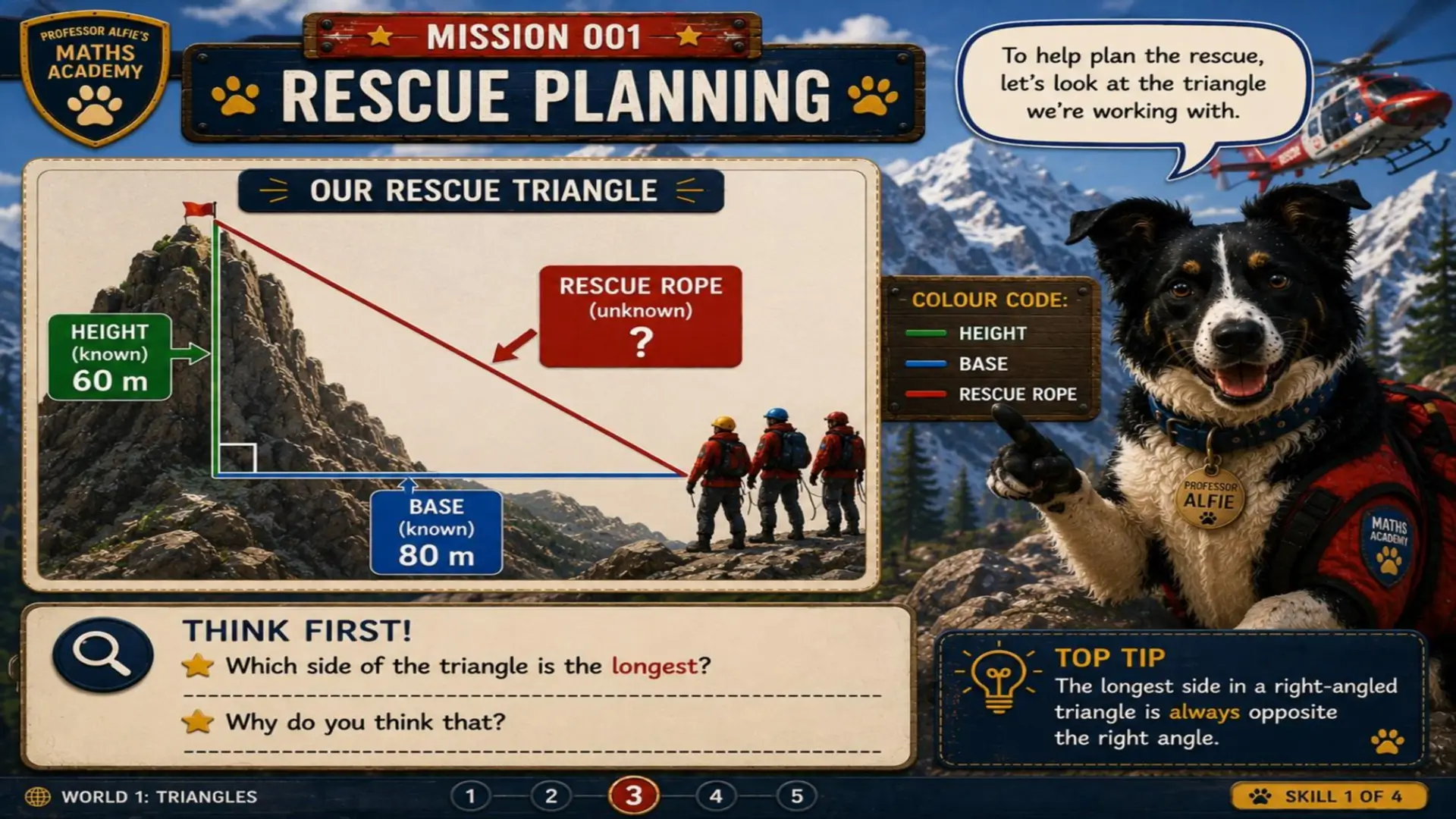
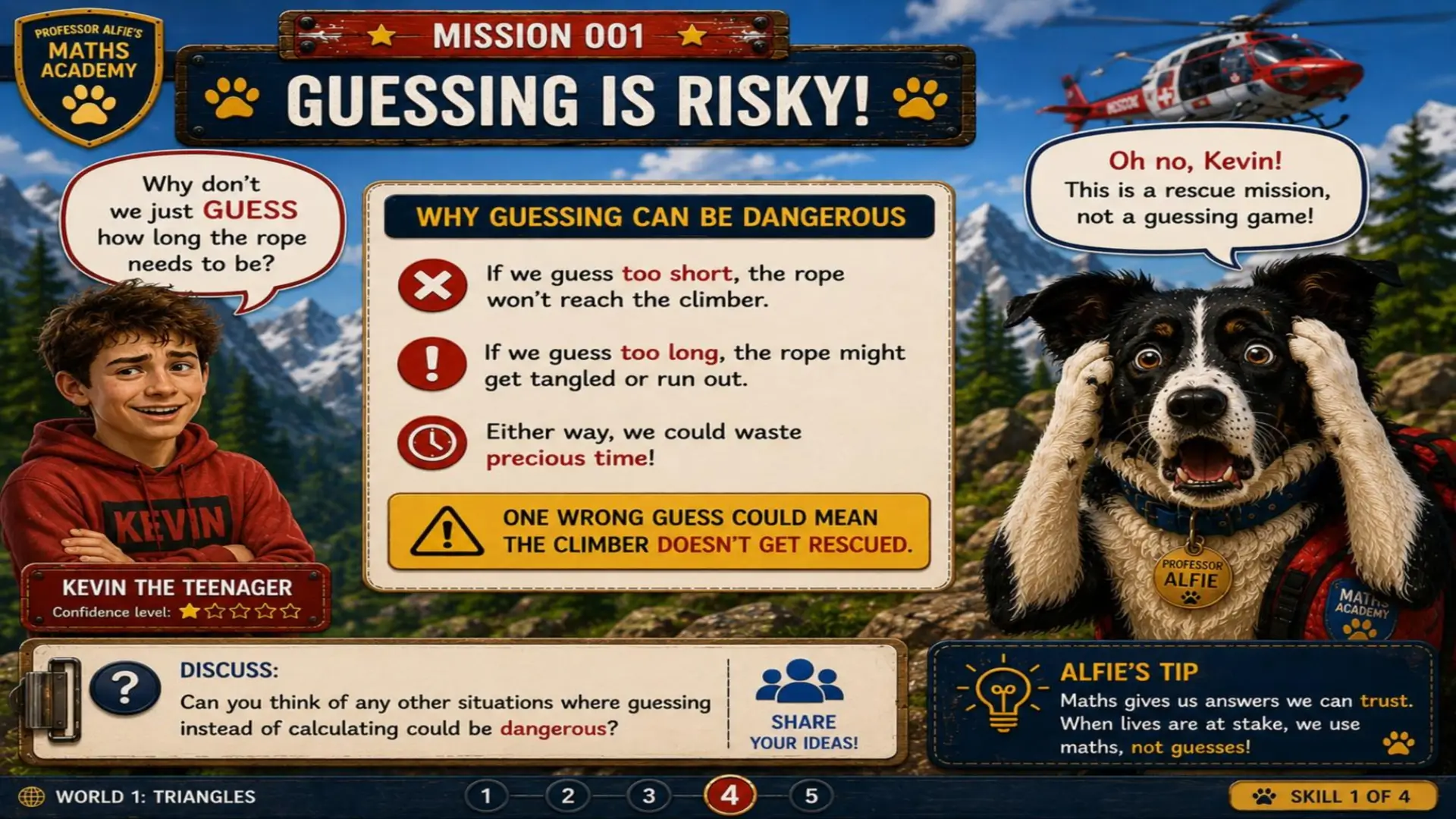
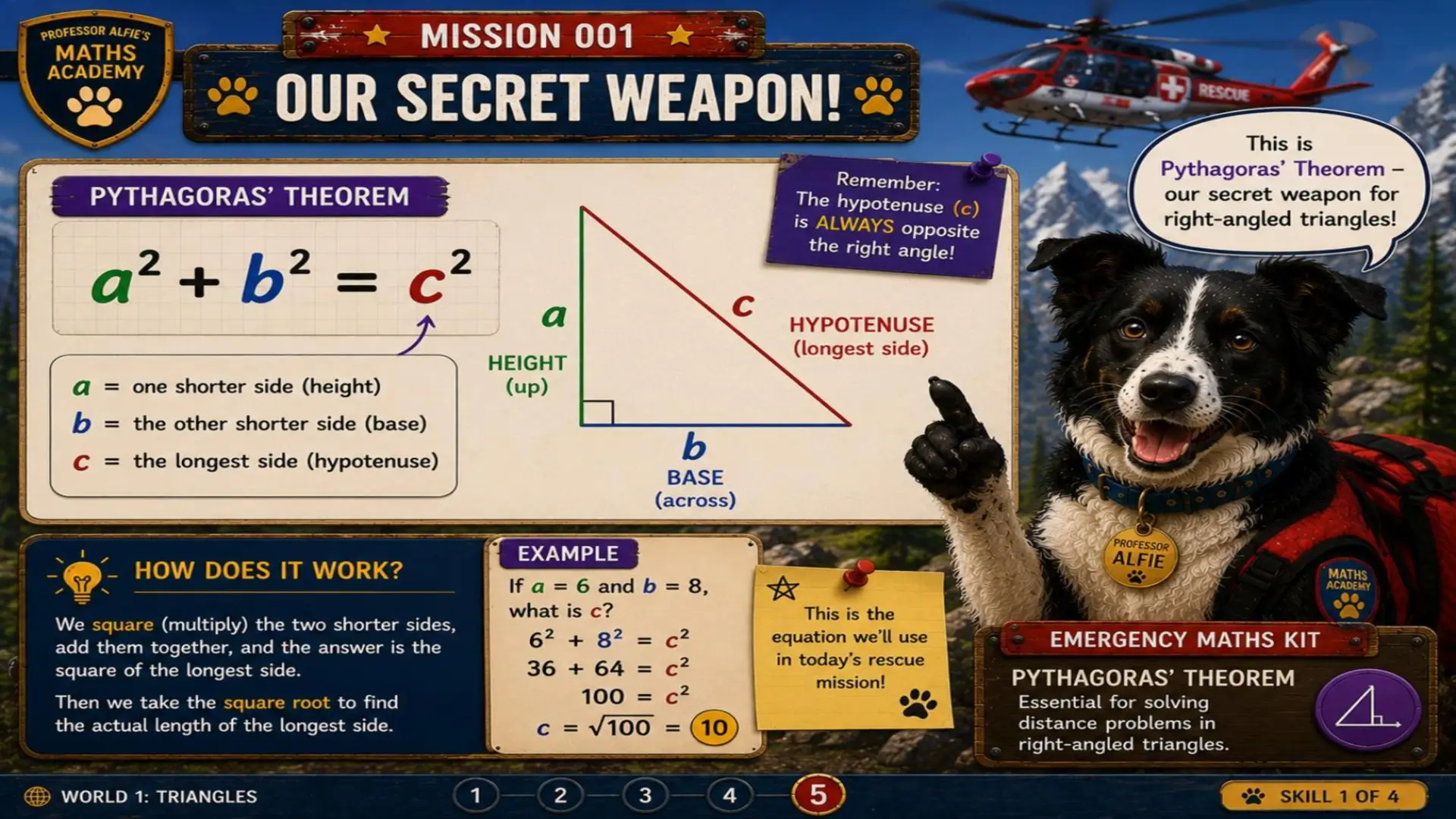
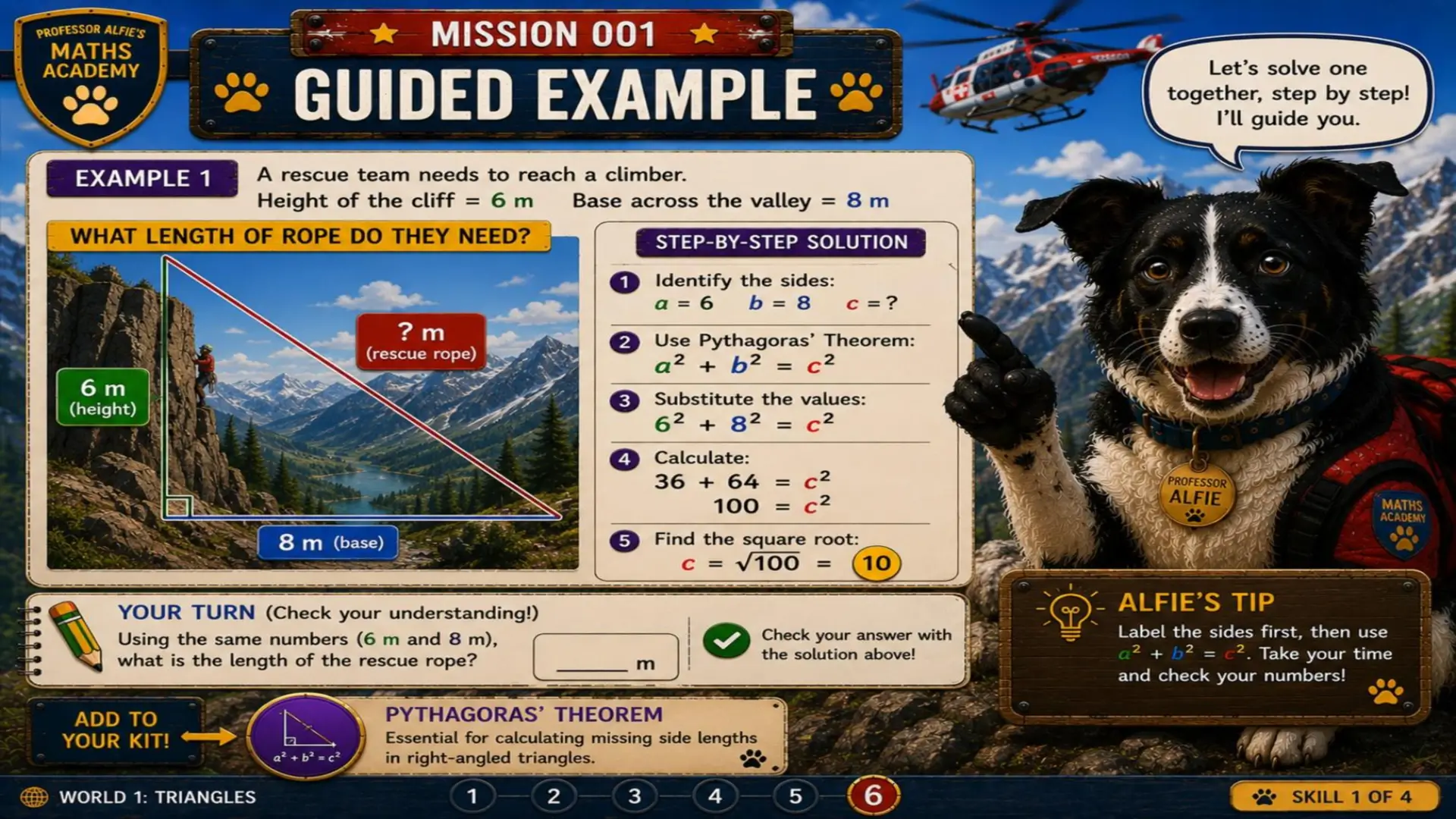
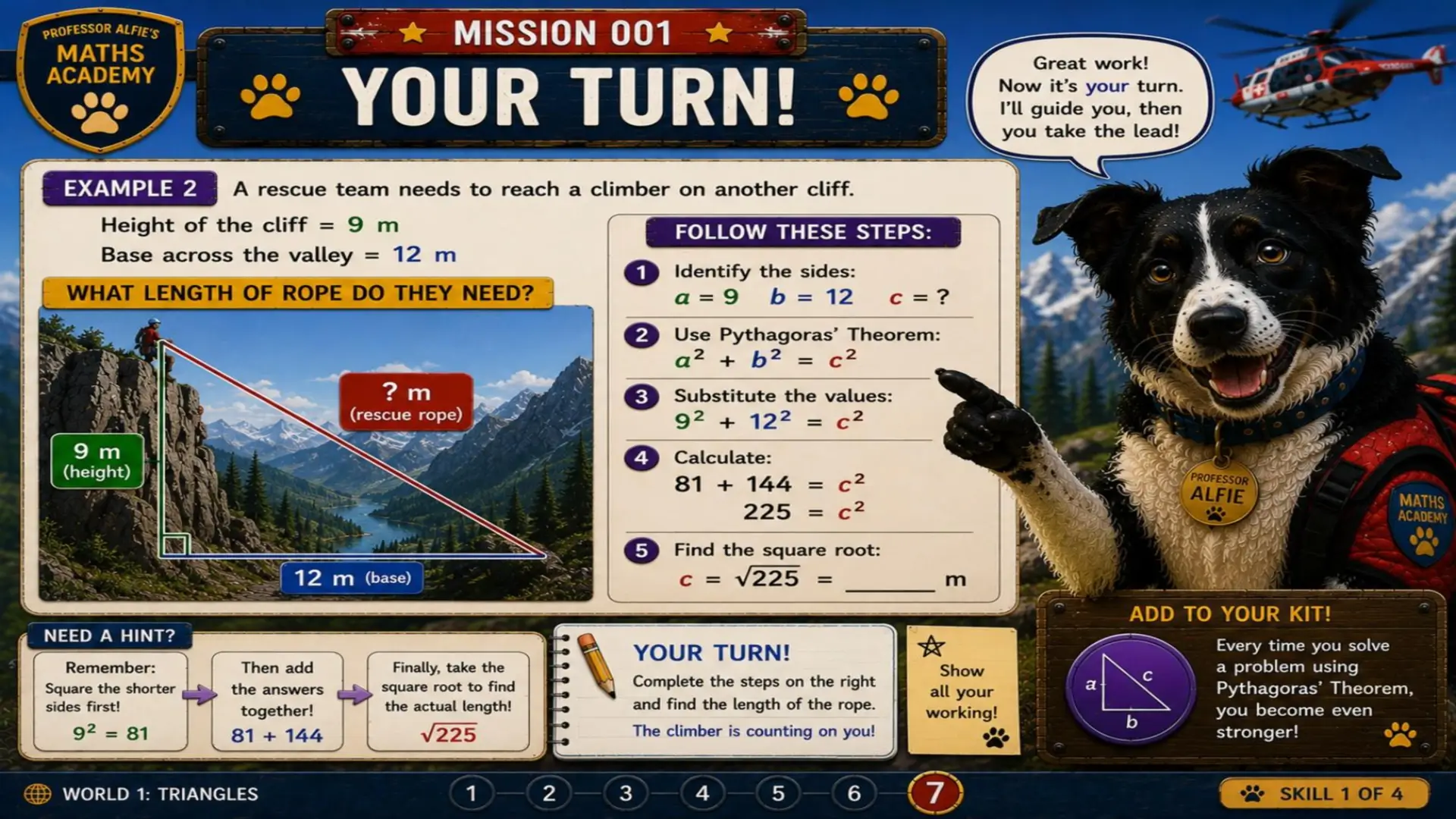
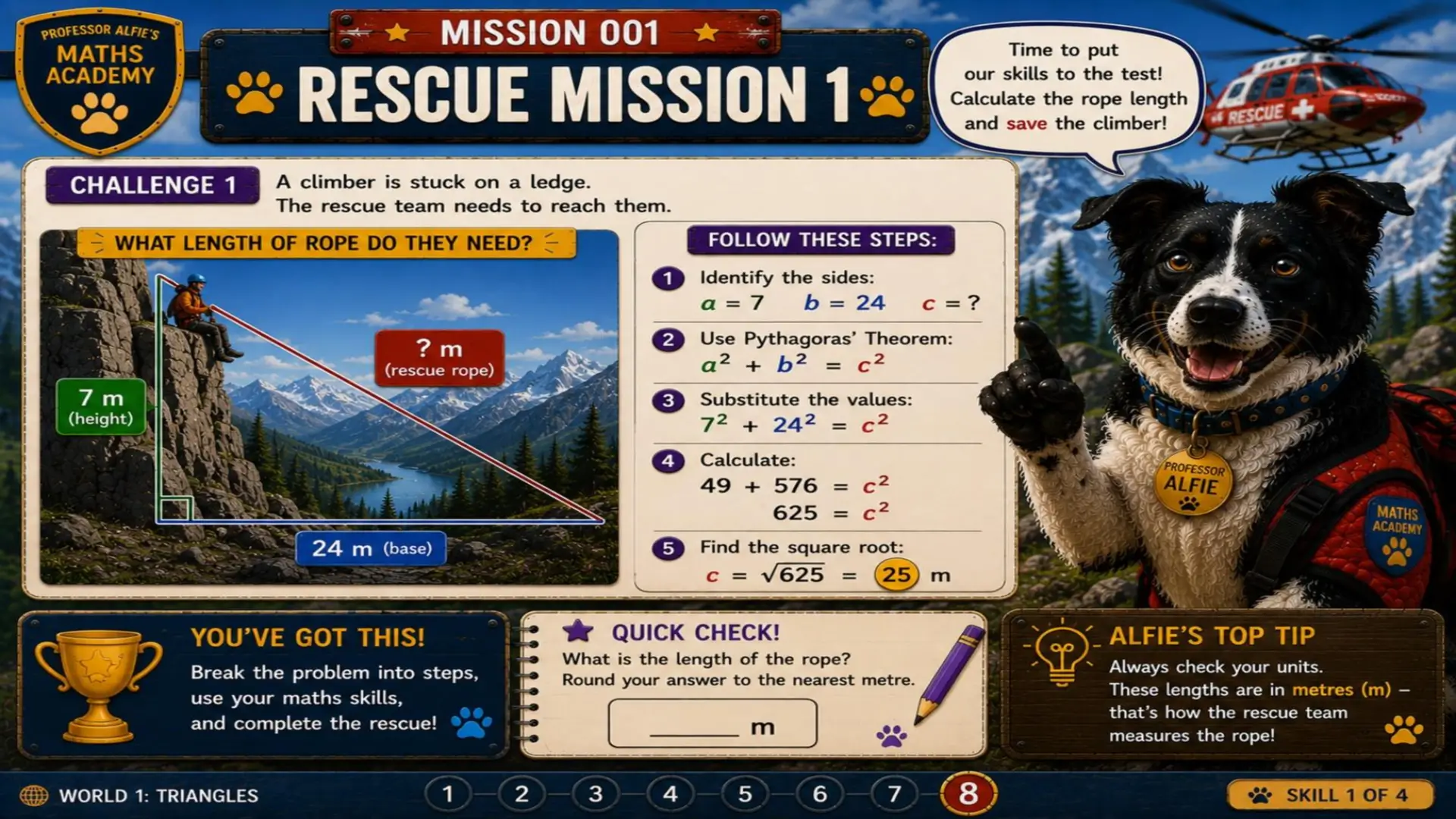
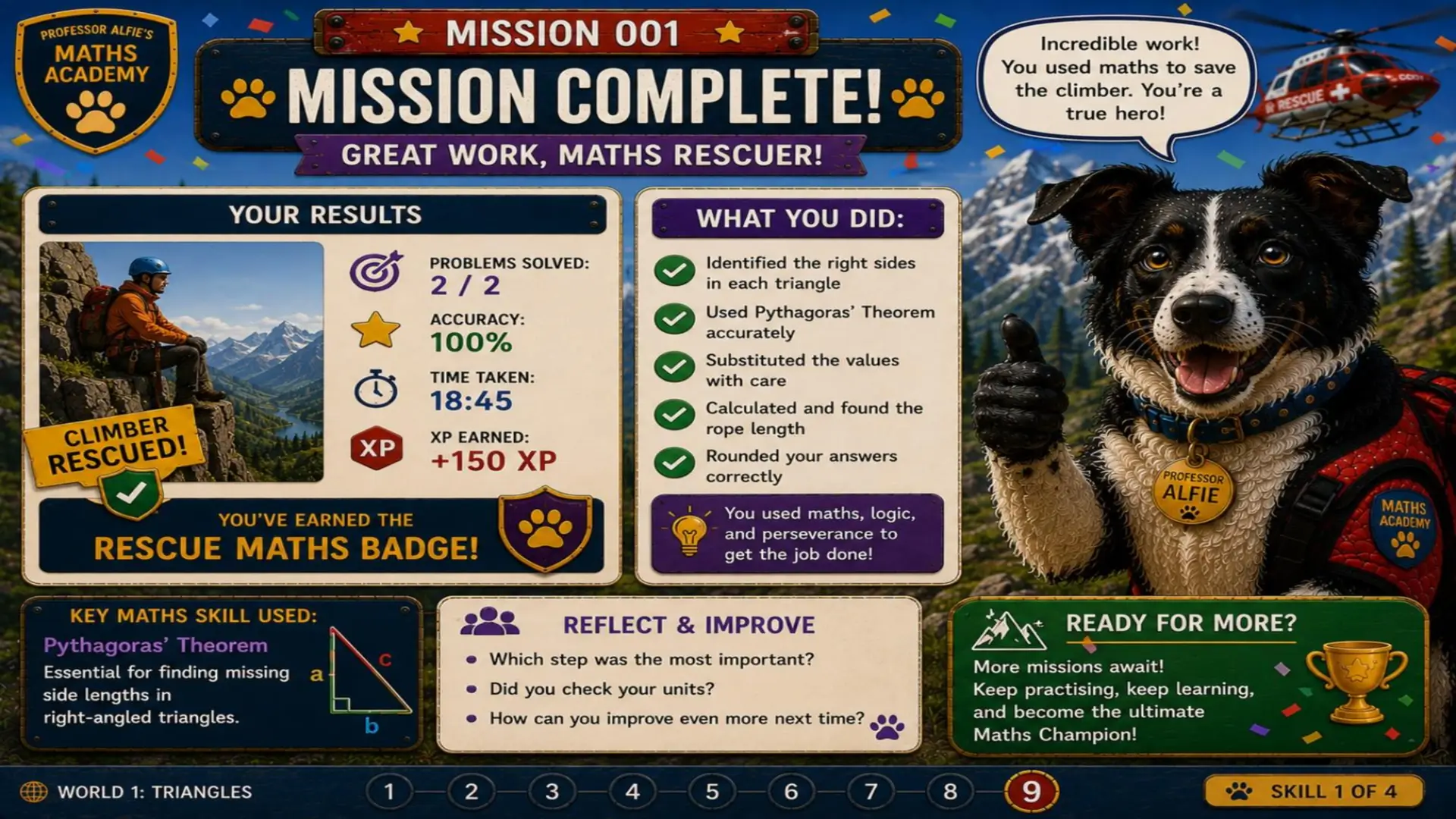
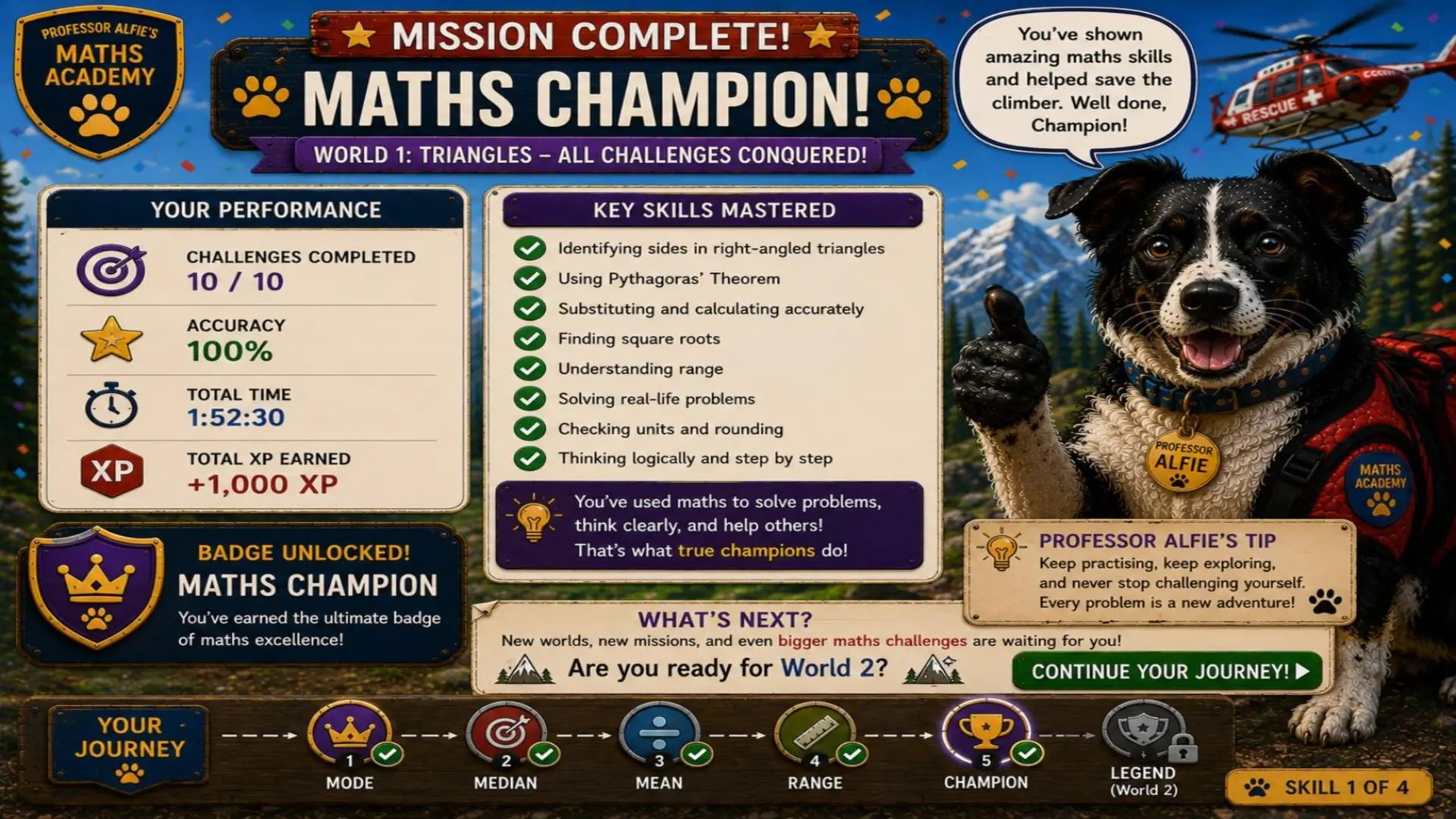
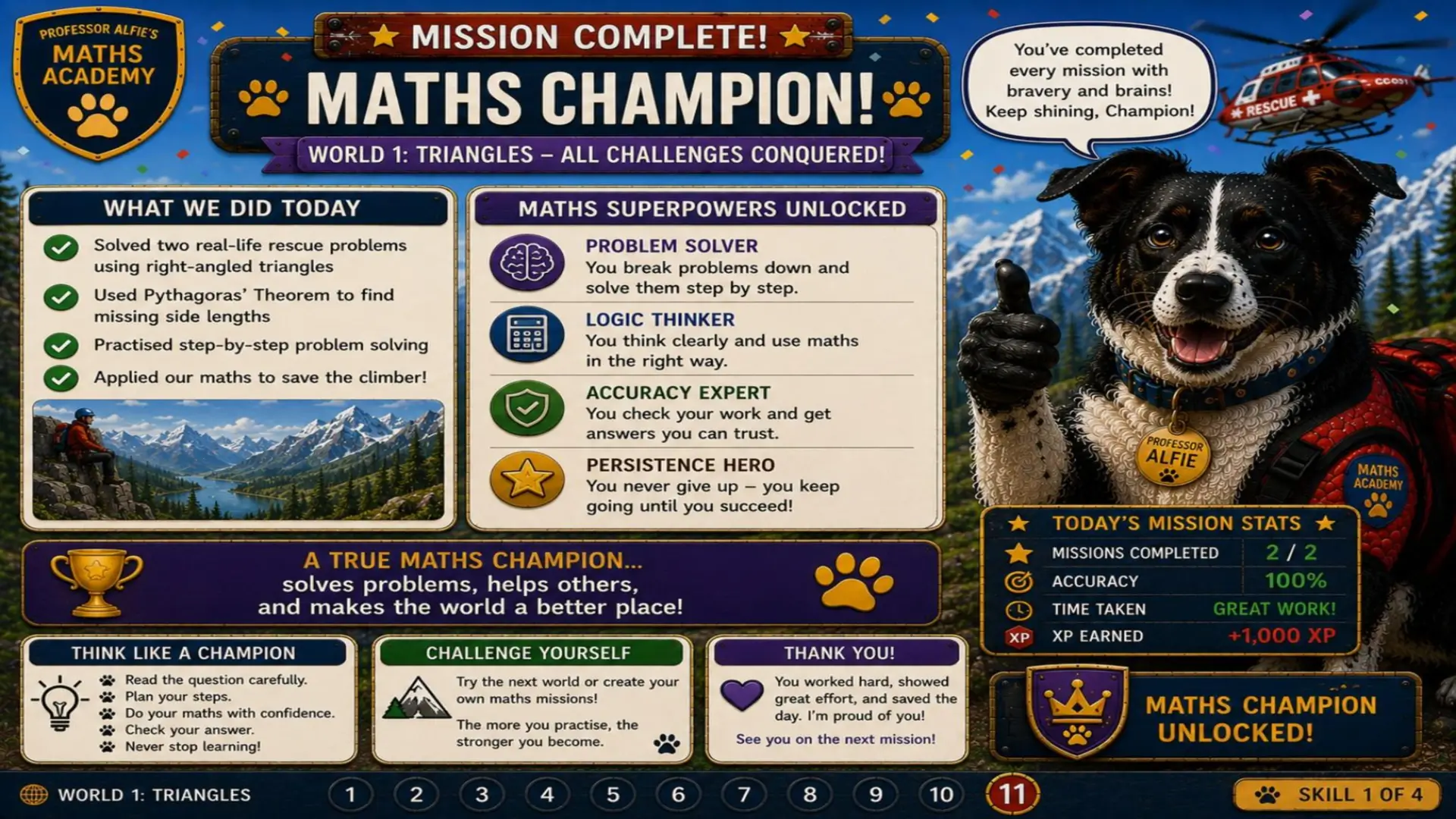
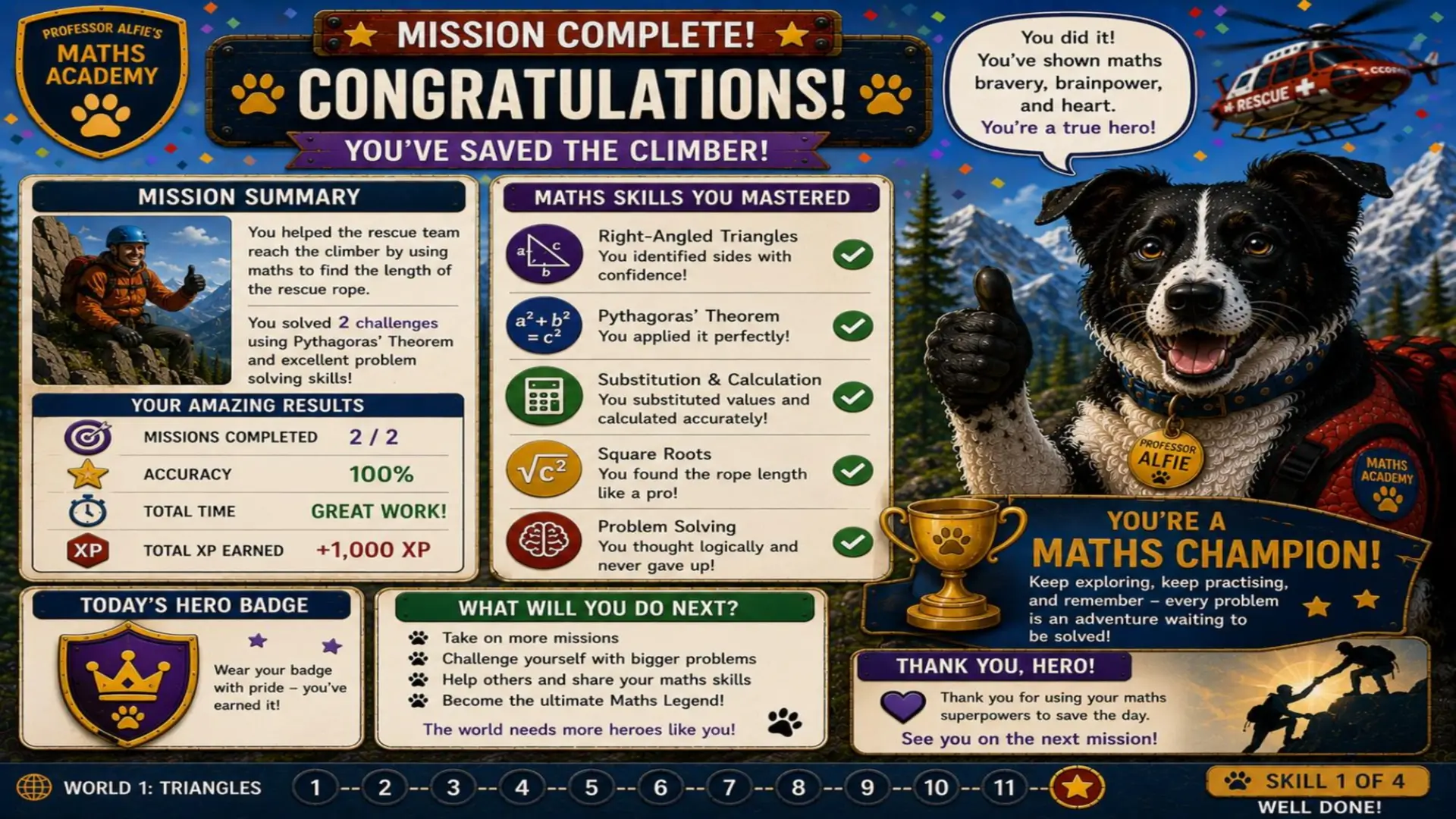
Professor Alfies Maths Academy - Mission 001: Operation Mountain Rescue
Overview
Students join Professor Alfie on an exciting mountain rescue mission where every mathematical challenge helps the team move closer to saving stranded hikers. Through immersive storytelling, practical problem-solving and carefully structured activities, learners develop essential mathematical skills while building confidence and resilience.
Learning Objectives
Year 7
- Apply the four number operations accurately.
- Develop confidence with fractions, decimals and percentages.
- Use BIDMAS correctly when solving calculations.
- Solve problems involving angles, perimeter and area.
- Interpret coordinates and introduce ratio and algebra.
- Develop understanding of probability and statistics.
Years 8–9
- Apply Pythagoras' Theorem to real-life scenarios.
- Use standard form confidently.
- Solve simultaneous equations.
- Investigate transformations.
- Apply trigonometry to practical problems (Year 9).
- Solve compound percentage problems.
- Develop algebraic manipulation skills.
- Explore surface area, volume and advanced probability.
Teaching Methodology
Using the PanovEducation methodology, students become active participants in a rescue mission rather than passive learners. Mathematical concepts are introduced through meaningful challenges, modelled explicitly and reinforced through guided practice before students independently solve increasingly complex mission tasks. Every activity contributes to the overall success of the rescue operation, giving mathematics a clear purpose and maintaining high levels of motivation.
Skills Developed
- Mathematical reasoning.
- Numerical fluency.
- Problem-solving.
- Logical thinking.
- Critical thinking.
- Spatial awareness.
- Mathematical communication.
- Resilience and perseverance.
Suitable For
- Year 7
- Years 8–9
- Alternative Provision
- SEND
- Small group tuition
- One-to-one tuition
- Learners who benefit from immersive, story-based learning
Resources Included
- Fully editable PowerPoint presentation
- Mission briefings
- Guided practice activities
- Independent challenges
- Teacher guidance
- Reflection opportunities
- Extension activities
Preview the lesson in the next tab or Download it as .PPTX.

Science – PanovExpress
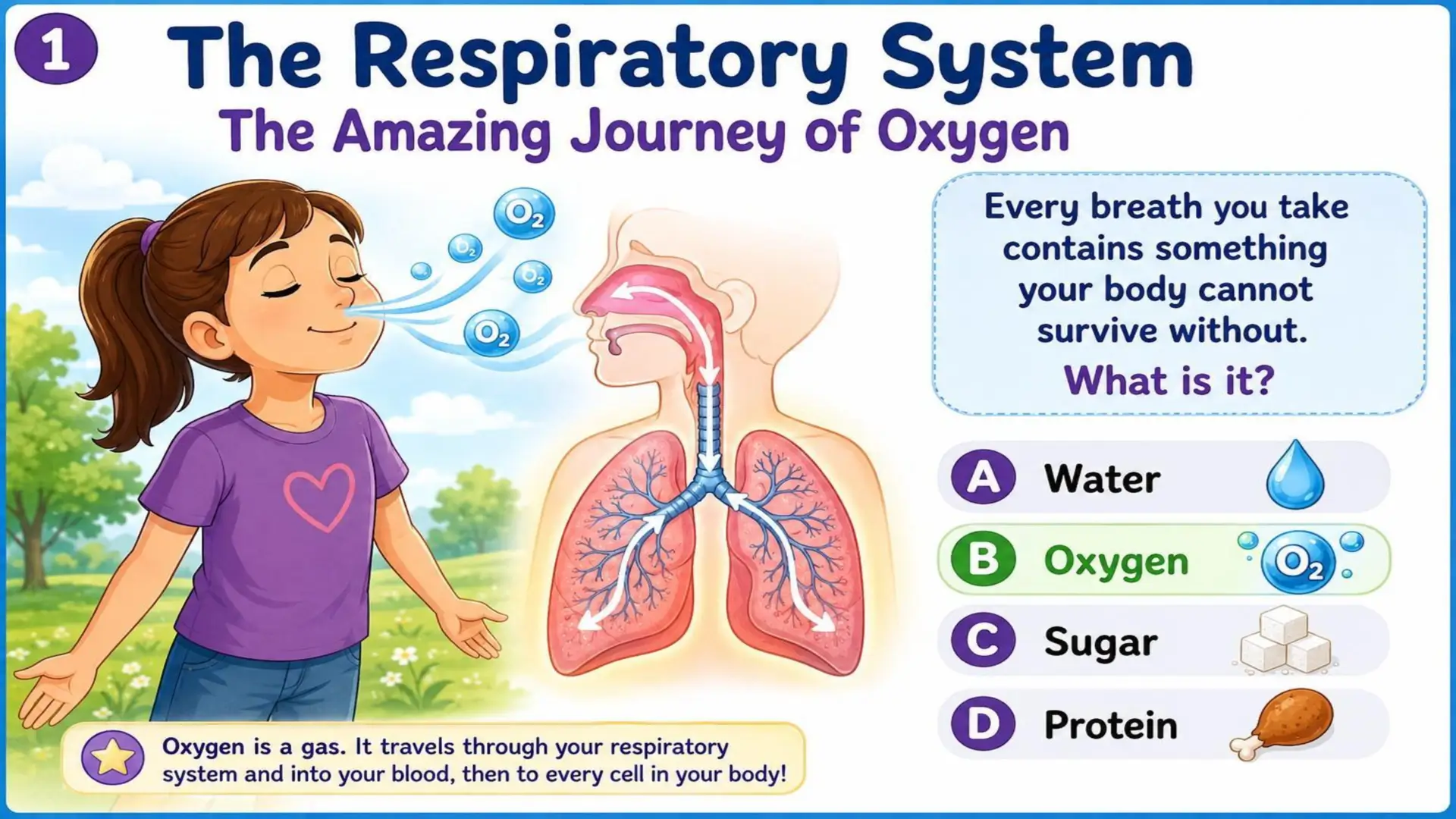
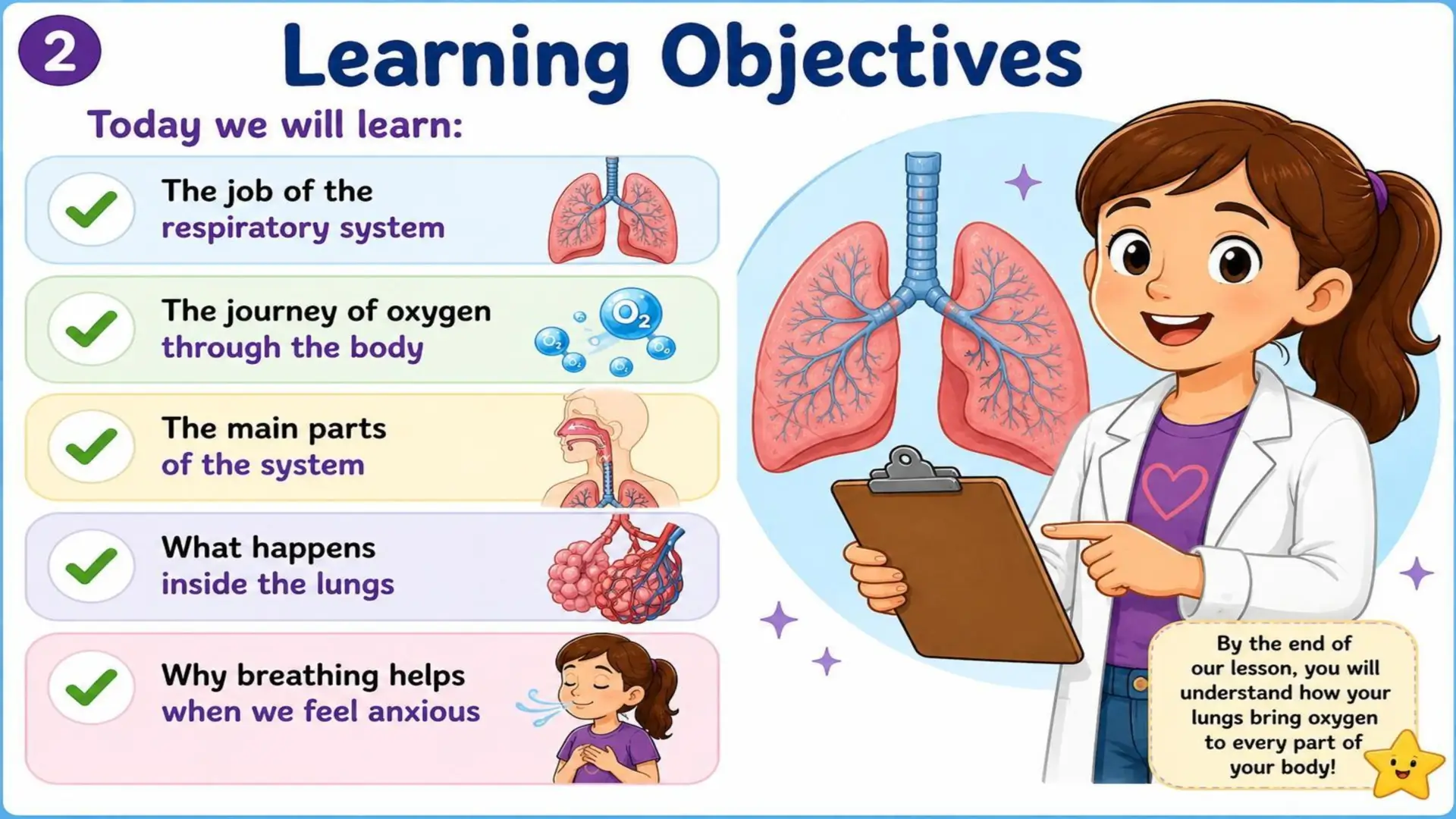
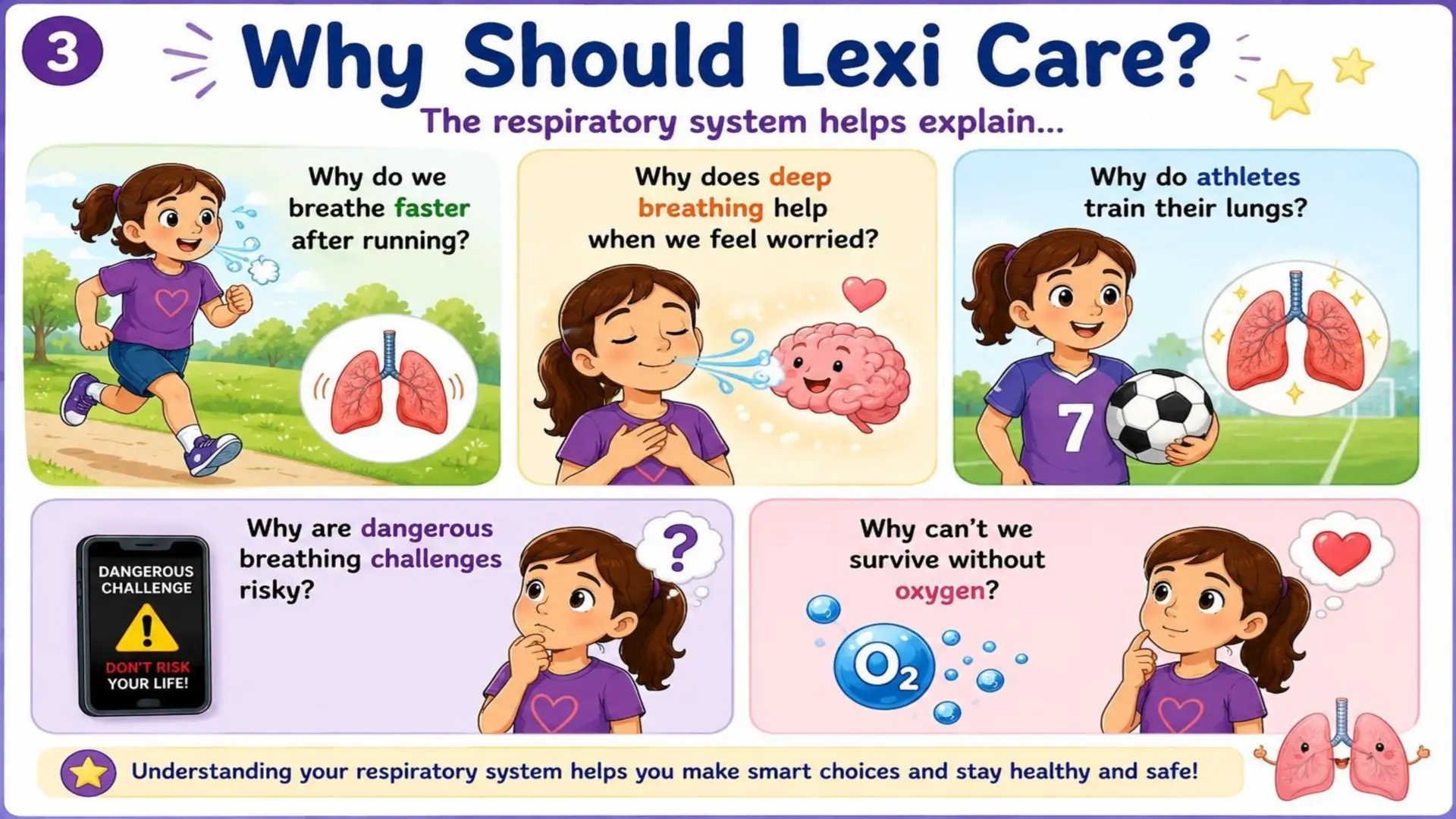
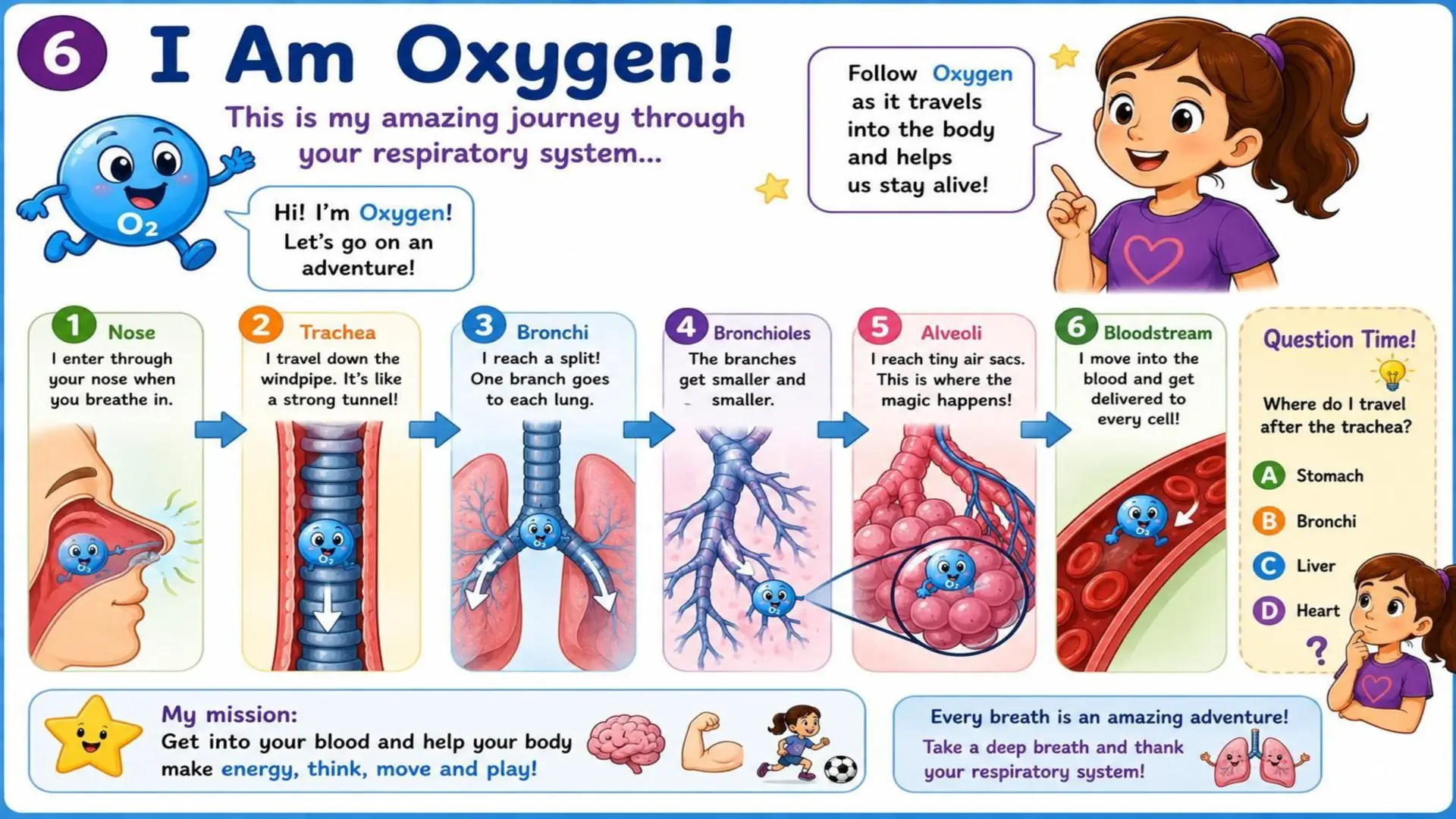
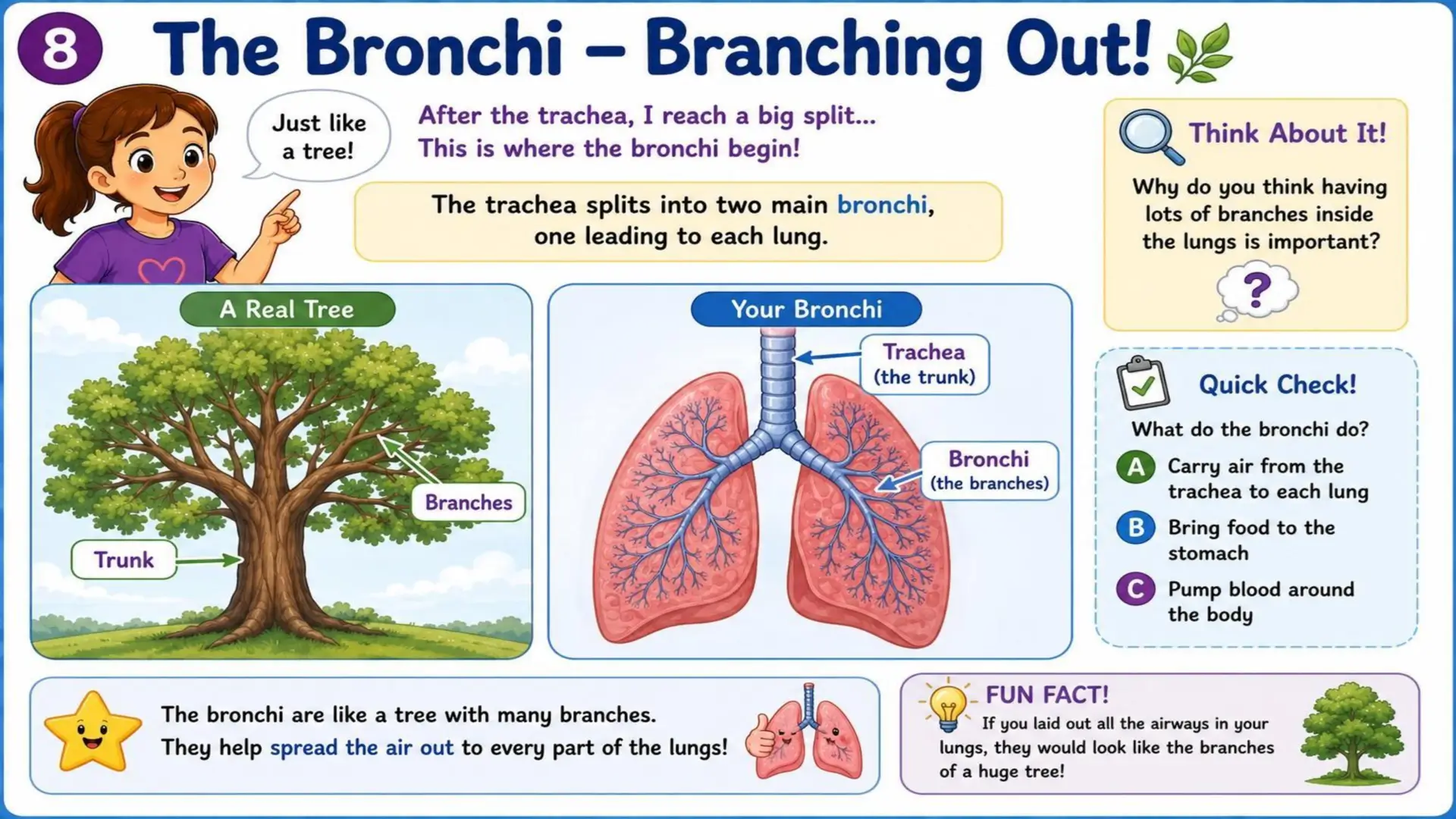
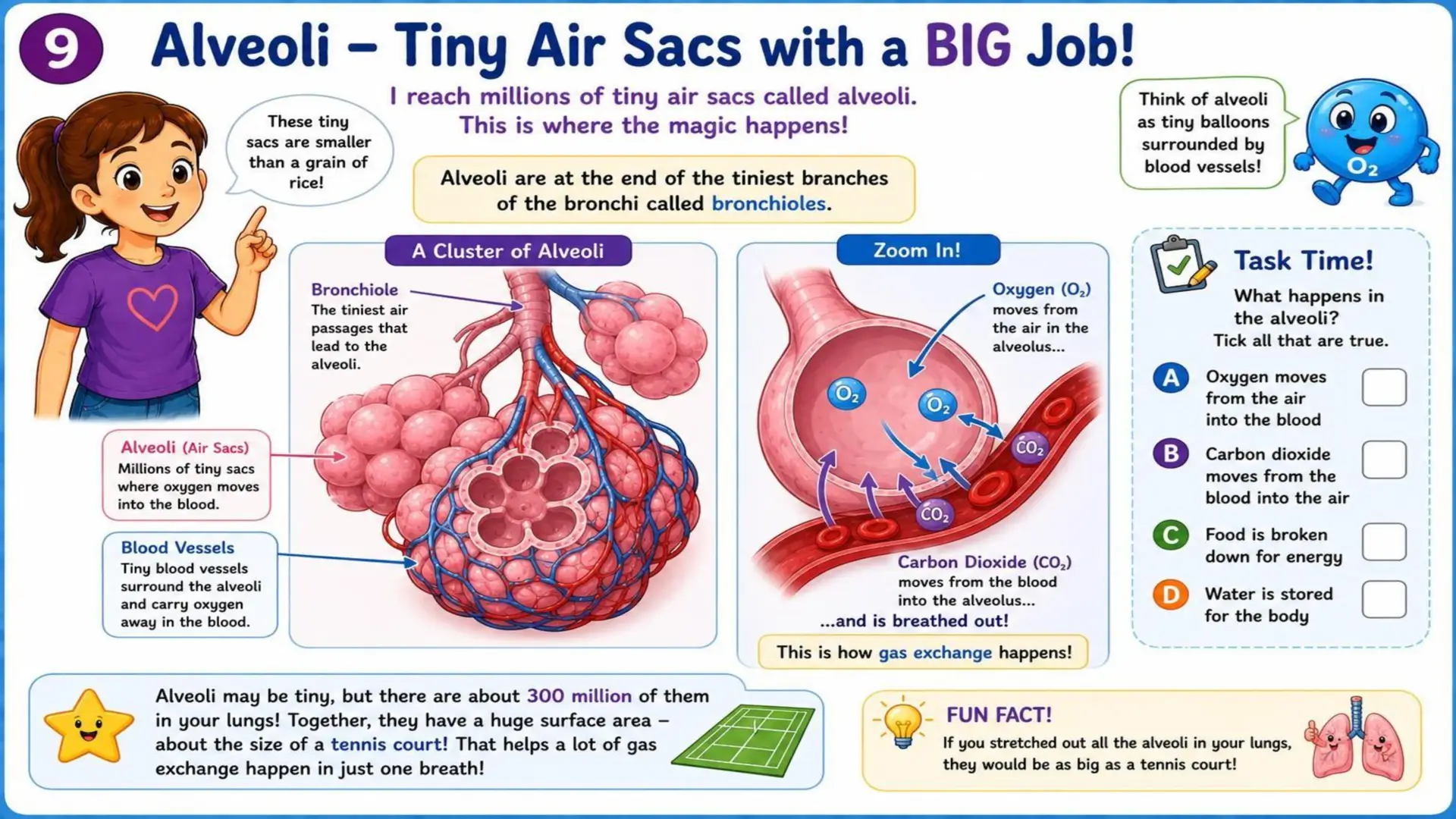
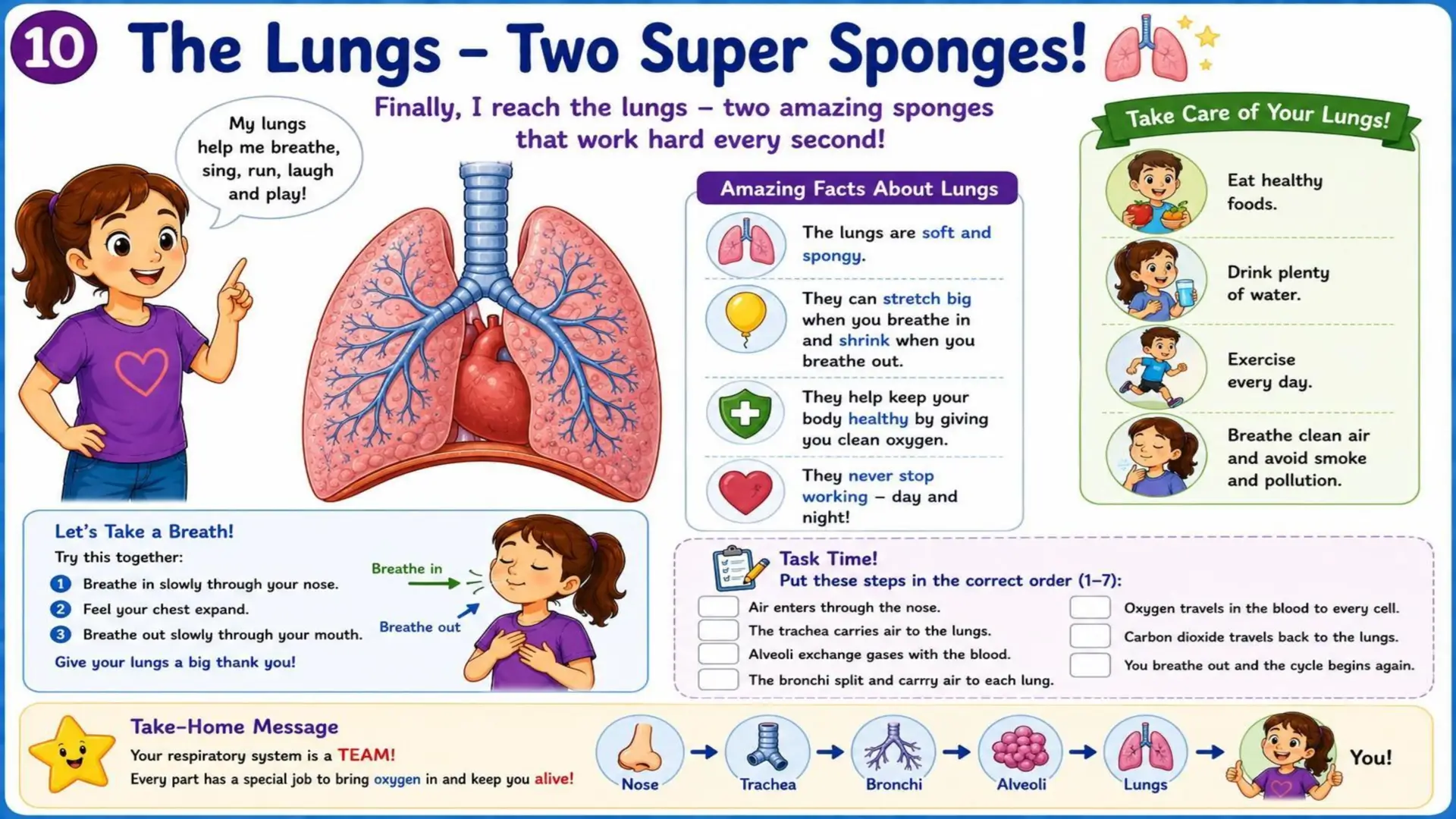
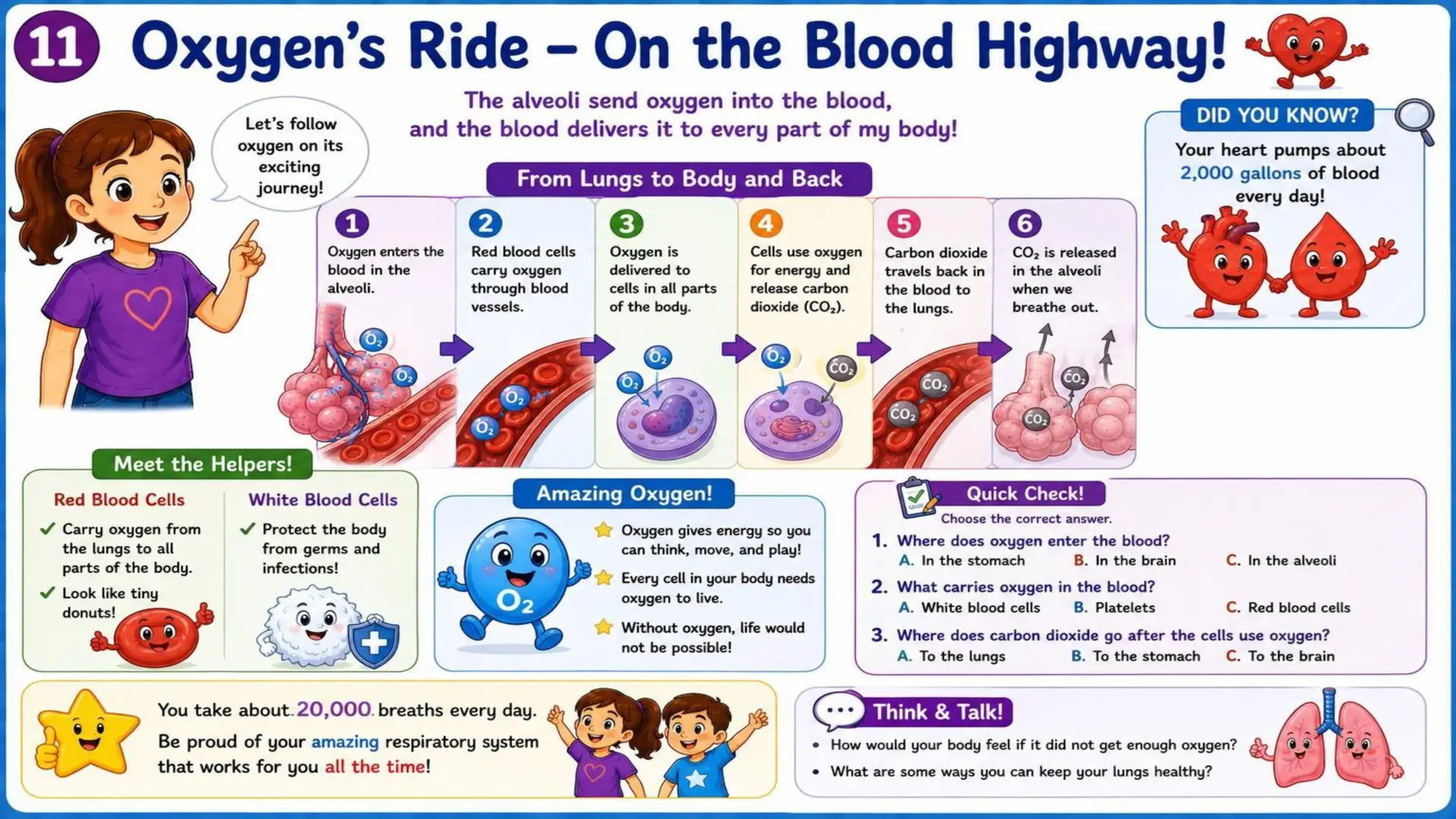
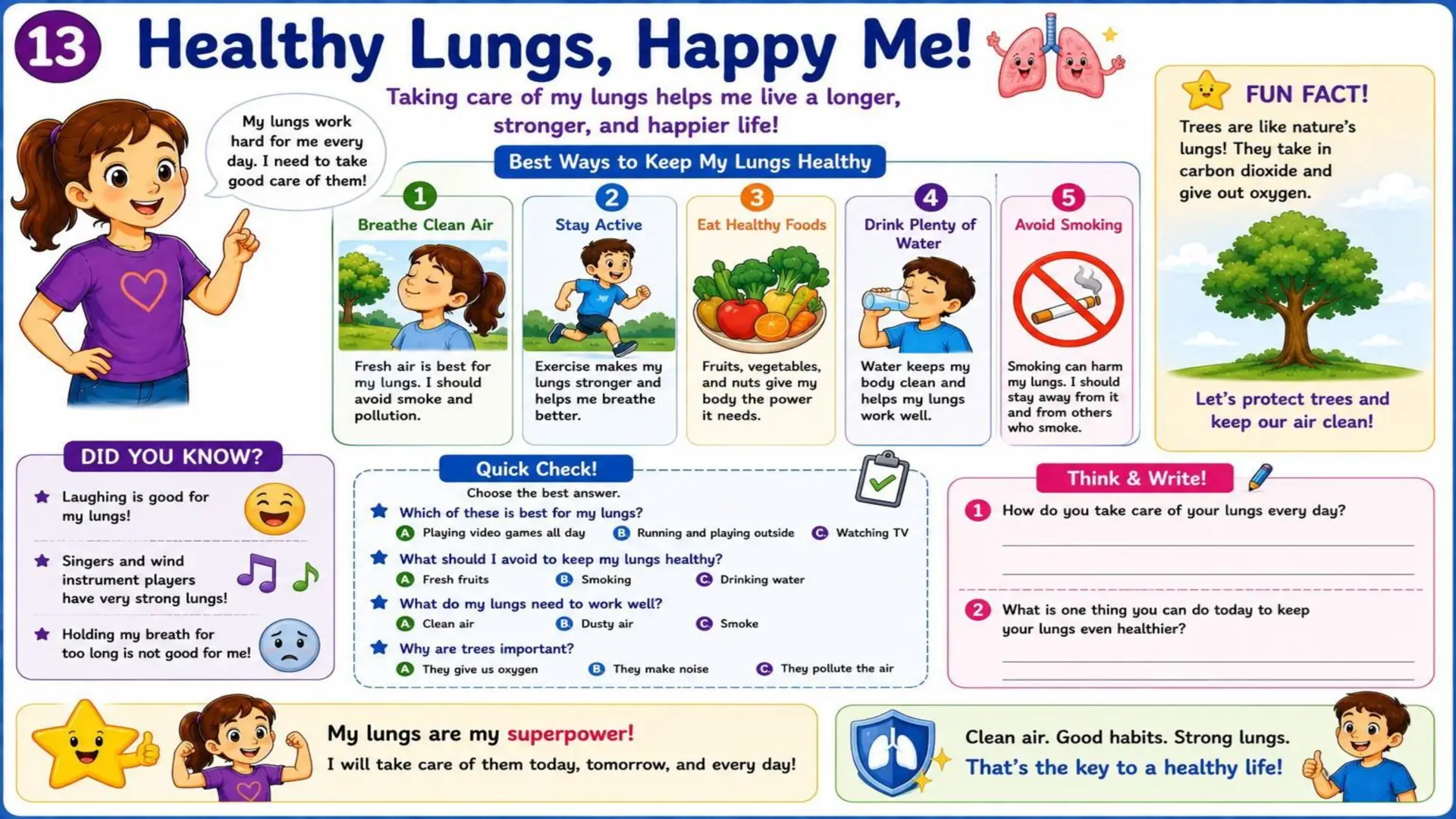
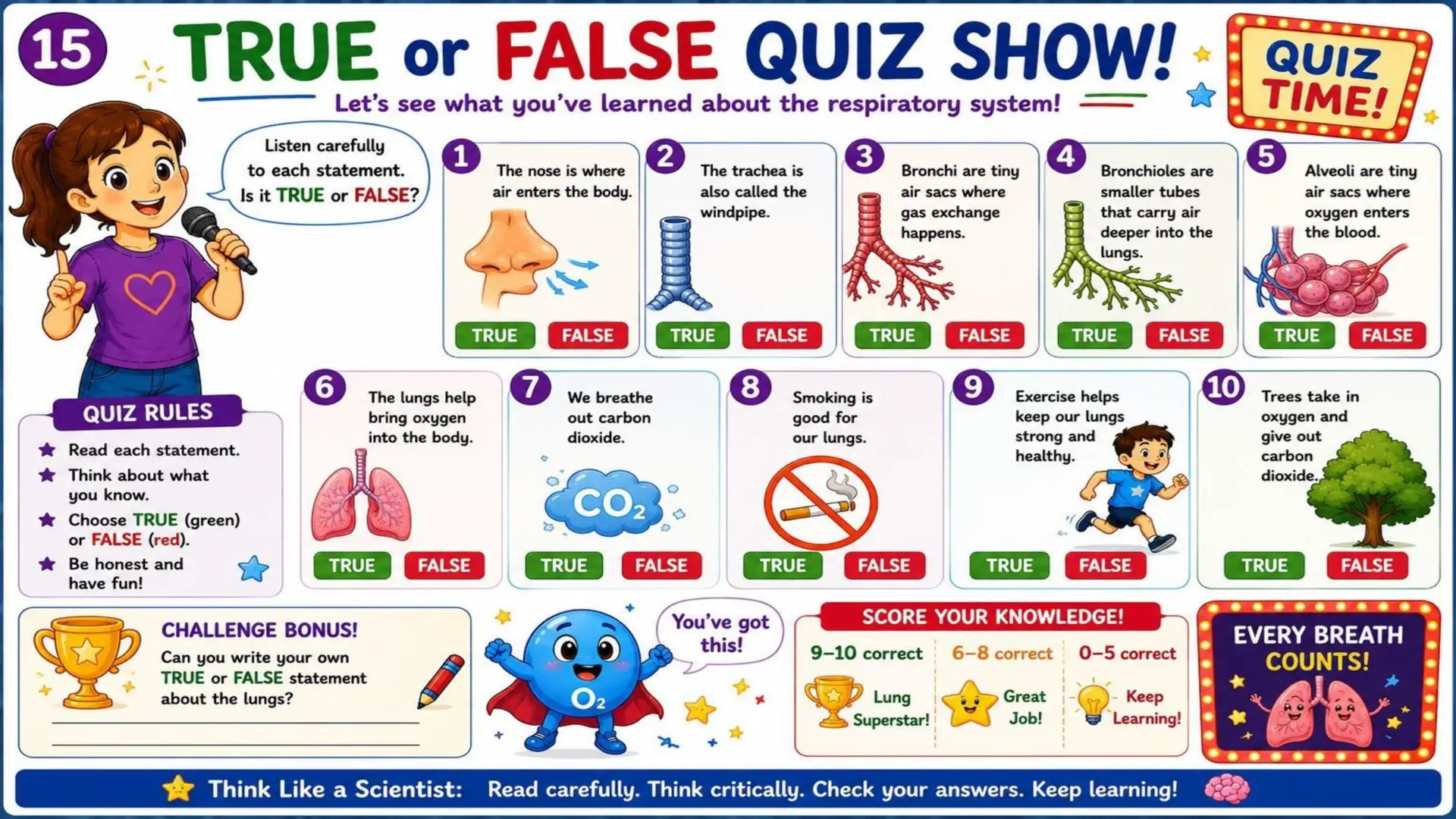
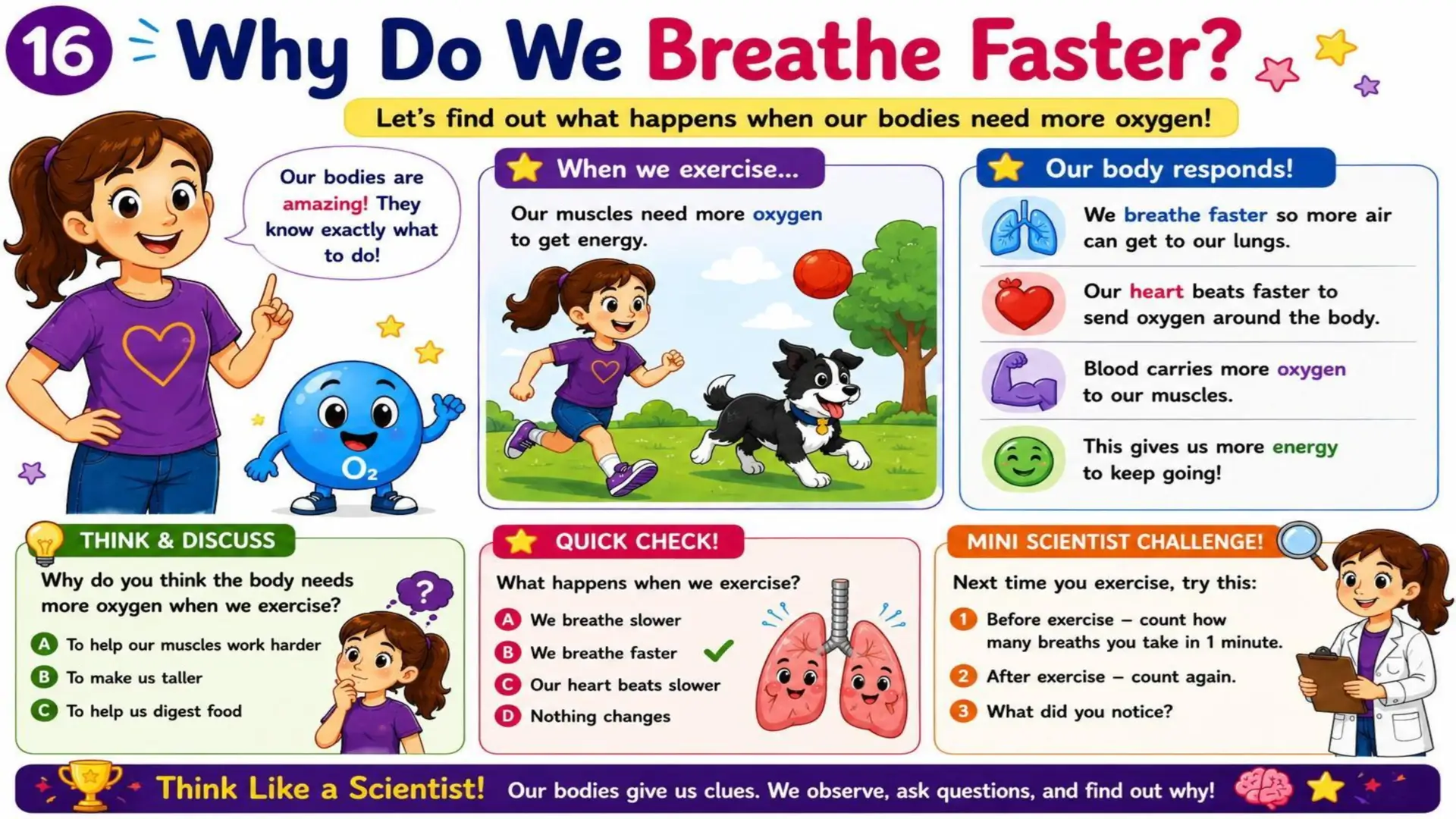
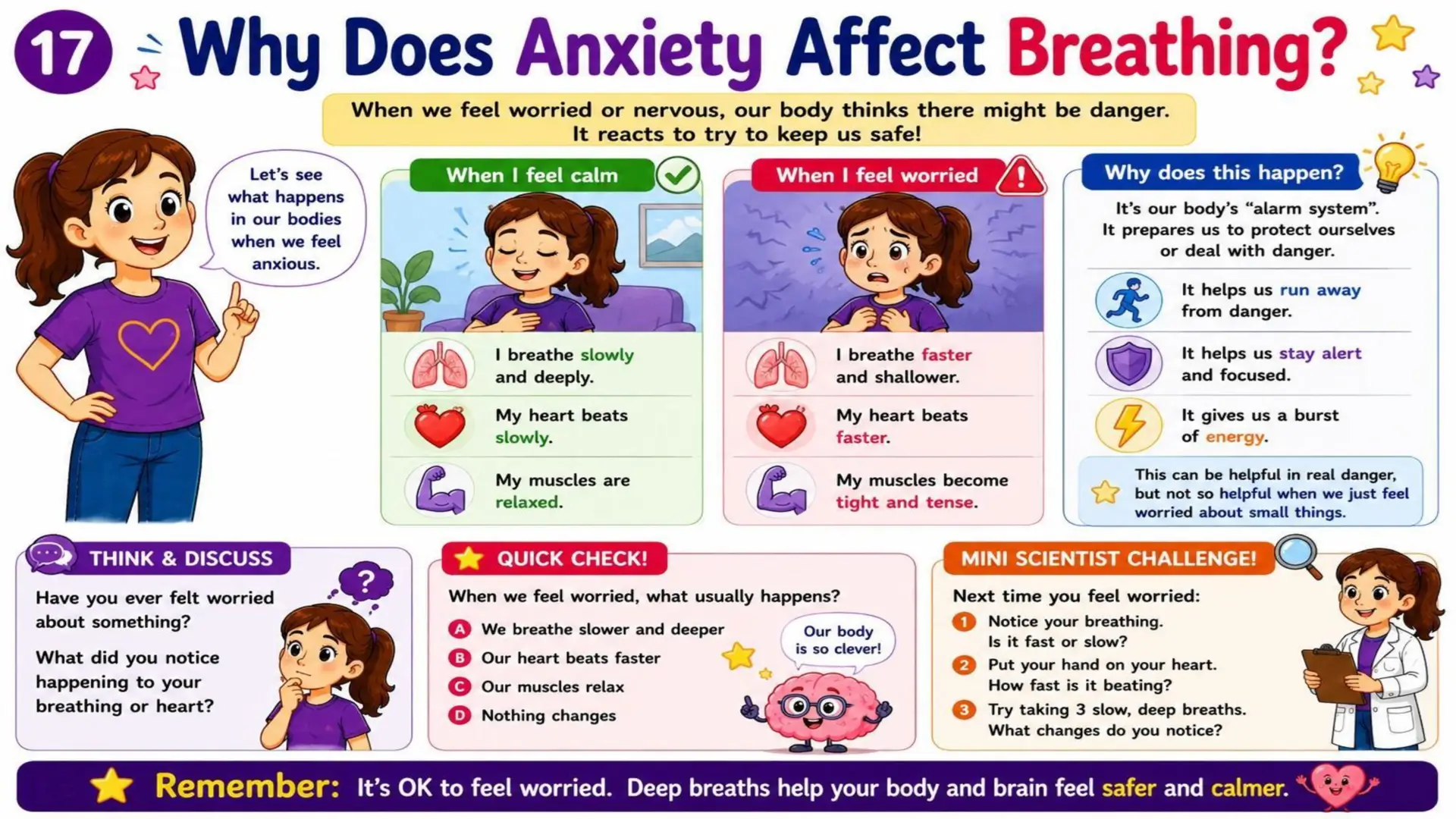
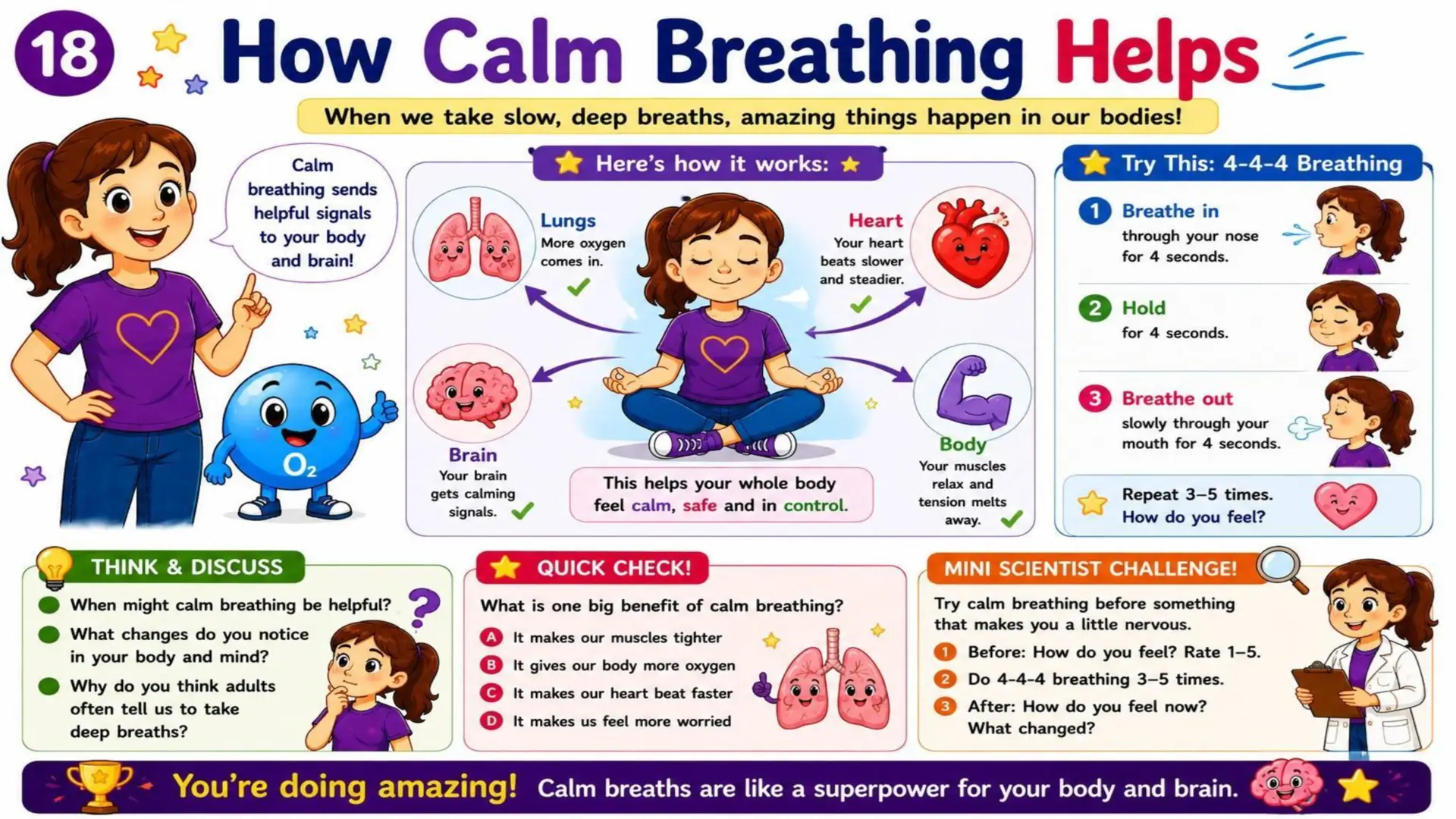
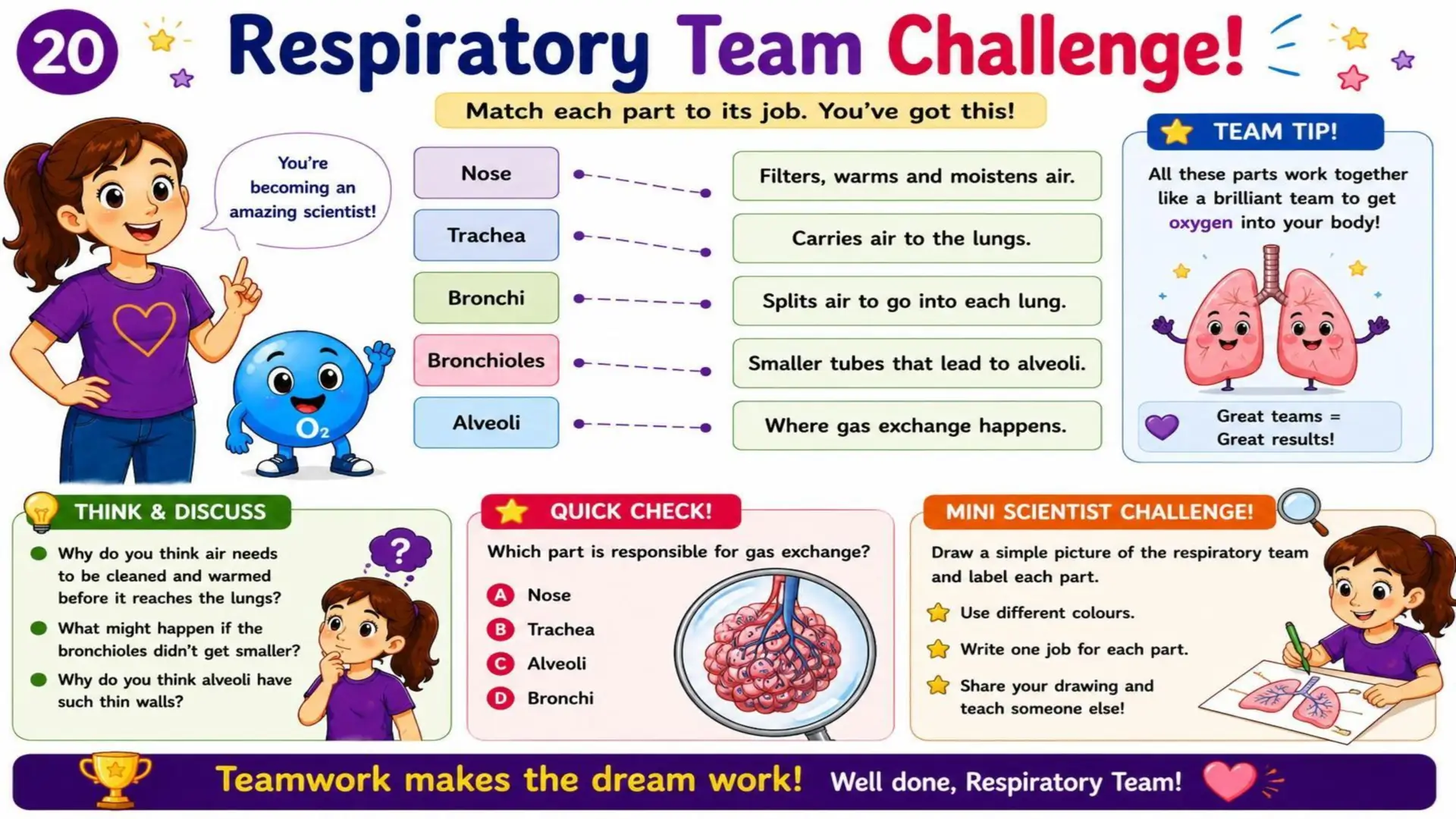
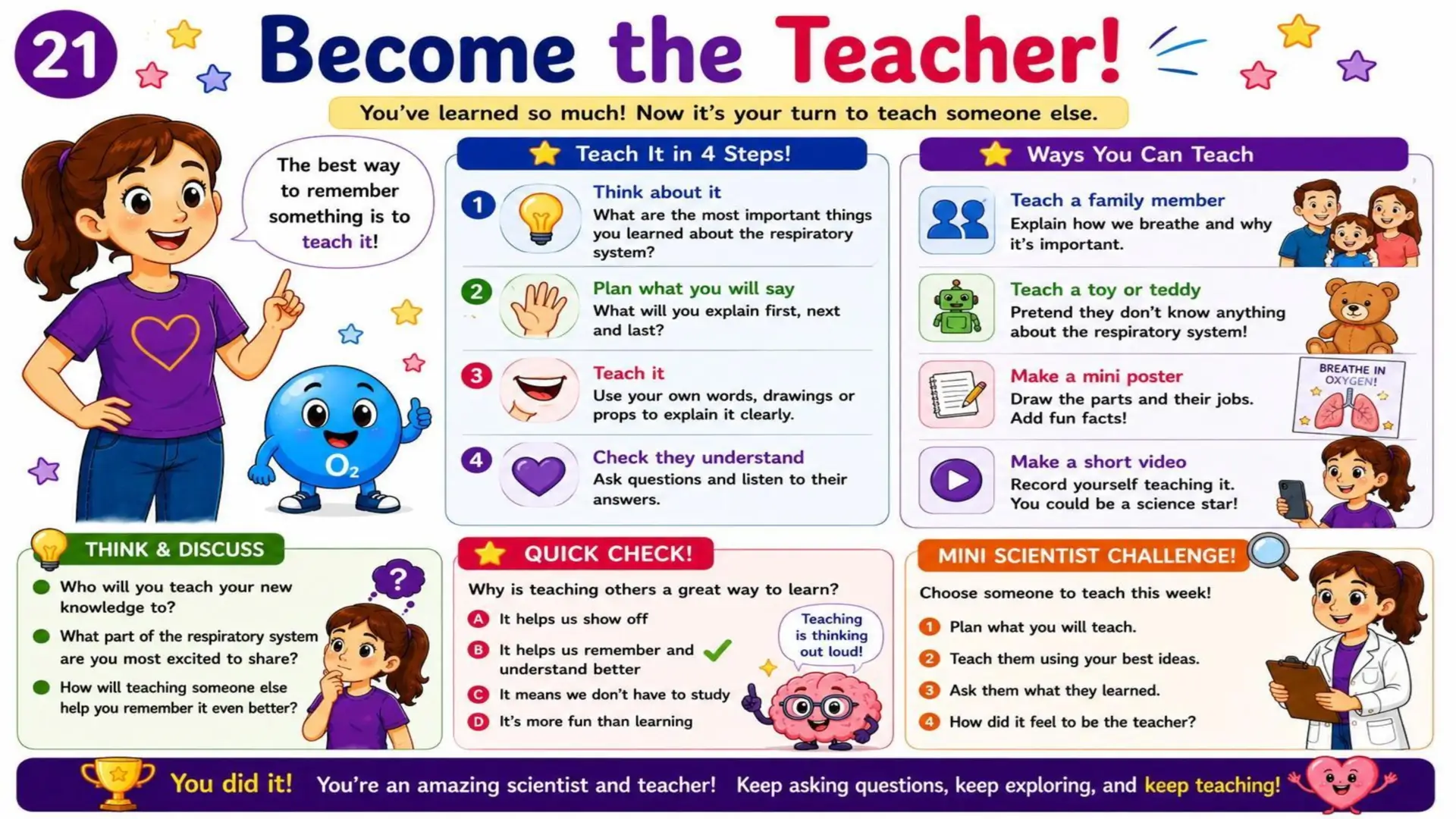
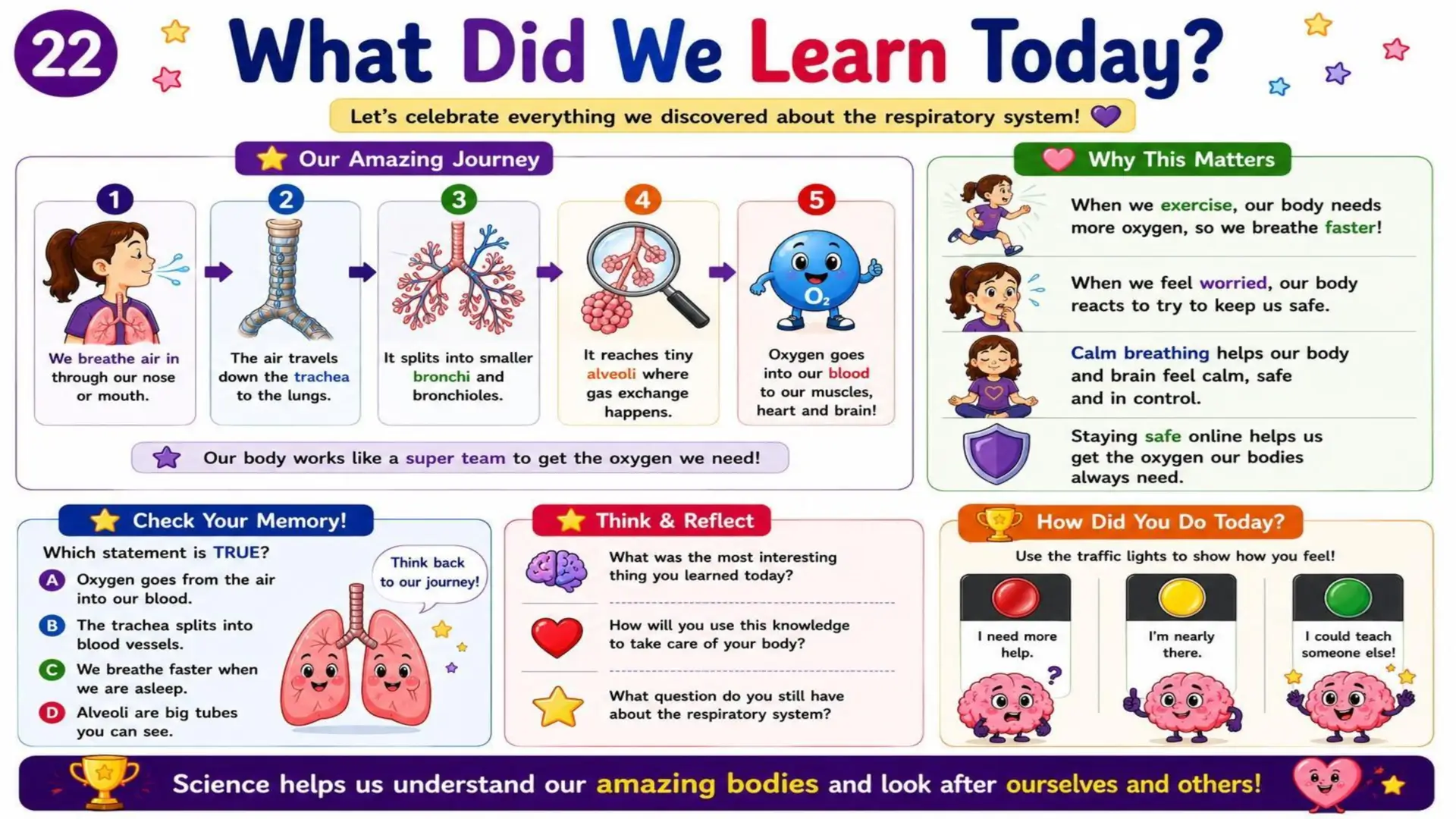
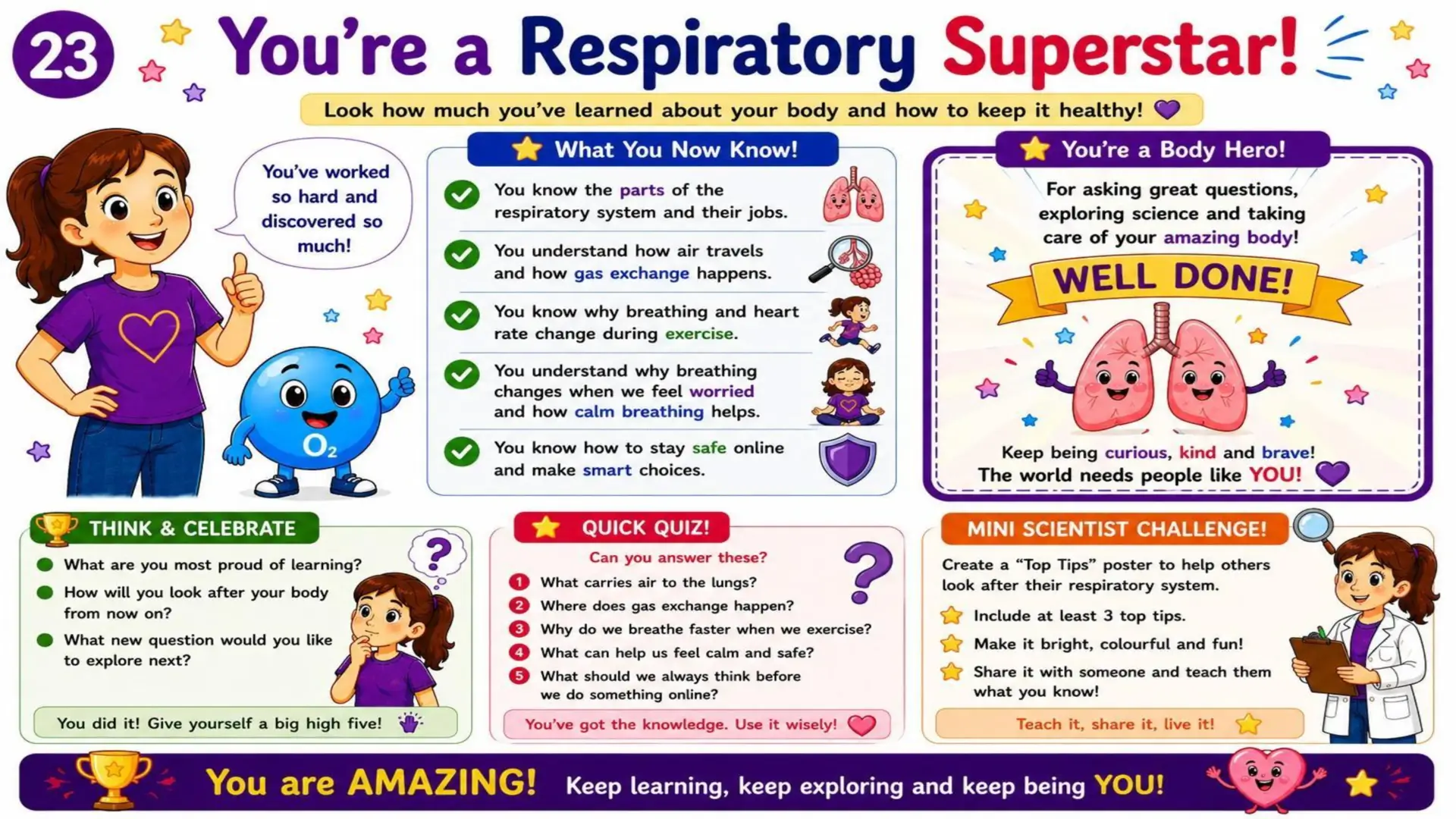
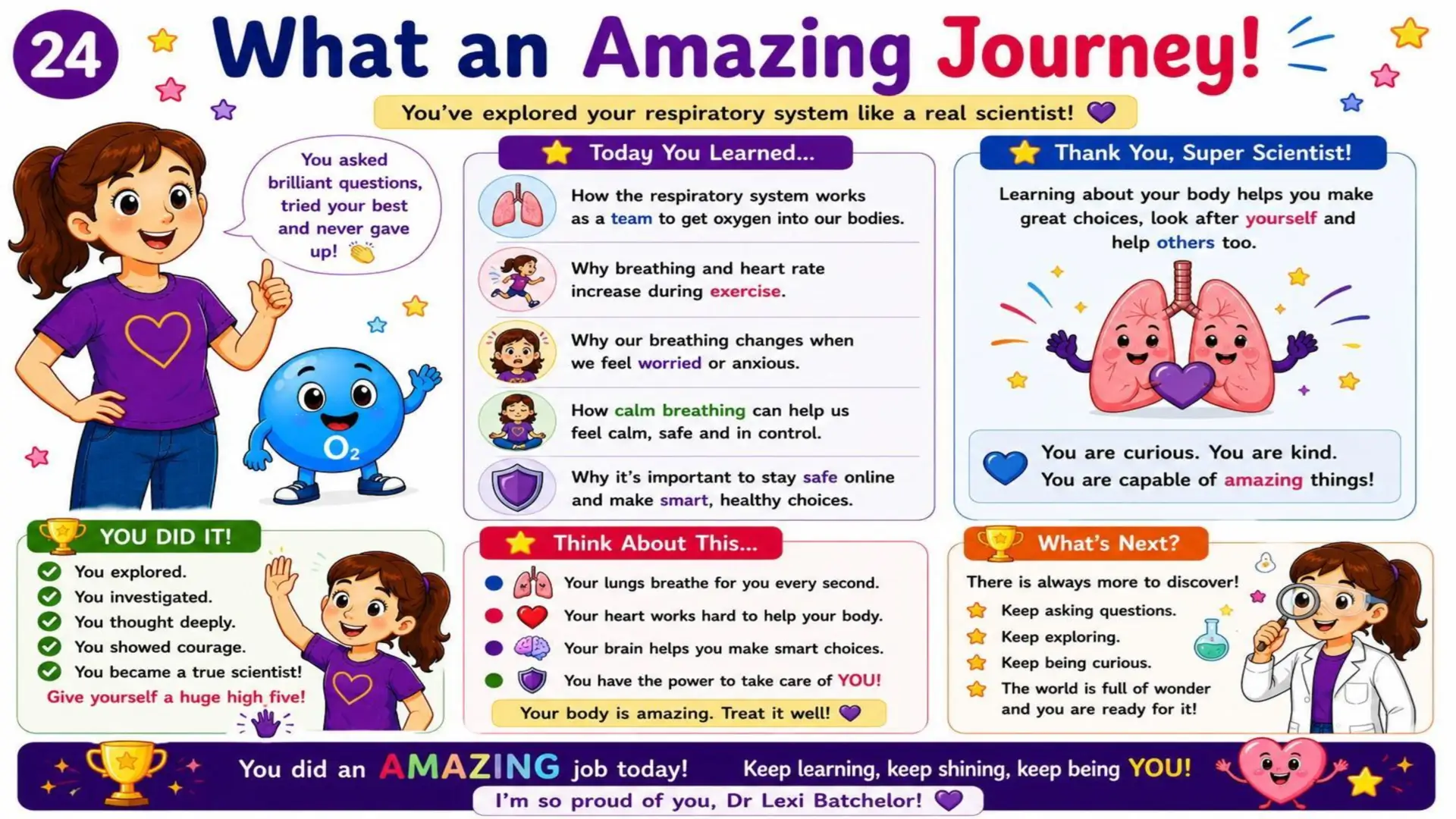
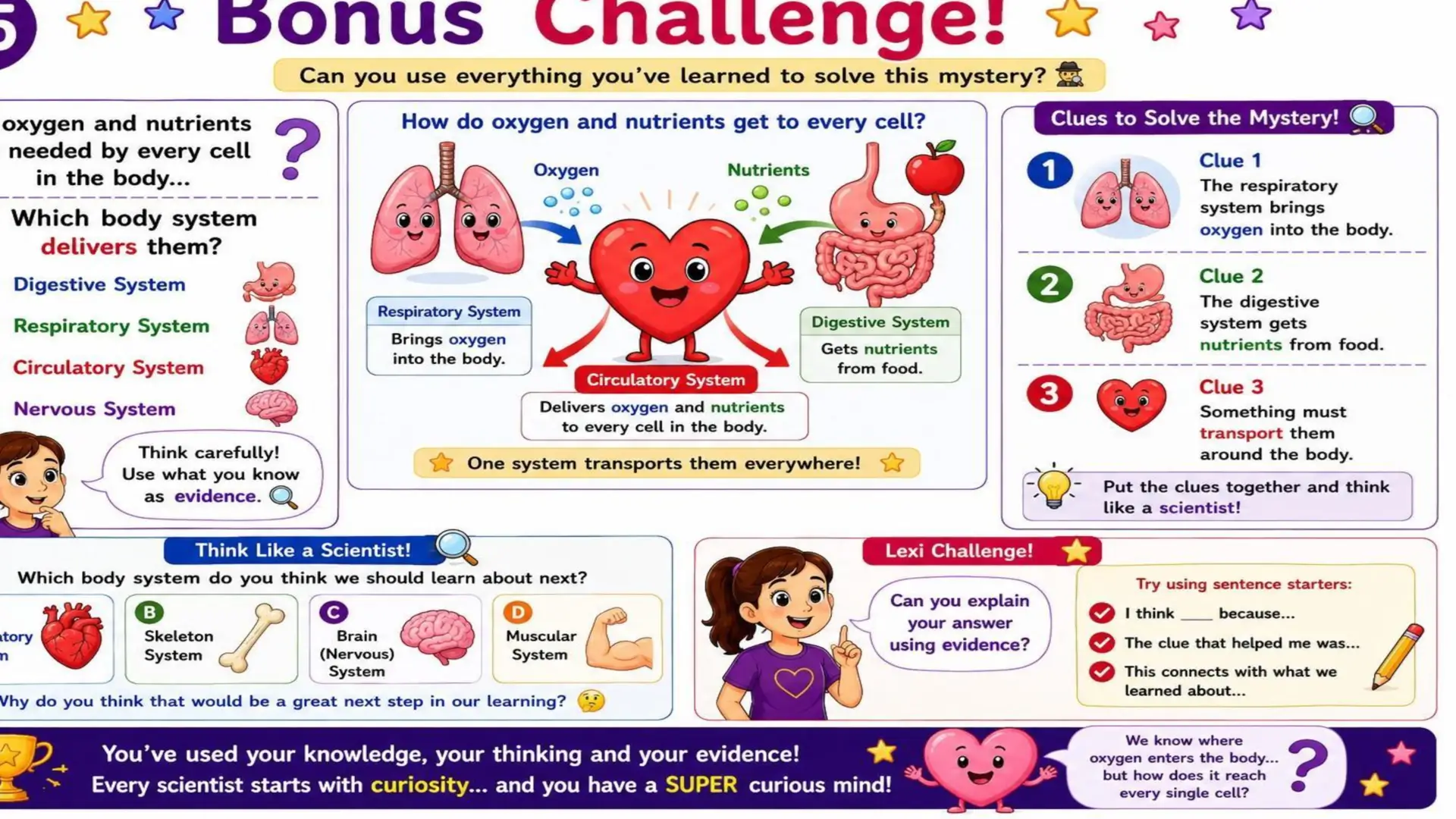
The Respiratory System: The Amazing Journey of Oxygen
Topic
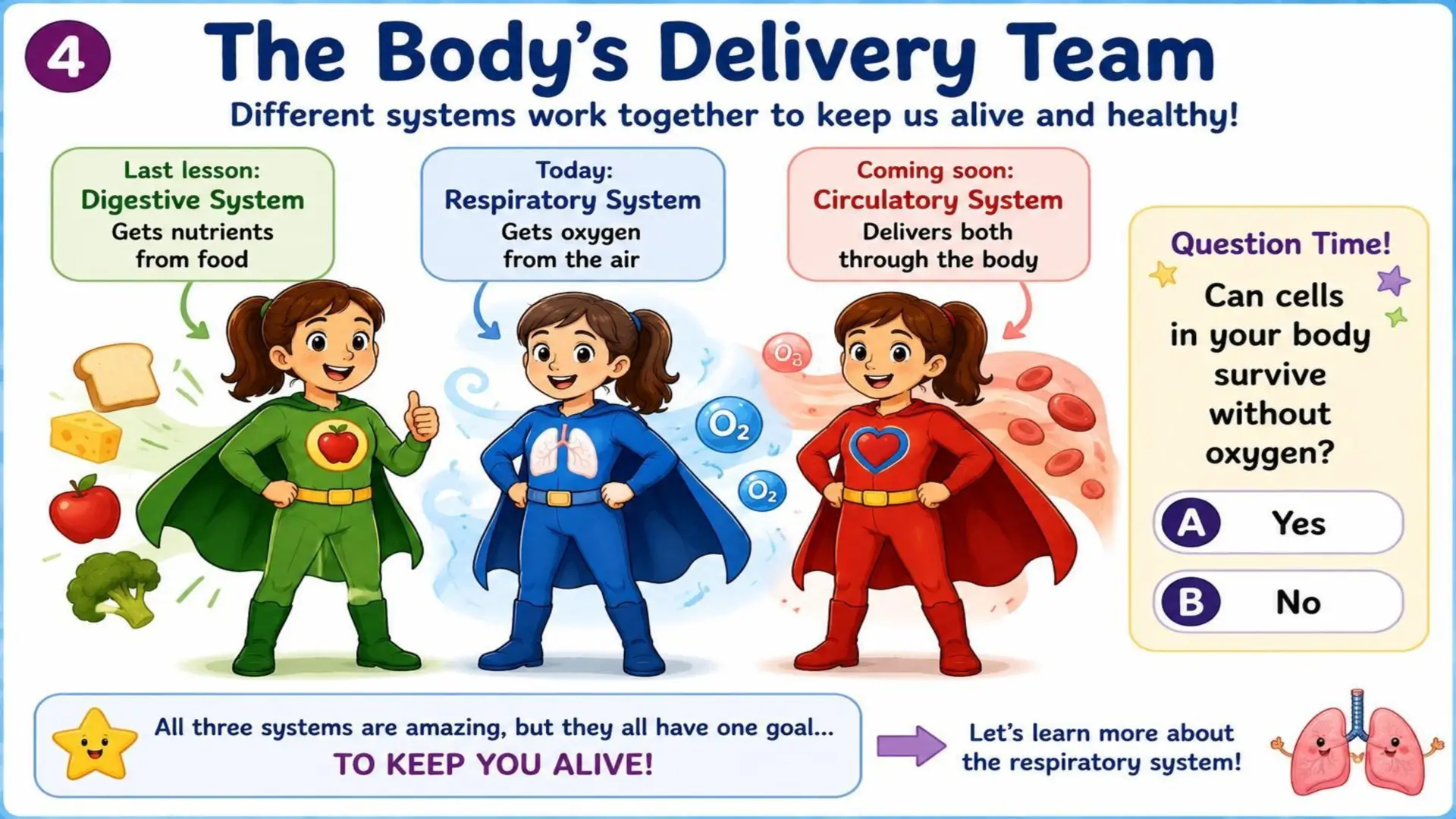
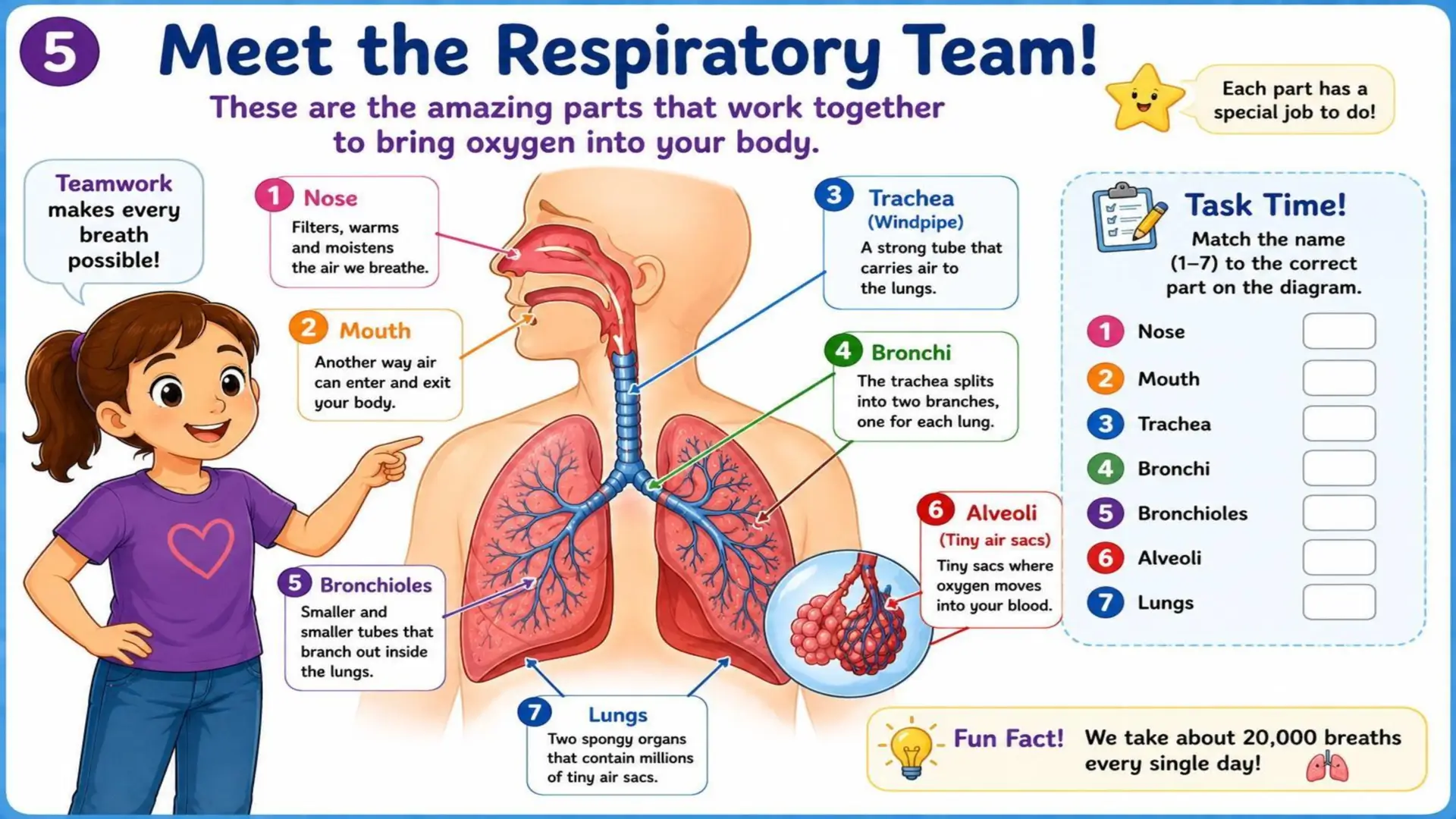
Understanding the human respiratory system through the "Delivery Company" approach. Students explore how oxygen travels through the body, discover the functions of key organs involved in breathing, and learn how these systems work together to keep us alive.
Learning Objectives
By the end of the lesson, students will be able to:
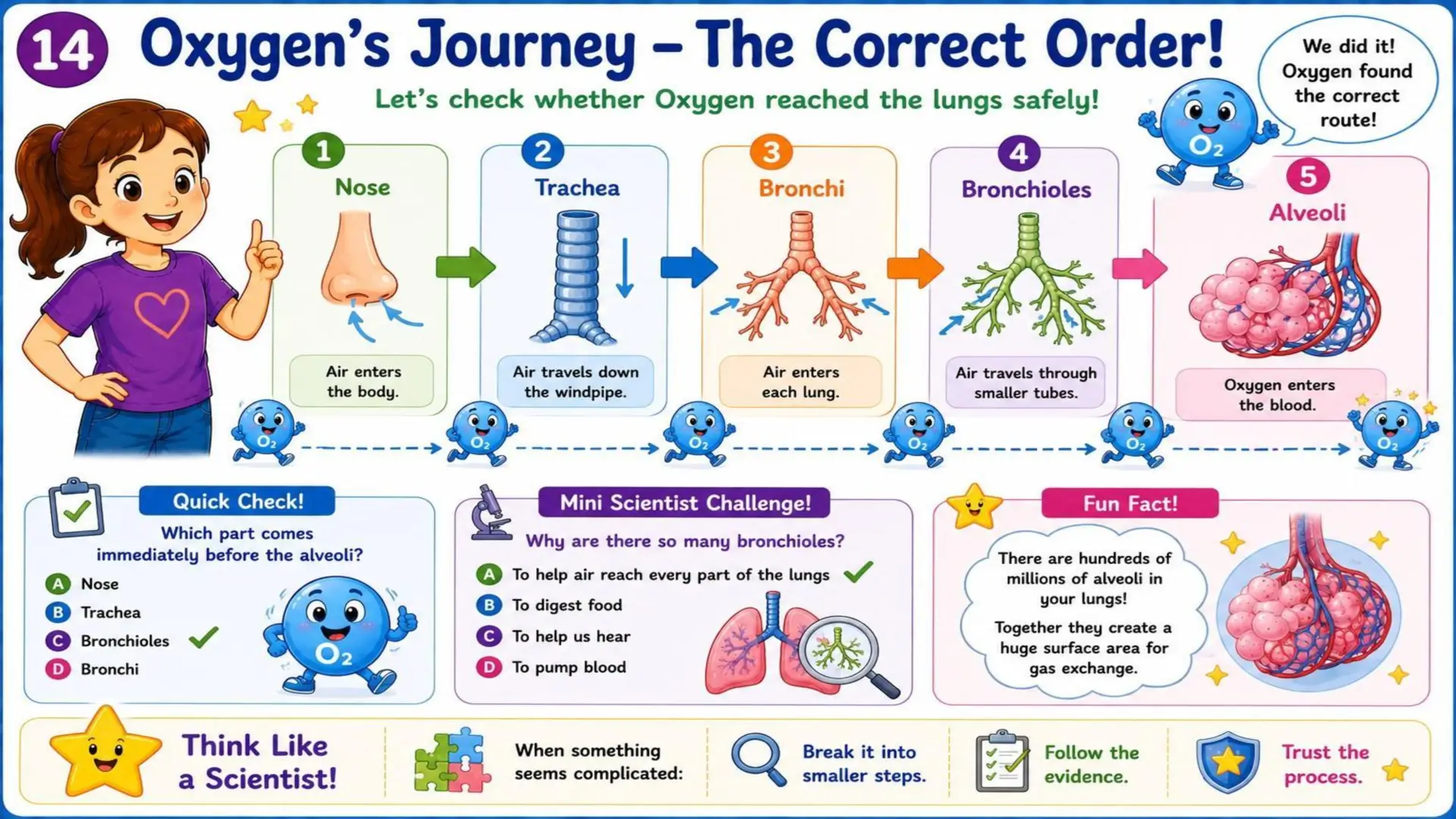
Identify the main organs of the respiratory system.
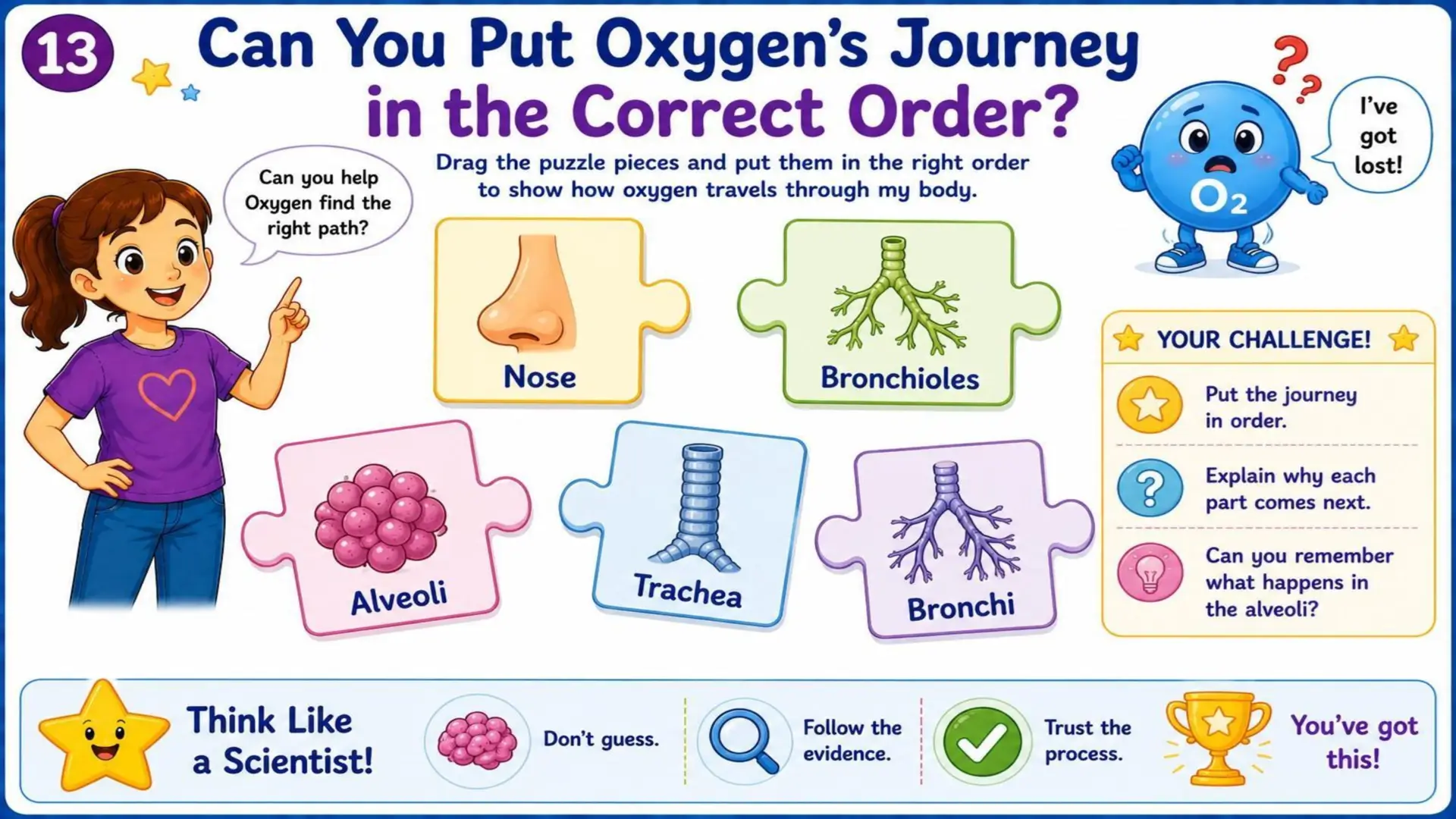
Describe the journey of oxygen from the air to the body's cells.
Explain the process of gas exchange in the alveoli.
Understand the relationship between the respiratory and circulatory systems.
Apply scientific knowledge to everyday situations, including exercise, breathing, and anxiety.
Teaching Methodology
This lesson uses the Delivery Company methodology, transforming the human body into a familiar delivery network that helps students visualise complex biological processes. By assigning meaningful roles to organs and body systems, abstract scientific concepts become easier to understand, remember and explain.
The lesson follows an enquiry-based structure that encourages active participation and scientific thinking:
- Engaging real-life scenario and discussion.
- Introduction of the body's "delivery team".
- Guided exploration of the respiratory system and oxygen's journey.
- Interactive sequencing and retrieval activities.
- Application of knowledge through problem-solving and discussion.
- Reflection, review and self-assessment.
The Delivery Company approach combines storytelling, visual learning, retrieval practice and real-world application to develop scientific understanding while increasing engagement, curiosity and confidence. Students are encouraged to explain ideas using scientific vocabulary and to make meaningful connections between classroom learning and everyday life.
Preview the lesson in the next tab or Download it as .PPTX.



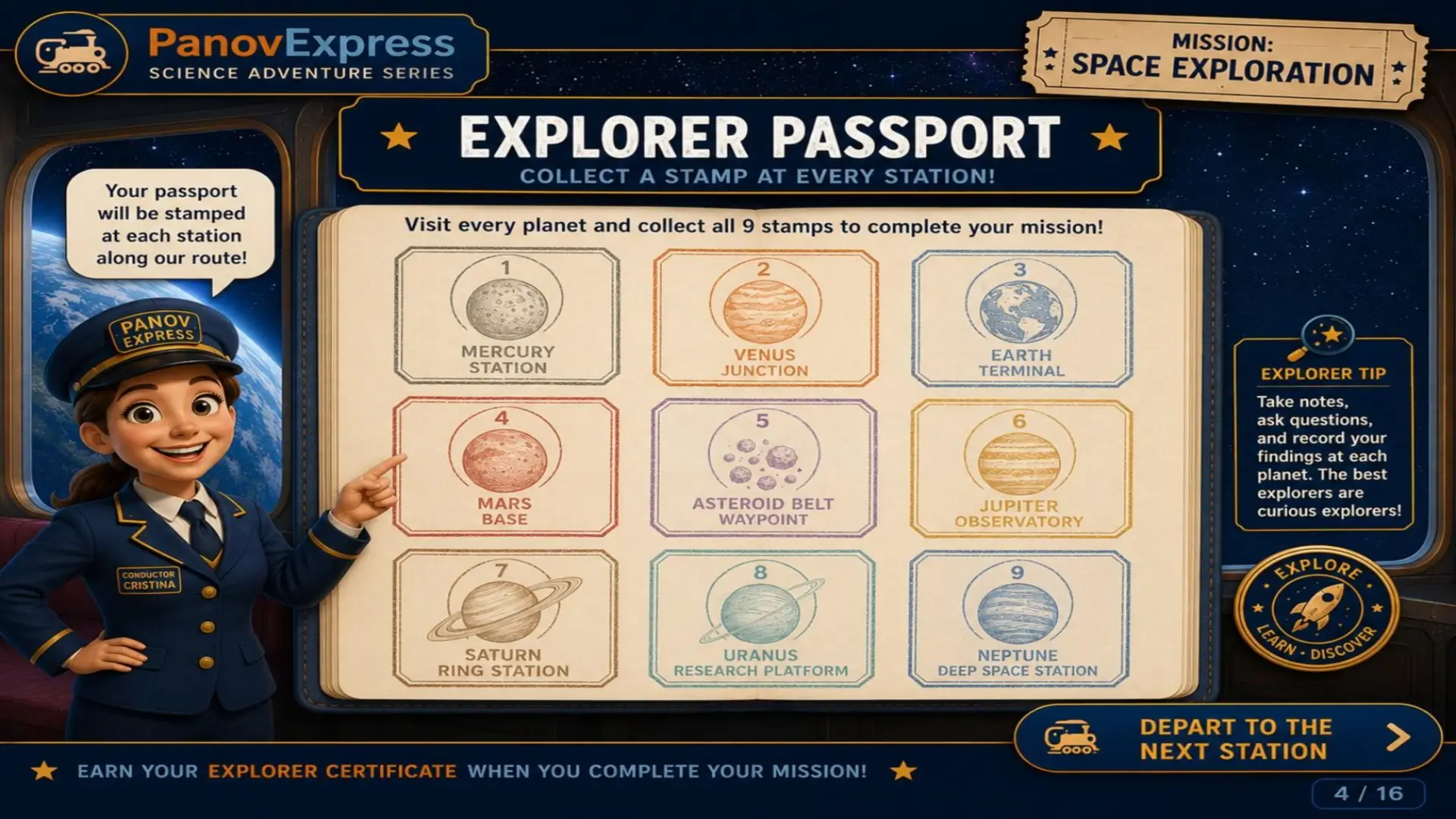
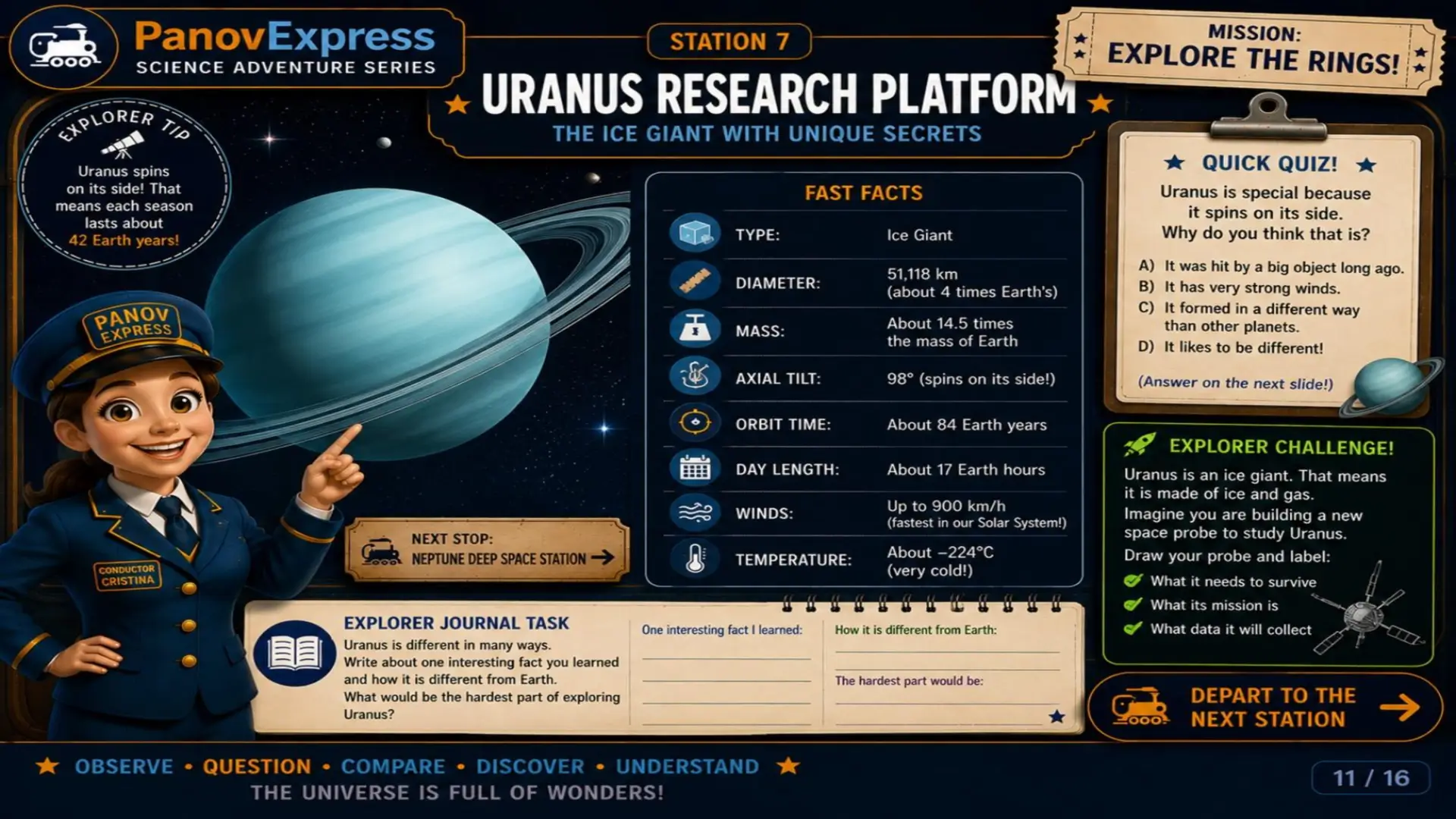
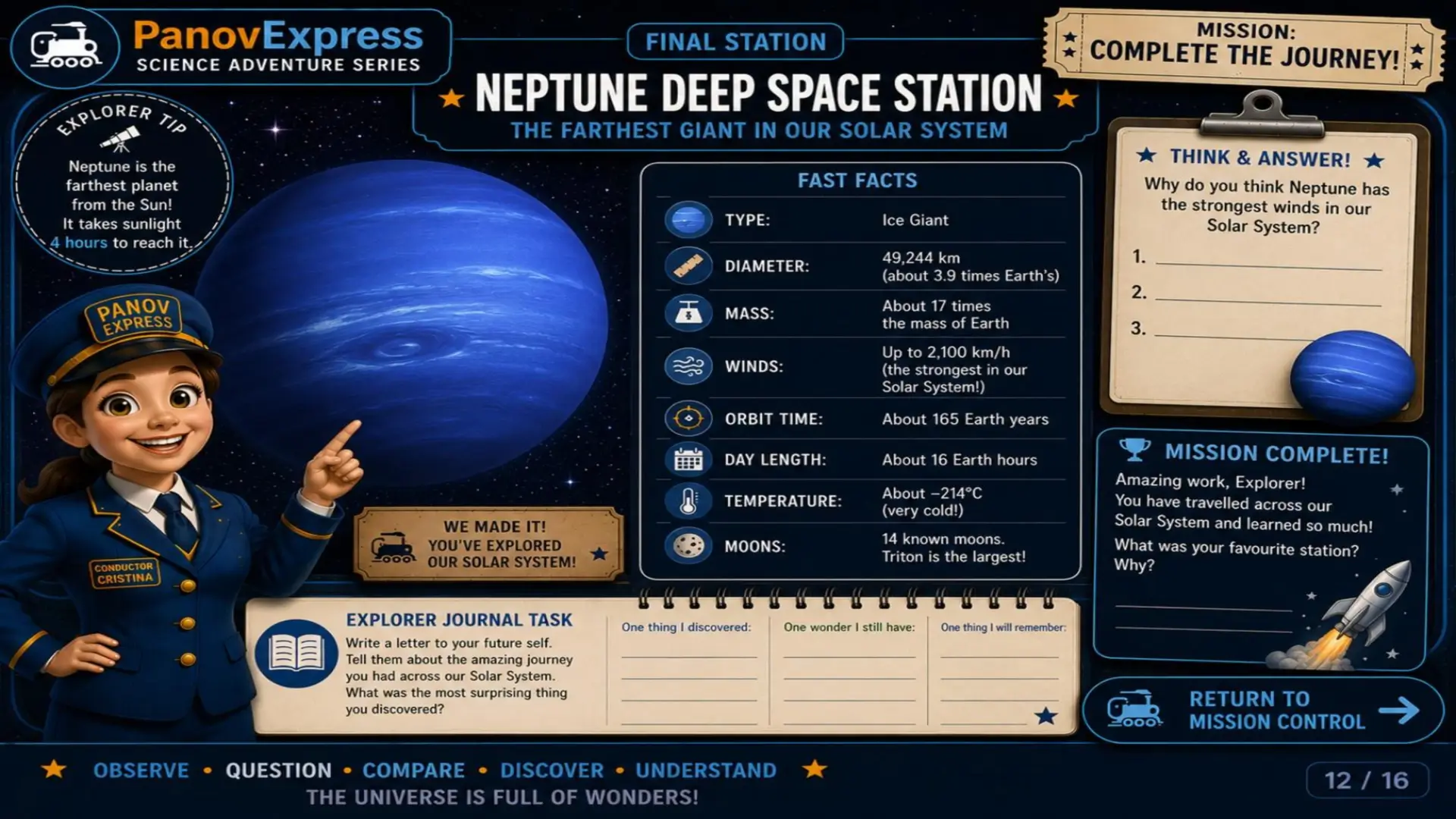
Space Exploration: Journey Through Our Solar System
Topic
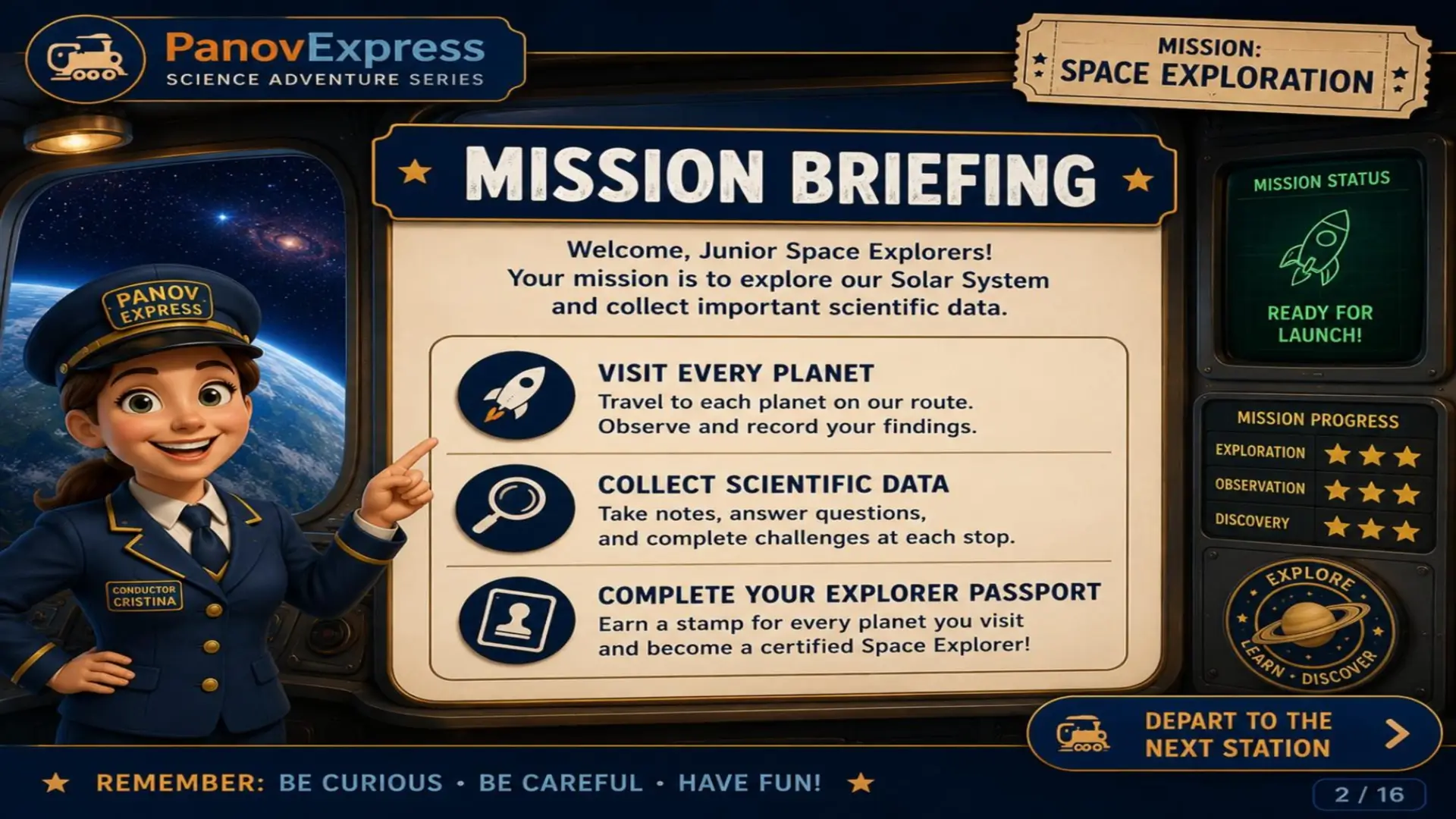
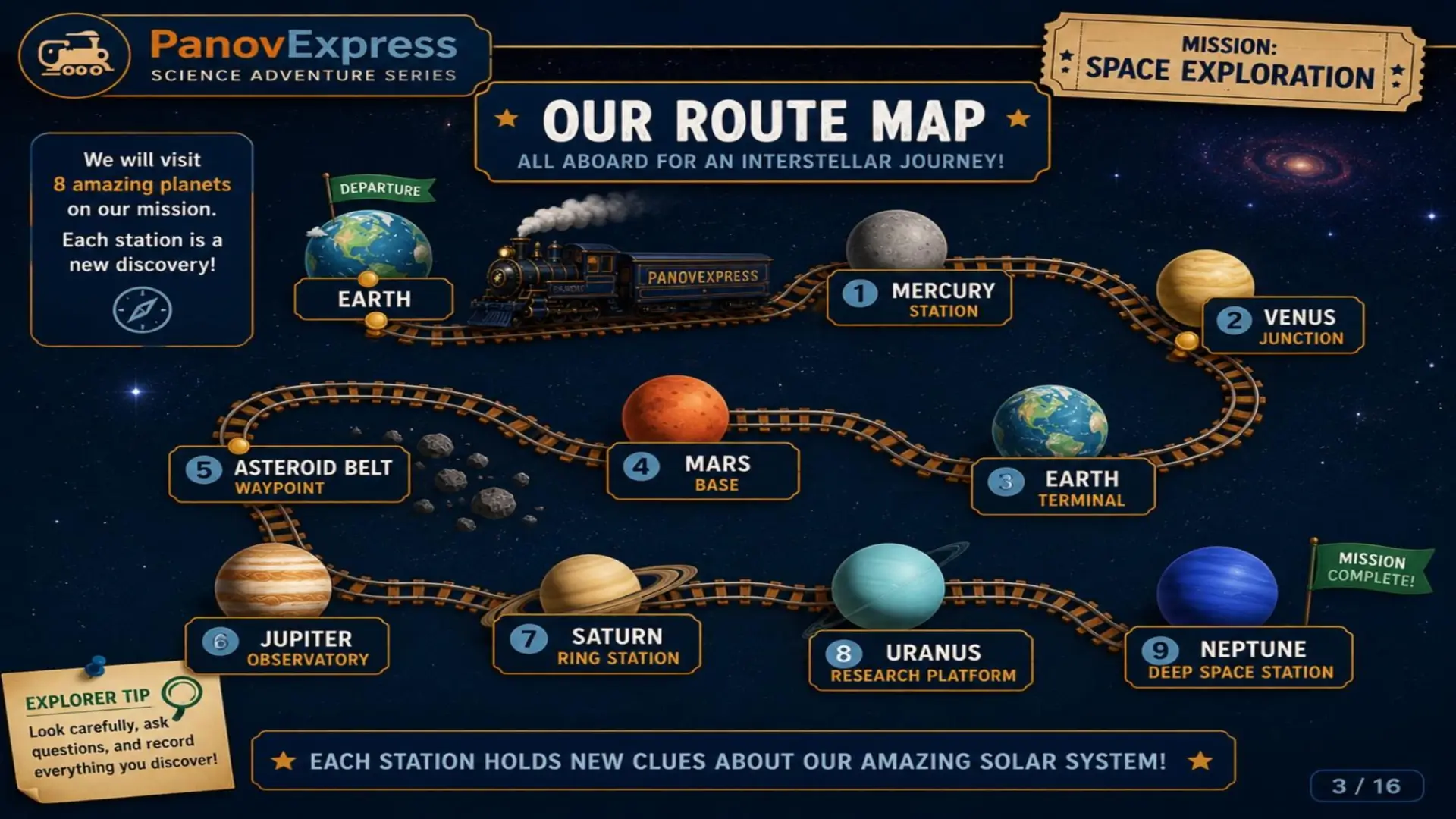
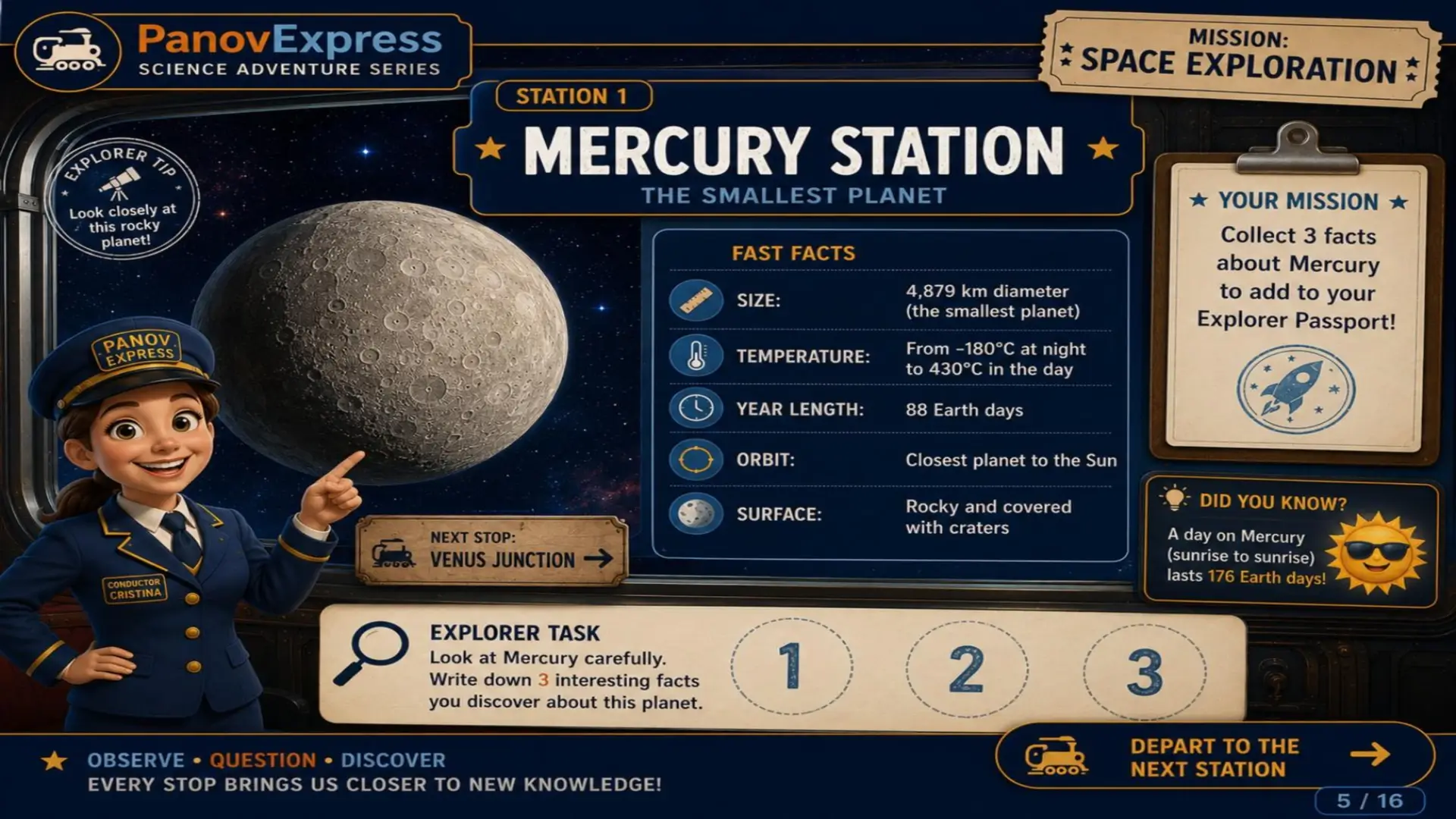
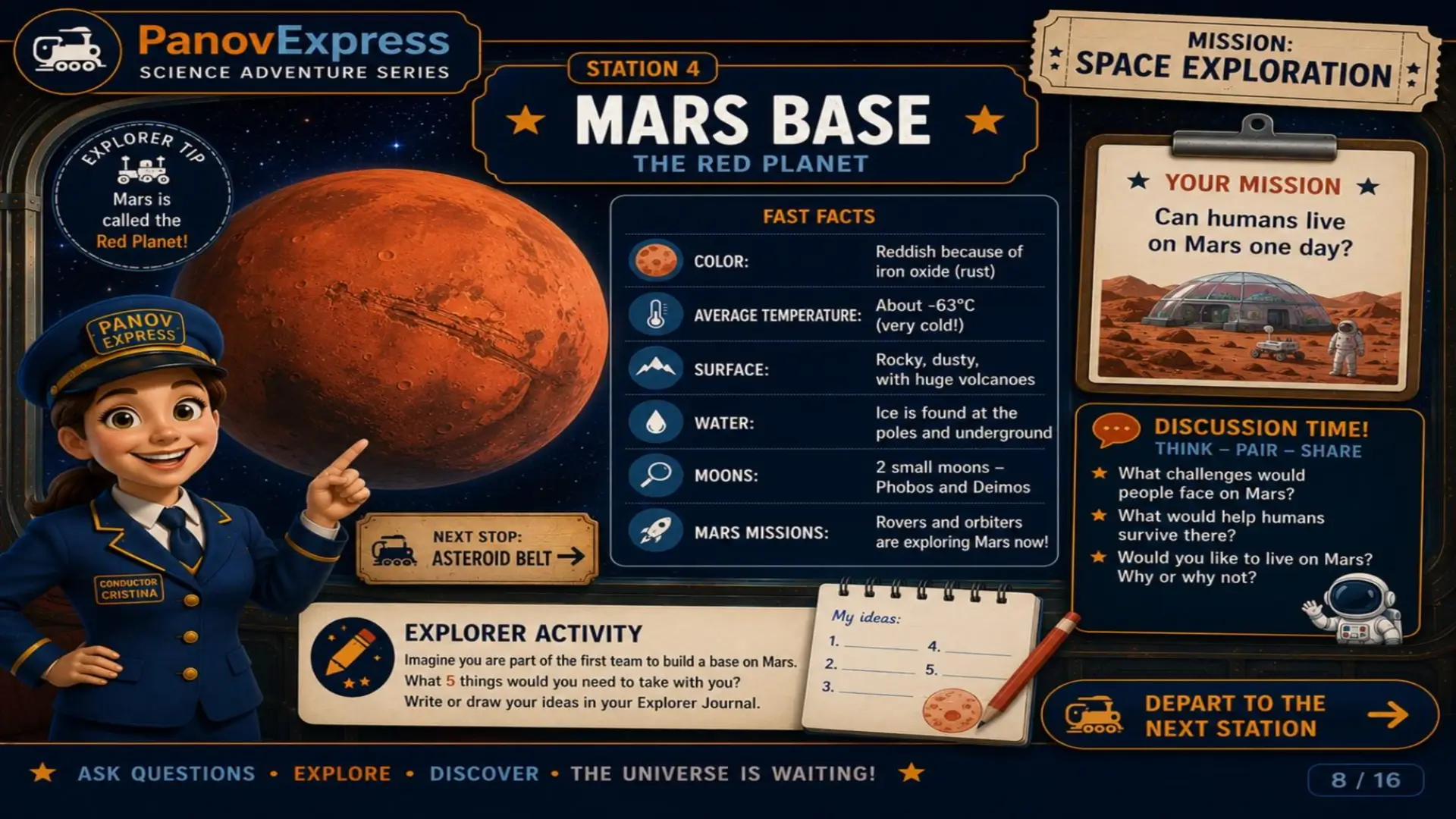
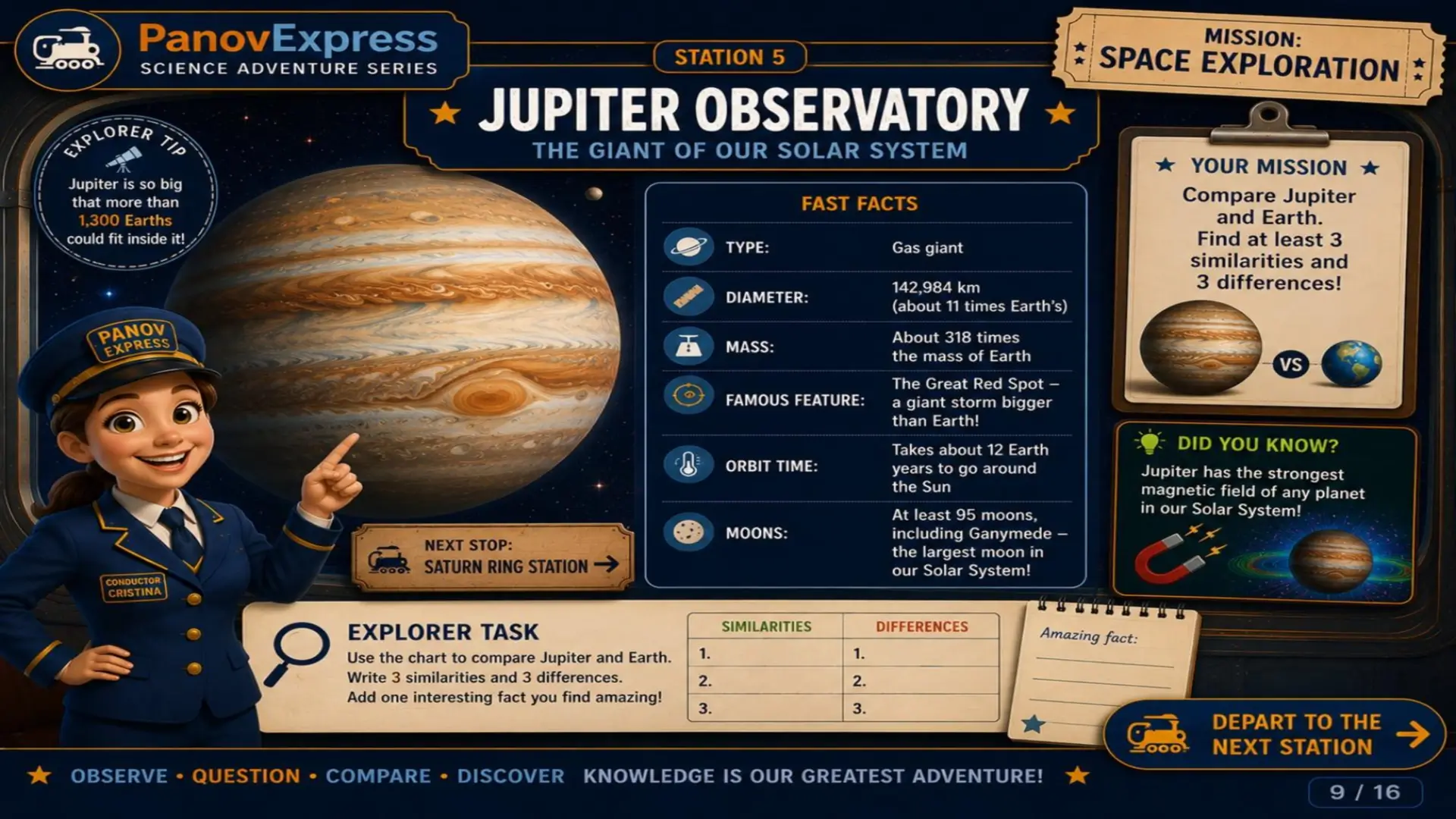
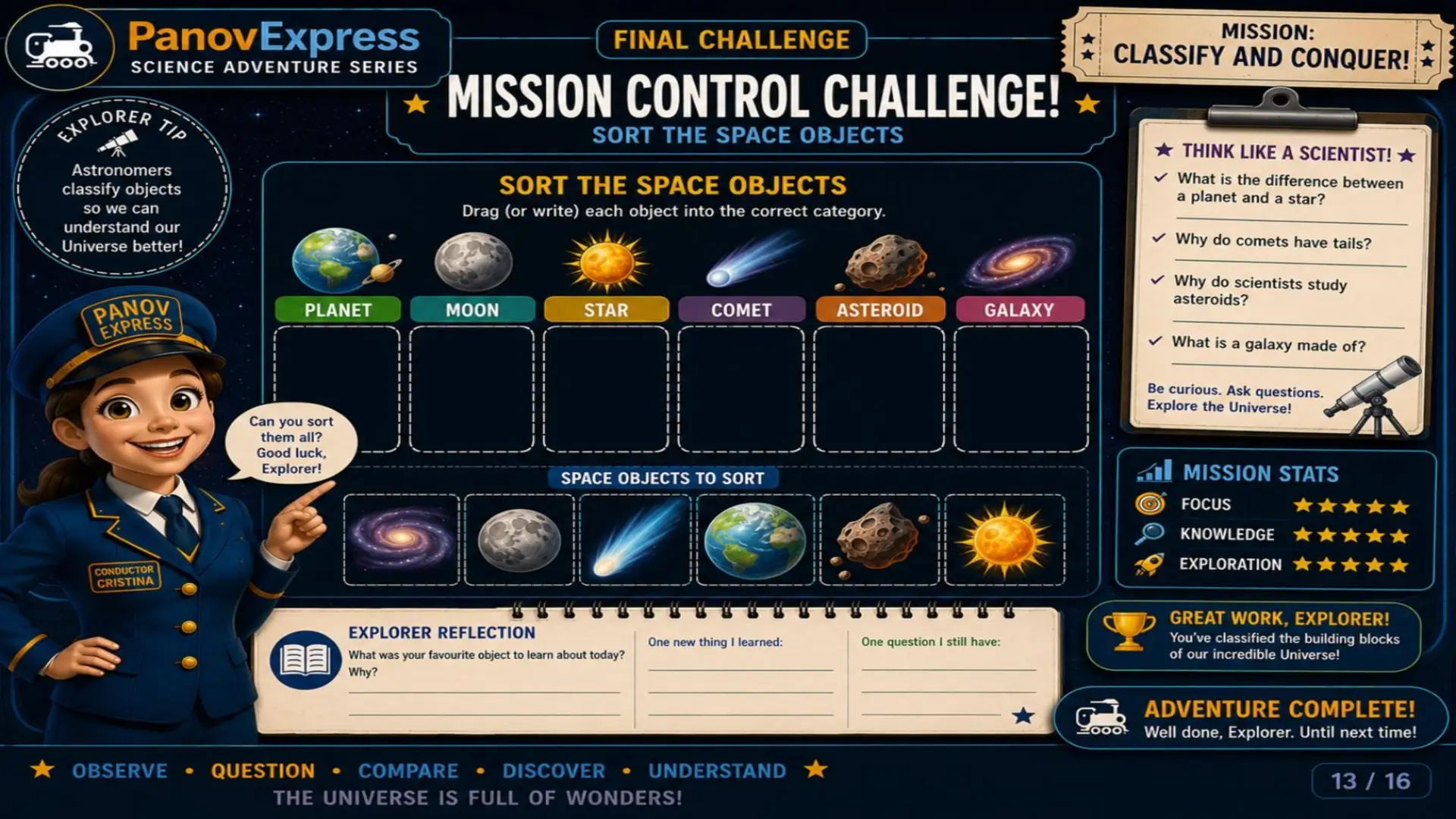
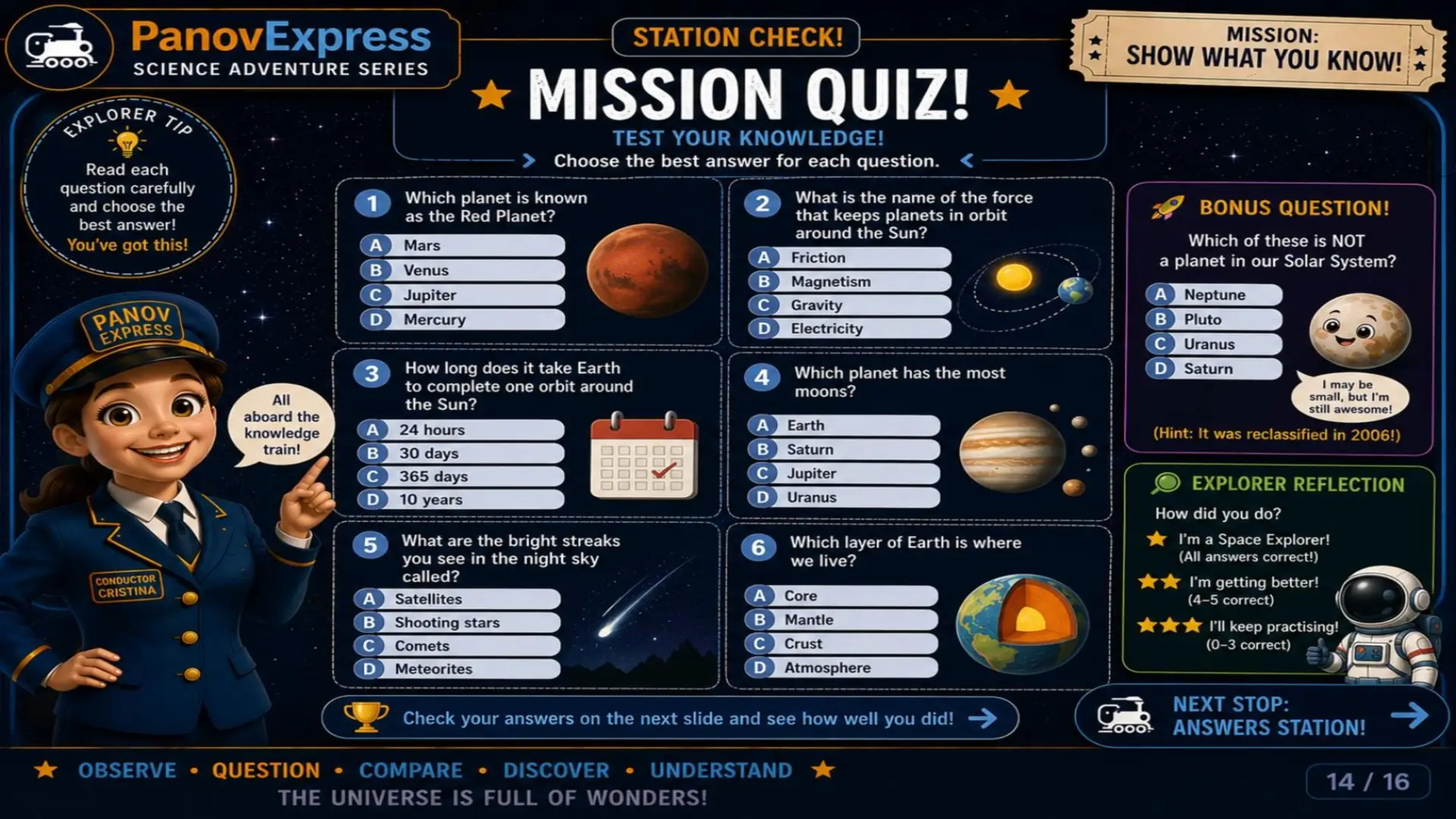
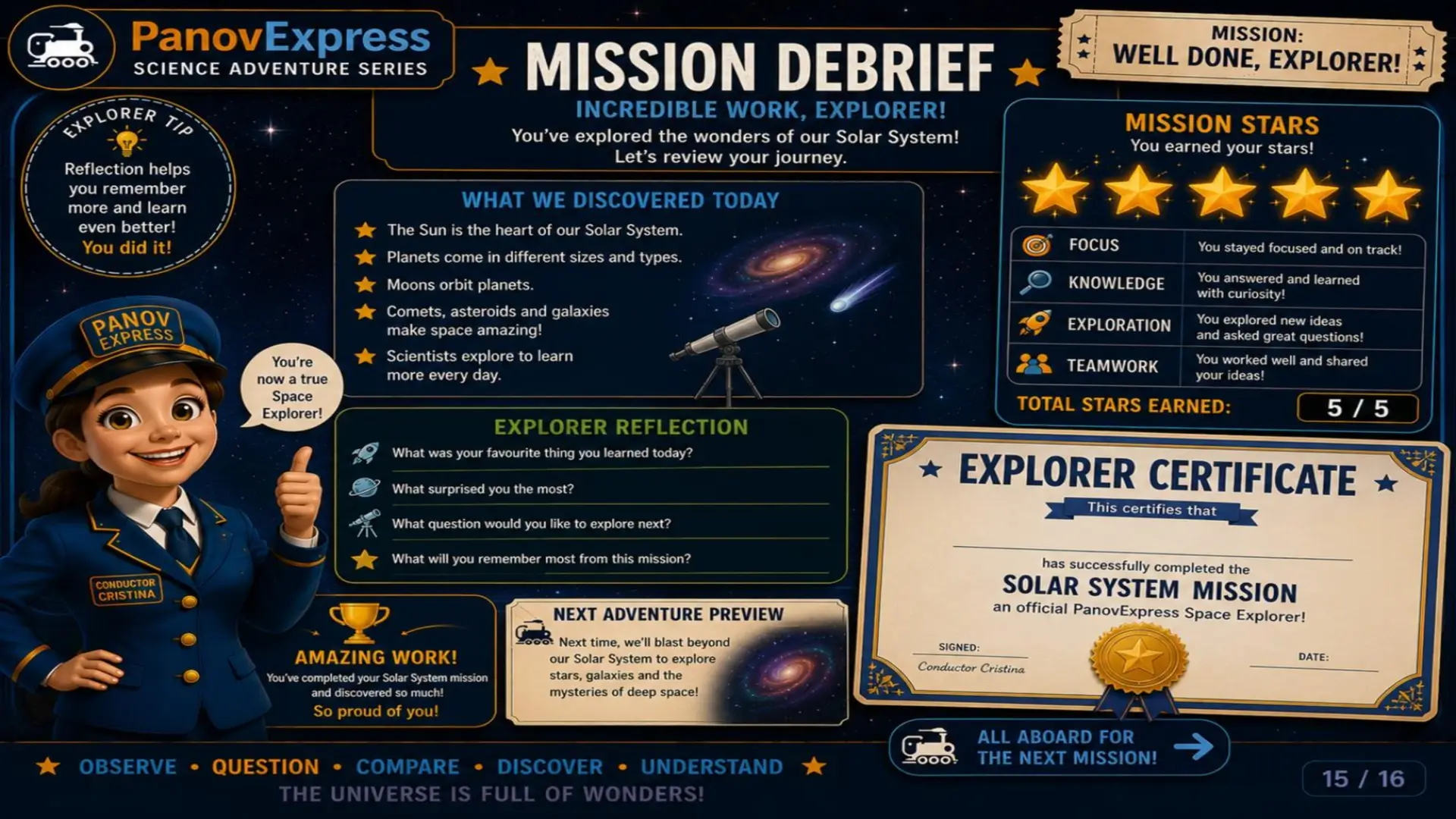
An immersive science adventure in which pupils become Junior Space Explorers, travelling across the Solar System aboard the PanovExpress. Learners investigate each planet through observation, discussion, comparison activities, scientific enquiry and problem-solving before completing their mission as certified Space Explorers.
Learning Objectives
By the end of the lesson, pupils will be able to:
- Identify the eight planets of the Solar System.
- Describe key characteristics of each planet.
- Compare planets using scientific vocabulary.
- Explain why planets differ in temperature, size and composition.
- Develop scientific enquiry skills through questioning and investigation.
- Apply knowledge through quizzes, classification activities and reflection tasks.
- Communicate scientific ideas verbally and in writing.
Teaching Methodology
This lesson uses the PanovExpress approach to science, combining curriculum knowledge with immersive storytelling and enquiry-based learning.
Features include:
- Role-based learning (children become Junior Space Explorers)
- Mission-based progression through themed "stations"
- Observation and scientific enquiry
- Think–Pair–Share discussion activities
- Guided recording and Explorer Journal tasks
- Retrieval practice through quizzes and classification challenges
- Reflection and self-assessment
- Mission rewards and Explorer Certificate to celebrate achievement
The lesson encourages curiosity, scientific thinking and active participation while covering key National Curriculum content in an engaging, memorable way.
Preview the lesson in the next tab or Download it as .PPTX.





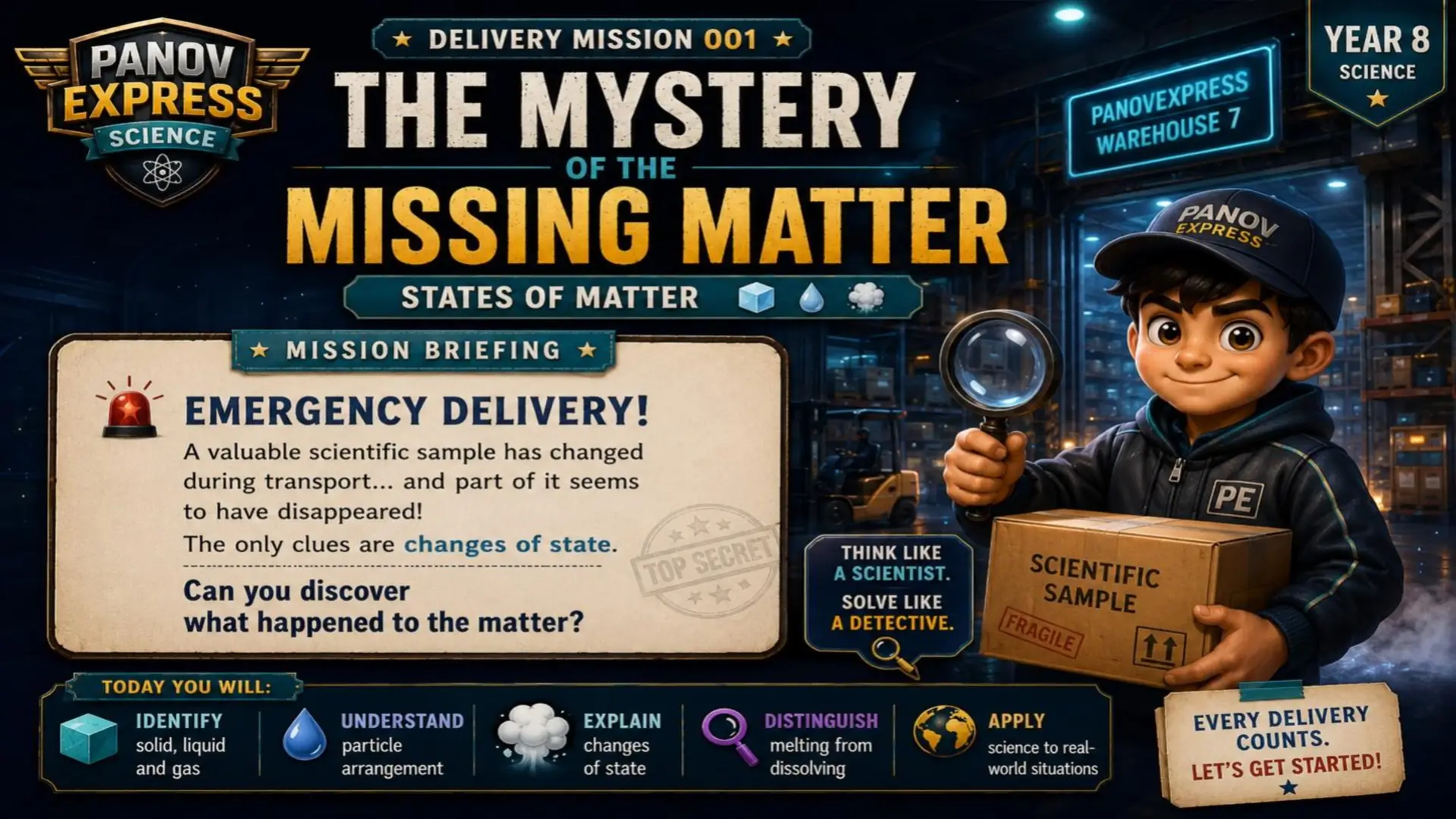
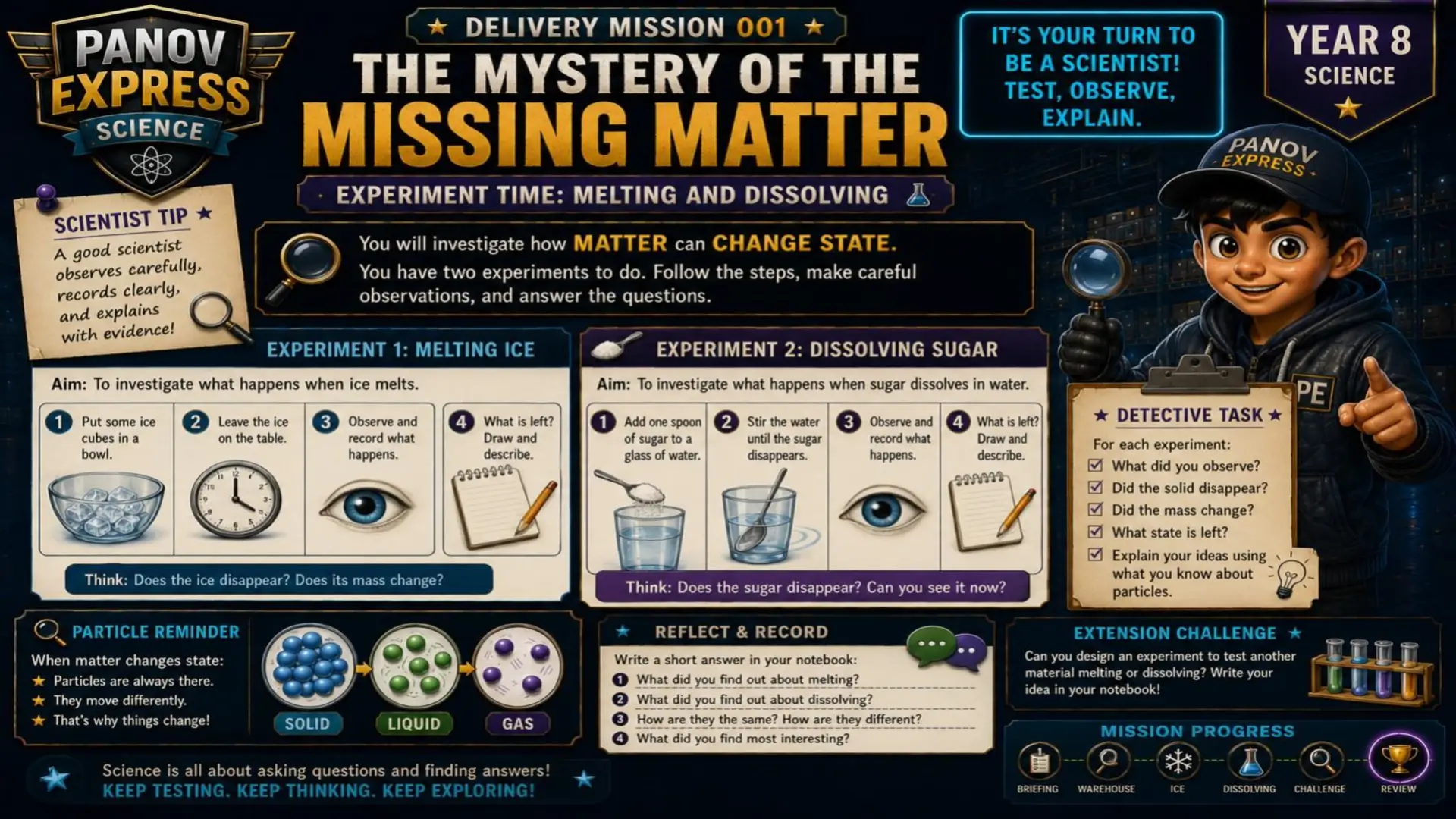
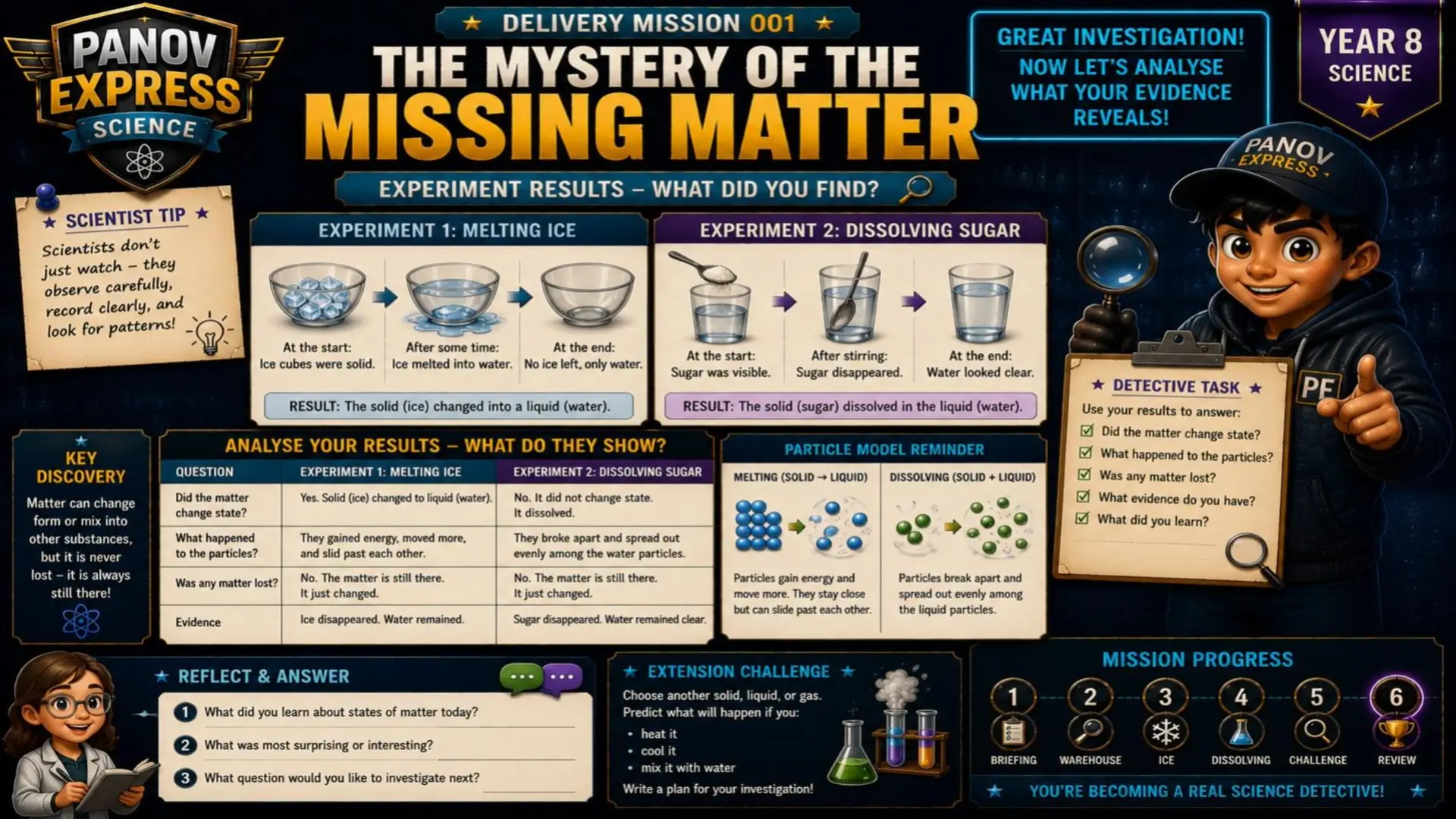
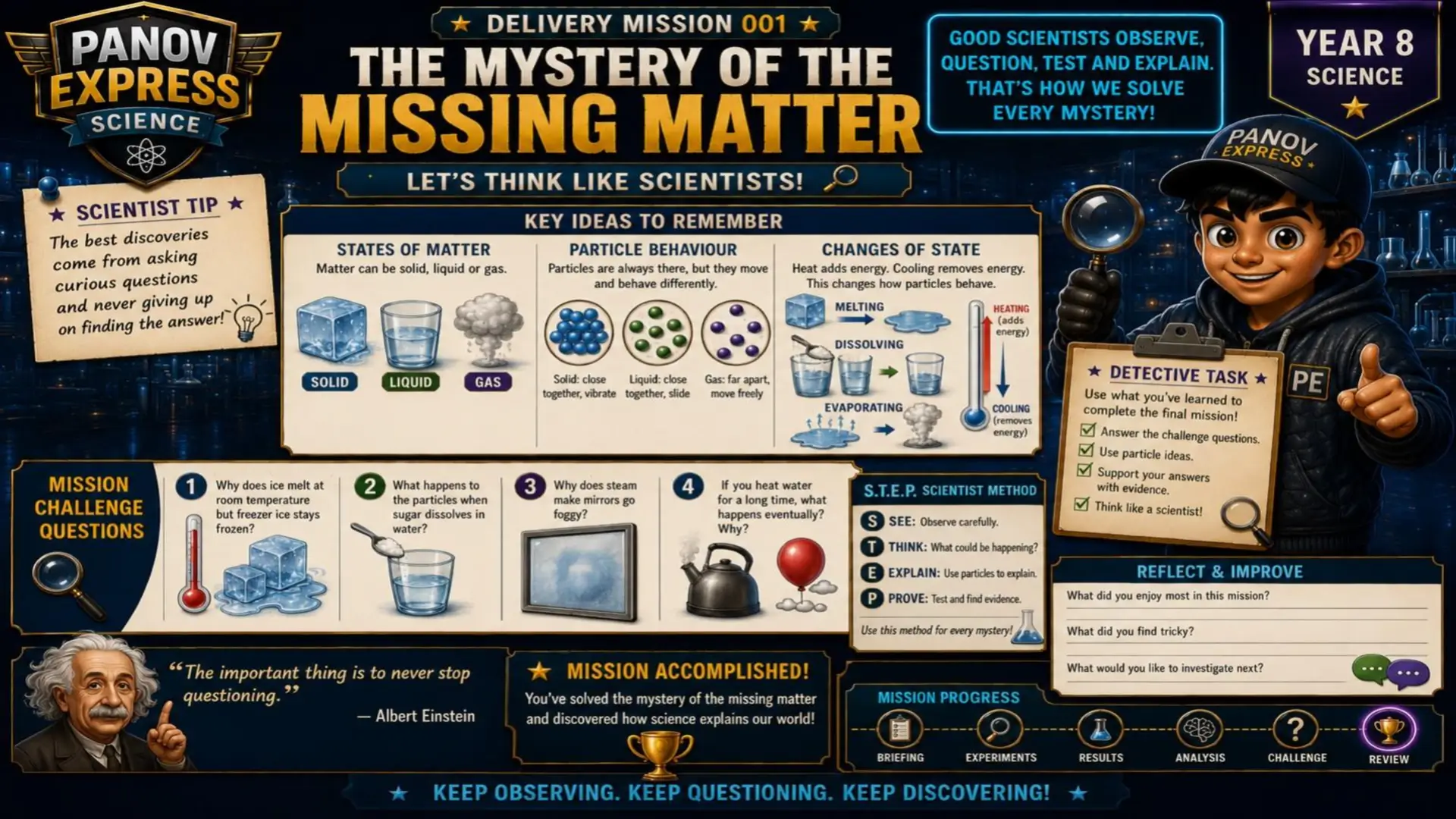
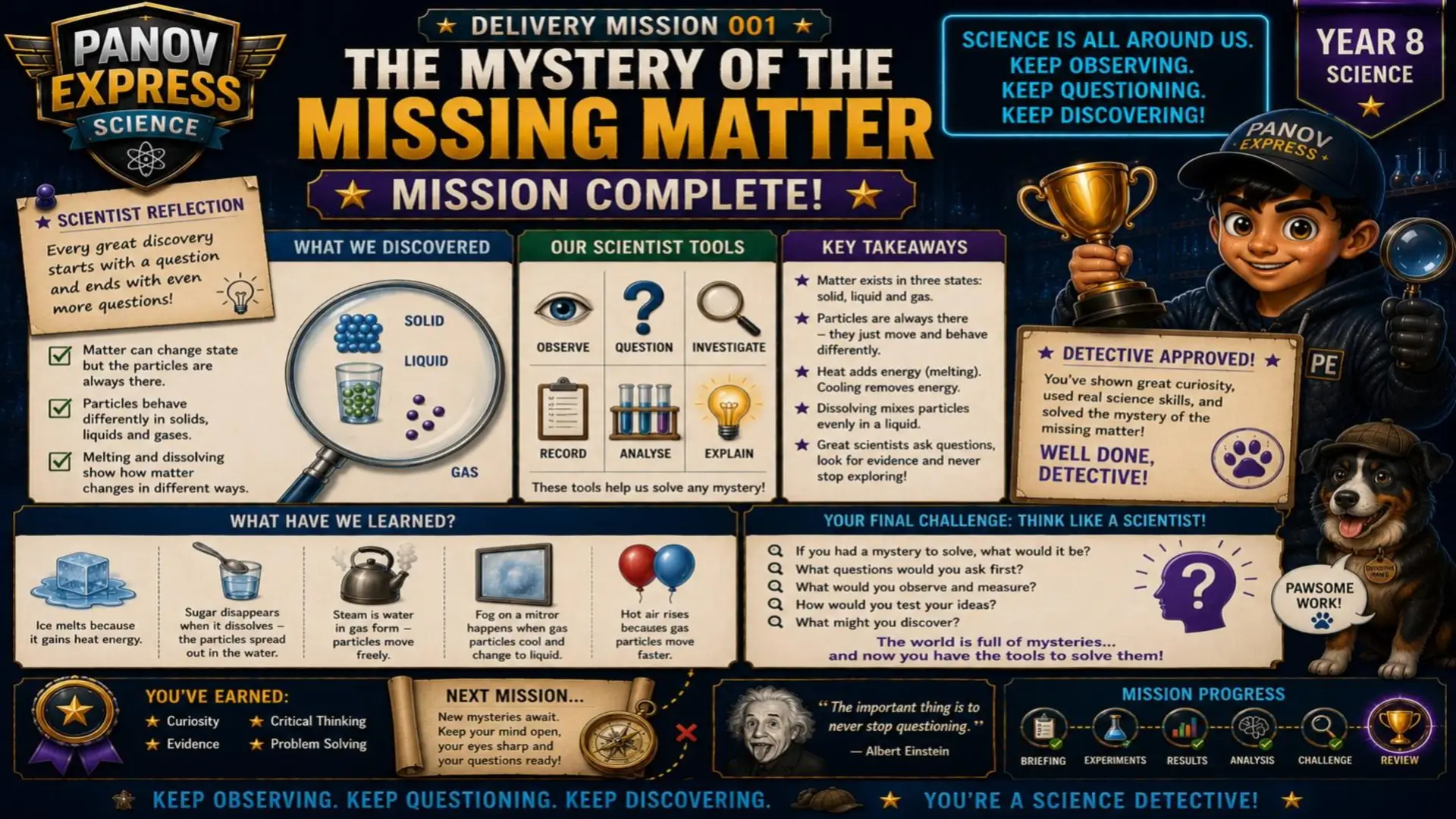
States of Matter and Changes of State
Overview
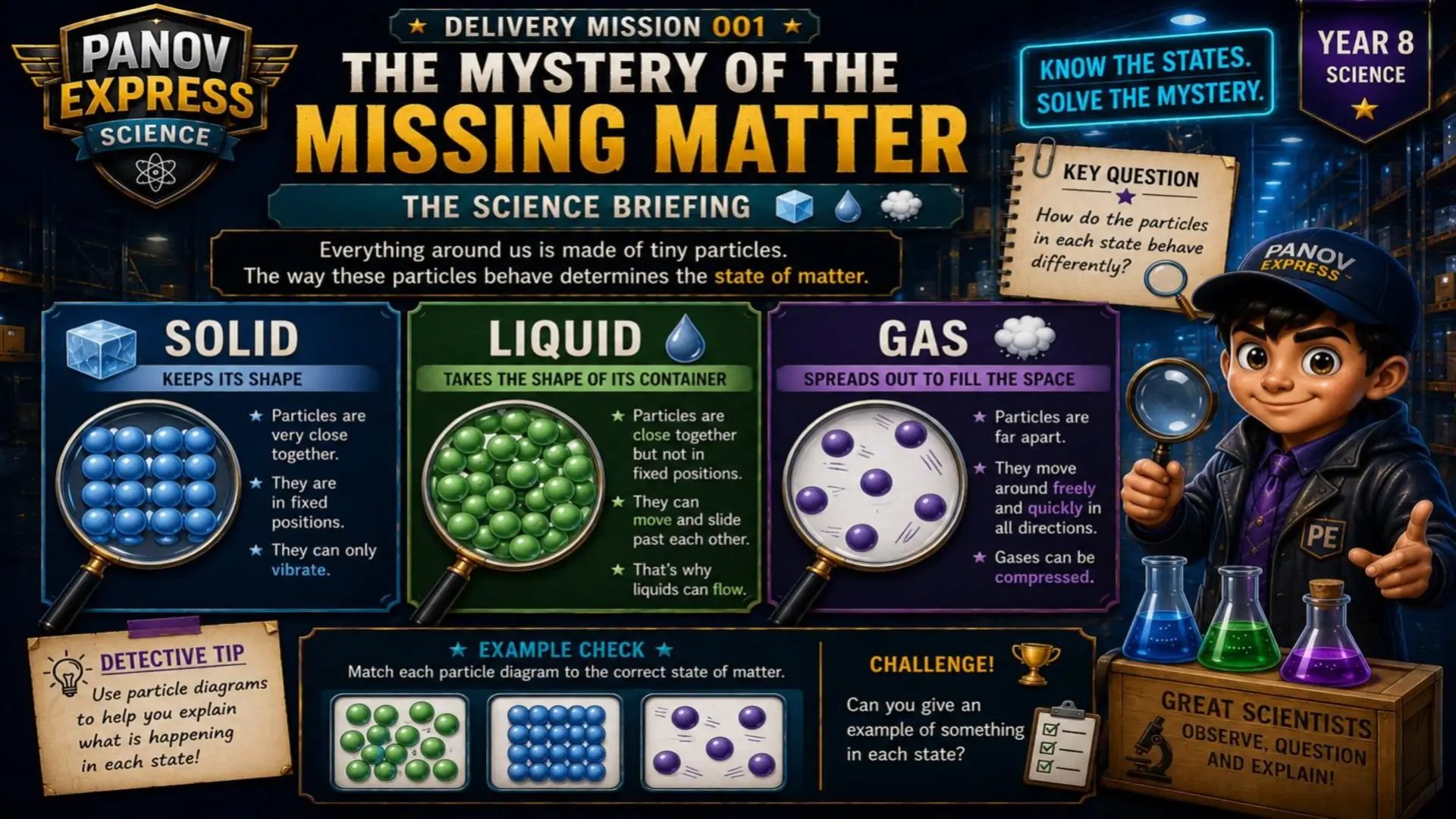
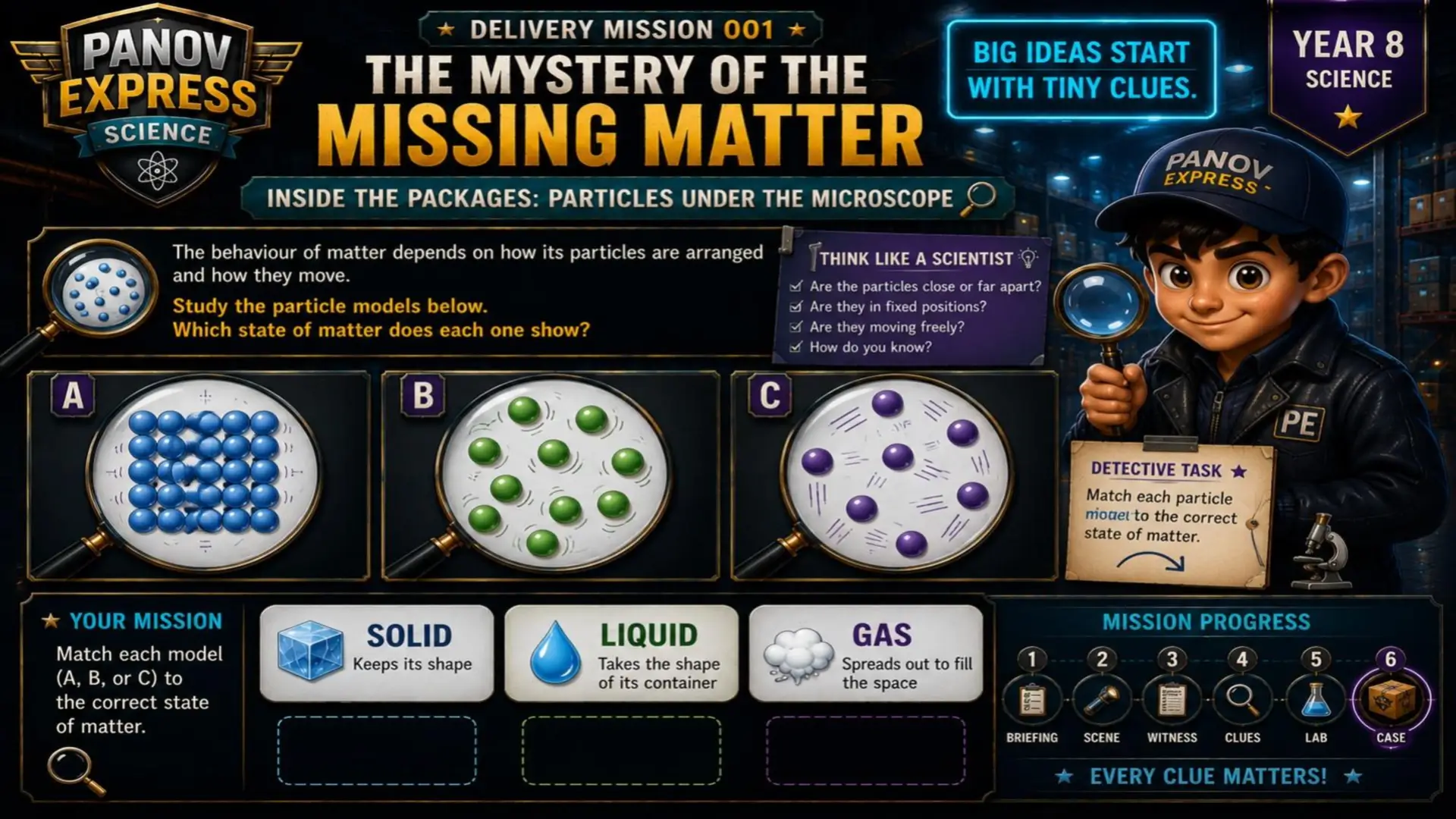
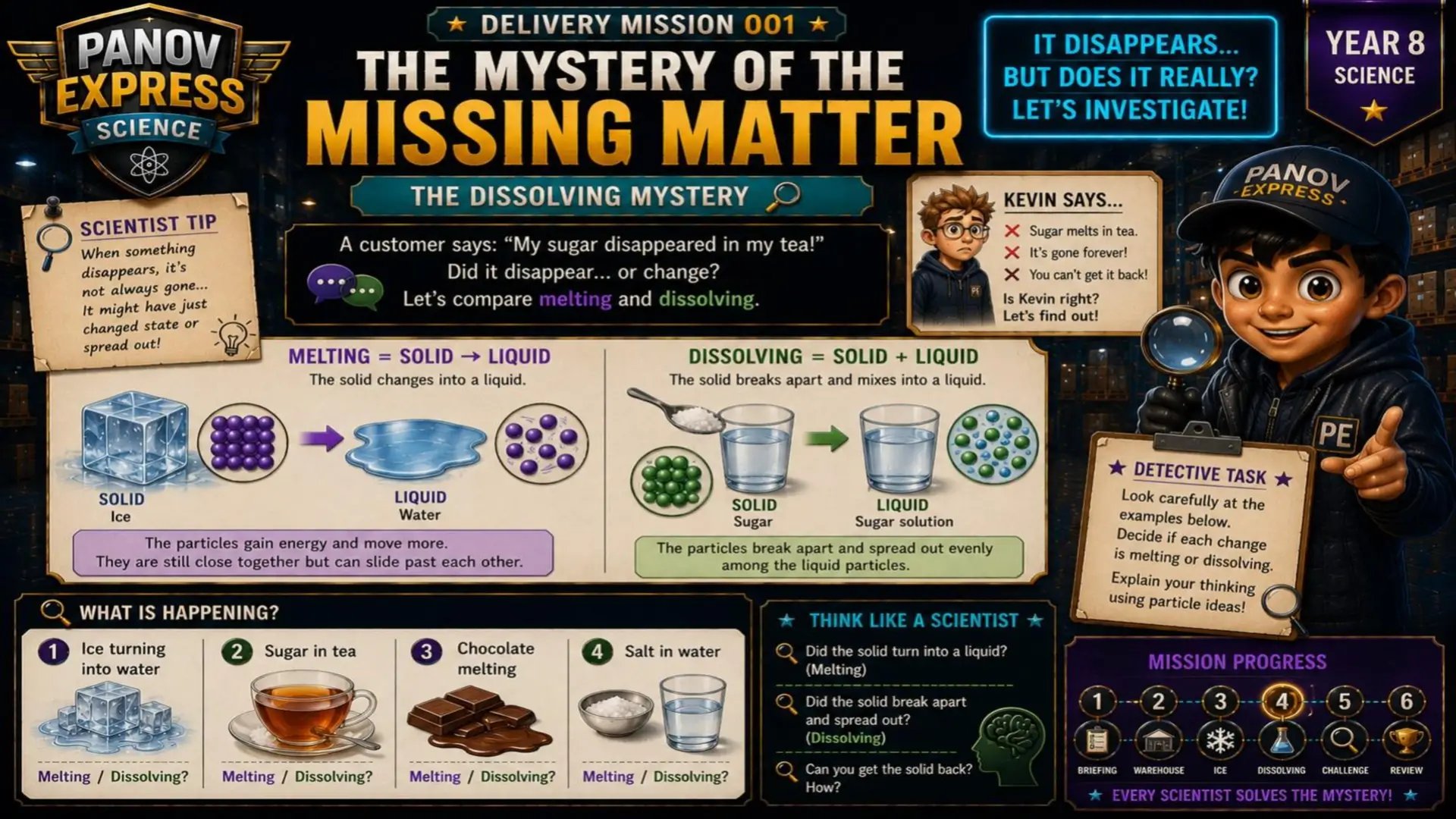
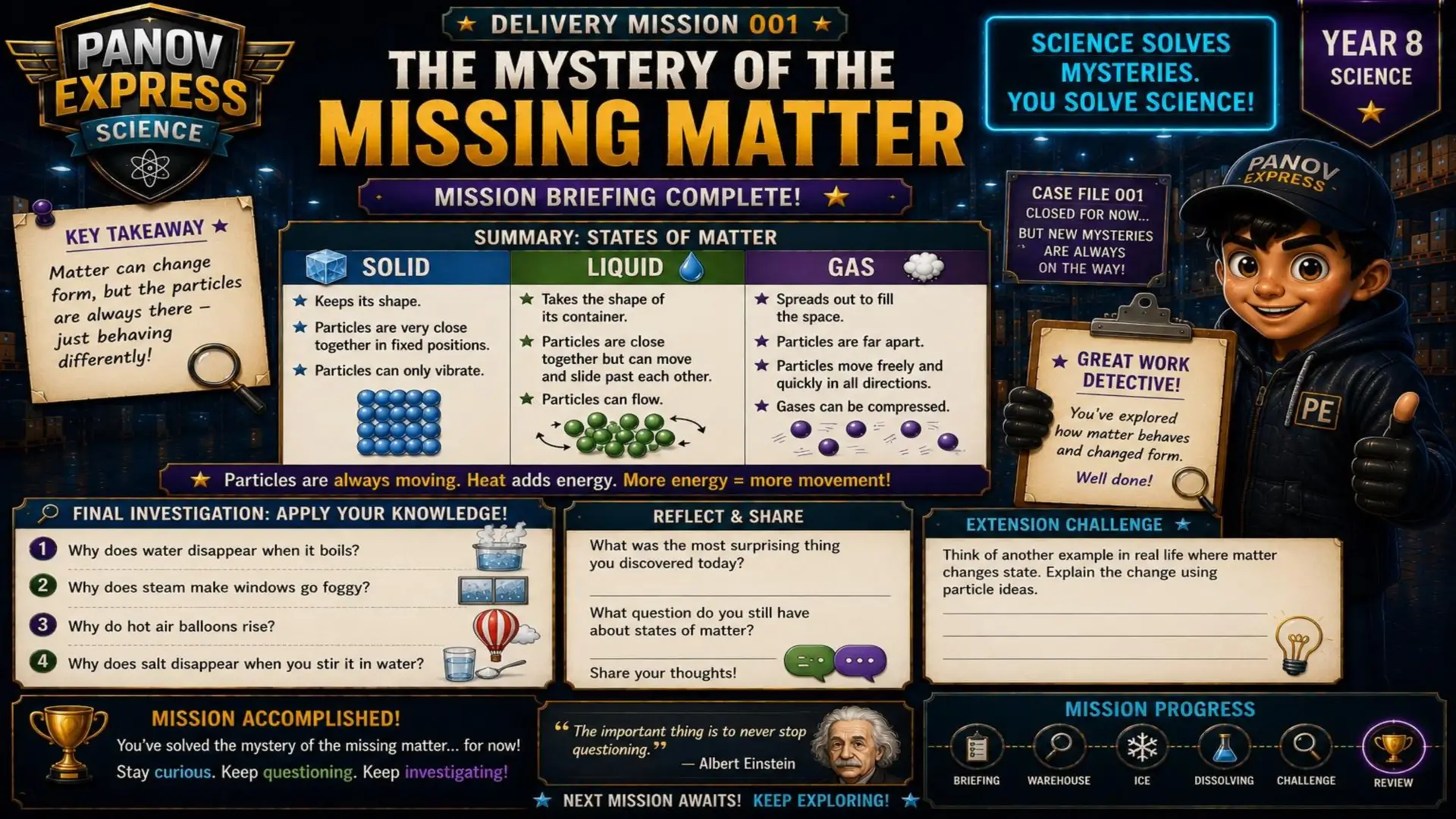
Students become members of a specialist scientific delivery team, investigating how materials behave in different states and how they change from one state to another. Through engaging scientific missions, learners explore particle behaviour, melting, freezing, evaporation, condensation and dissolving while applying scientific understanding to real-world situations.
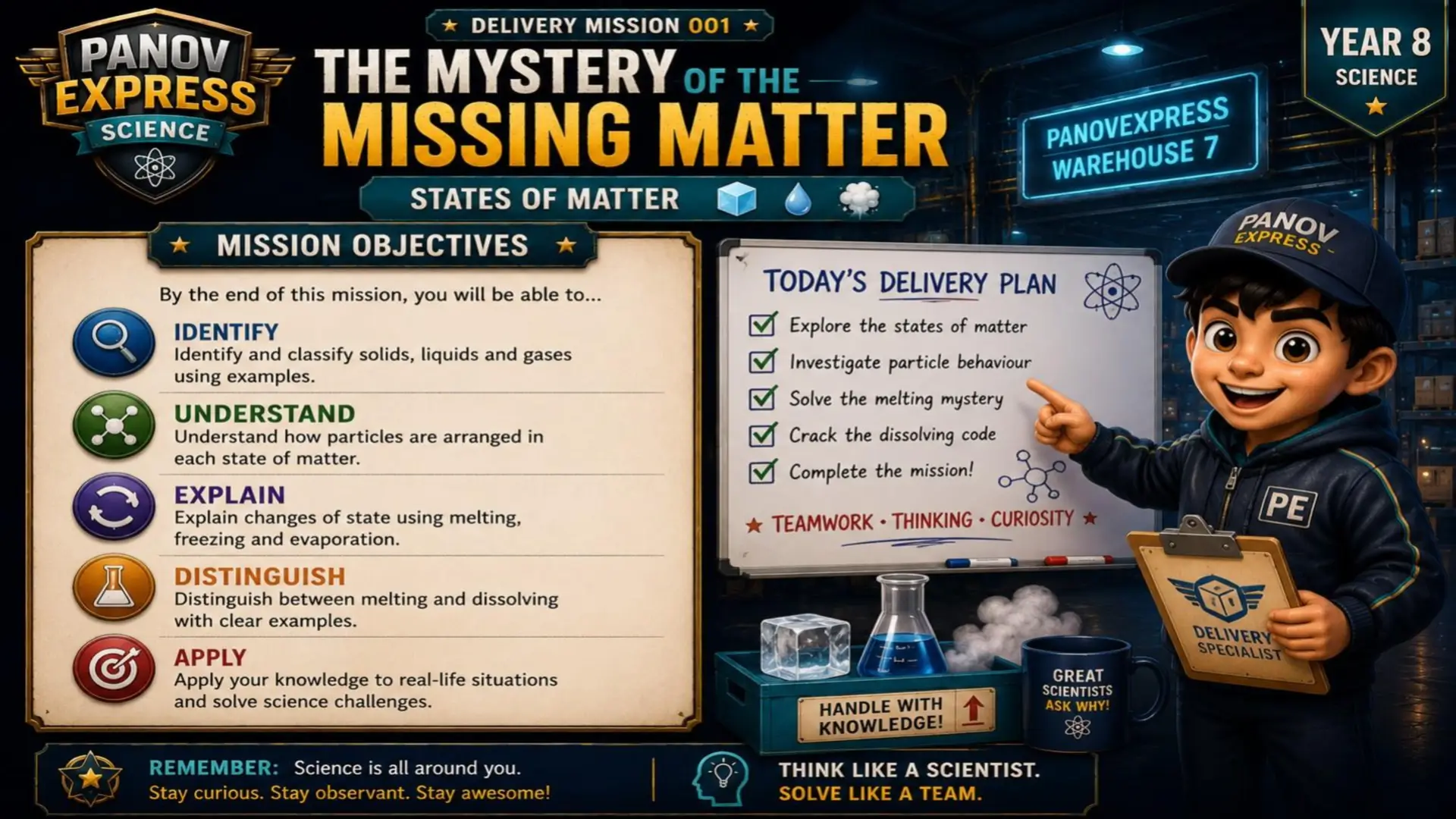
Learning Objectives
- Identify the properties of solids, liquids and gases.
- Explain particle behaviour using the particle model.
- Describe changes of state including melting, freezing, evaporation and condensation.
- Distinguish between melting and dissolving.
- Apply scientific understanding to everyday situations using accurate scientific vocabulary.
Teaching Methodology
Using the PanovEducation methodology, learners become members of a specialist delivery team solving real-world scientific challenges. Through investigation, visual modelling, guided discussion, explicit teaching and independent application, students develop scientific understanding within an engaging mission-based narrative. Scientific concepts are introduced in meaningful contexts, helping learners build confidence while strengthening observation, reasoning and problem-solving skills.
Skills Developed
- Scientific enquiry
- Observation
- Scientific reasoning
- Problem-solving
- Critical thinking
- Scientific vocabulary
- Speaking and discussion
- Independent application
Suitable For
- Year 8 Science
- KS3 Science
- Alternative Provision
- SEND
- Small group tuition
- One-to-one tuition
- Learners who benefit from immersive, mission-based learning
Resources Included
- Fully editable PowerPoint presentation
- Mission briefing
- Visual models and diagrams
- Guided activities
- Independent practice tasks
- Teacher guidance
- Reflection opportunities
Preview the lesson in the next tab or Download it as .PPTX.